



Victorian Walnut Gentleman Chair
A victorian walnut gentleman chair offers deep comfort and grand proportions, crafted in dark timber for the formal parlour.
Victorian Walnut Gentleman Chair
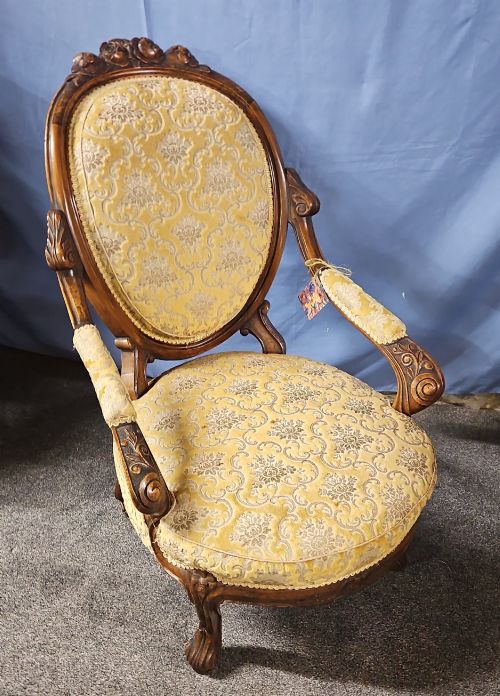
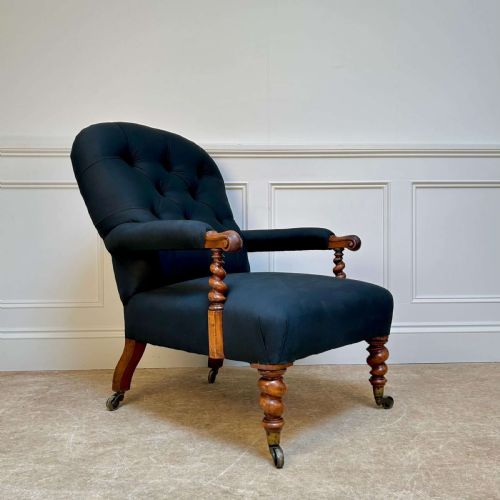
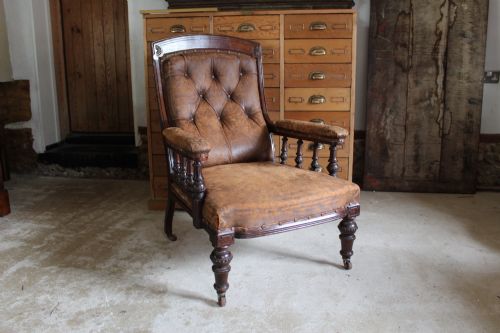
A victorian walnut gentleman chair is a robust, upholstered seat designed for comfort in the nineteenth century parlour or library. These armchairs typically feature lower, wider proportions than their companion ladies' chairs, built to accommodate gentlemen of the period. Buyers most frequently meet open-arm or spoon-back forms with exposed timber frames.
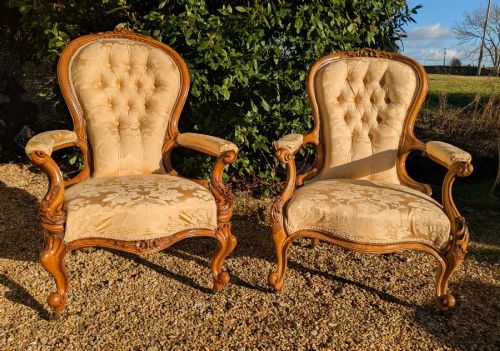
The evidence shows these seats appearing individually, in pairs, or as part of larger drawing room and salon suites. Periods span the nineteenth century, with many examples originating from the middle decades. Surviving pieces range from plain open-arm library chairs to elaborately carved rococo revival seating.
Materials and Construction
Walnut serves as the primary structural timber, chosen for its rich dark grain and suitability for intricate carving. Workshops utilised this wood to form curved show frames, spoon backs, and turned legs.
Upholstery relies on traditional materials like velvet, leather, and various textile fabrics stretched over internal stuffing. Button-backed finishing frequently secures the fabric, providing both structural tension and decorative depth.
Listings incorporate walnut, leather, velvet, and ceramic components across Victorian, Arts and Crafts, and Edwardian styles.
Judging Quality and Craftsmanship
Depth and crispness of the carved walnut ornamentation set superior examples apart from plainer production. Highly regarded pieces display deeply sculpted floral or scroll motifs on the show frame rather than shallow stamping.
The solidity of the joinery and the grace of the timber curves dictate the overall stature of the chair. Finer specimens maintain robust frame integrity combined with well-proportioned open arms and balanced structural lines.
Hindley & Sons
The Victorian Walnut Gentleman Chair Glossary
- Spoon-back
- A chair back hollowed out in the shape of a spoon to fit the human spine. This ergonomic form appears frequently in mid-nineteenth century seating.
- Show wood
- Exposed timber framing left visible around the upholstered portions of a chair. It highlights the quality of the walnut and the carver's skill.
- Button back
- An upholstery method where deep buttons are pulled tight through the padding in a geometric grid. This creates characteristic tufting and keeps the interior stuffing secure.
- Open armchair
- A seat featuring uncovered wooden arms rather than fully padded sides. This style allows generous space for heavy nineteenth century garments.
Victorian Walnut Gentleman Chair: Frequently Asked Questions
What defines a gentleman chair?
A gentleman chair is a nineteenth-century upholstered armchair characterised by a wider seat and lower arms than companion ladies' chairs.
These proportions allowed gentlemen to sit comfortably while wearing formal attire of the period.
Where were these chairs used?
These armchairs originally furnished formal drawing rooms, libraries, and parlours of substantial Victorian homes.
They served as statement seating for guests and readers in reception spaces.
Are pairs common?
Mismatched or matching pairs frequently appear alongside corresponding ladies' chairs in larger salon suites.
Couples often bought his and hers matching sets for formal entertaining.
What timber was used?
Walnut is the predominant wood found in these nineteenth-century frames, valued for its rich tone.
Carpenters shaped the timber into smooth curves and elaborate carved decorations.