


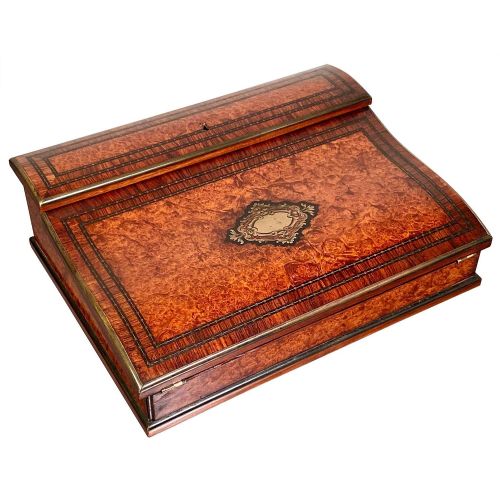


Victorian Walnut Desk Accessory
These Victorian walnut desk accessories are functional workspace pieces built from rich timber and brass, offering both practical organisation and period character.
Victorian Walnut Desk Accessory
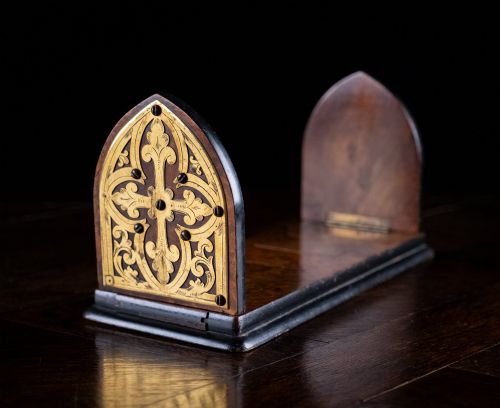
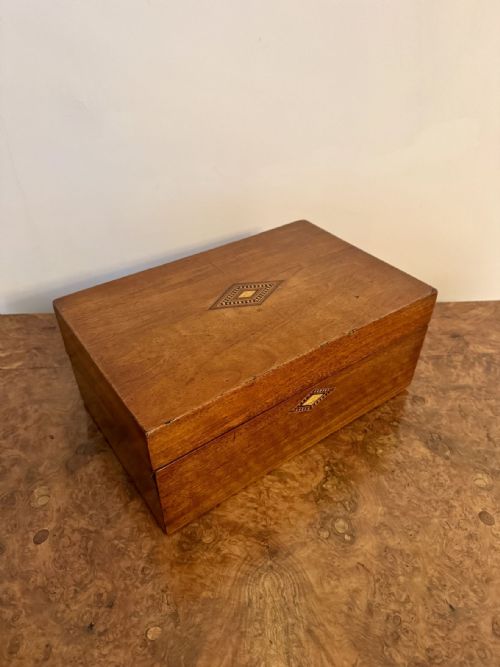
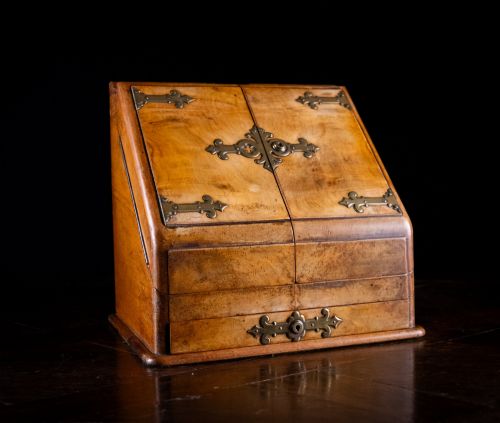
A victorian walnut desk accessory encompasses a range of desktop items designed for nineteenth-century writing and correspondence, including writing slopes, stationery boxes, and extending book slides. These objects served the functional needs of a Victorian study or library, keeping papers, books, and writing implements orderly.
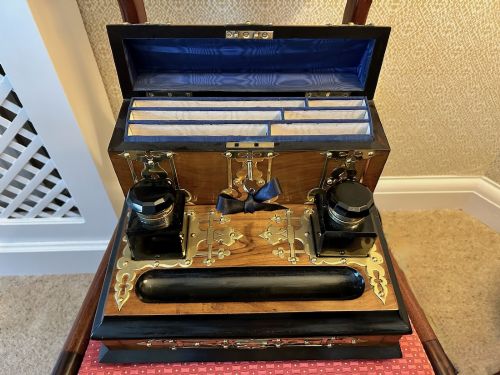
The pieces appearing on this page heavily feature walnut and burr walnut, frequently accented with brass mounts, glass inserts, and painted porcelain plaques. Forms range from compact travelling inkwells and tobacco boxes to large double-sided desk sets and elaborate stationery cabinets.
Origin variations include English Victorian pieces alongside French nineteenth-century examples and carved Black Forest items. The selection demonstrates how domestic workspaces of the period incorporated timber craftsmanship into daily routines.
Materials and construction
Makers utilised solid walnut and decorative burr walnut veneers over secondary timbers, often applying brass hinges, corners, and strapwork to reinforce the forms. Tunbridge ware inlay added intricate geometric wood mosaics to surfaces, while hand-carved details defined Black Forest dog and bear figures.
Interiors integrated fitted compartments for stationery, glass inkwells with brass collars, and velvet or leather writing surfaces. Locking mechanisms by makers such as Bramah secured valuable contents within slopes and cabinets.
Carved wooden bears and dogs hold inkwells ready on the desk, watching over nineteenth-century correspondence with wooden vigilance.
Assessing quality
Quality rests in the selection of timber grain, particularly the depth of burr walnut figures and the precision of Tunbridge ware mosaic work. Finely painted porcelain plaques and detailed hand-carved animal figures separate standard utility items from more ambitious decorative examples.
Hardware integration also marks the distinction, as heavy brass mounts, operational patent mechanisms, and functioning locks demonstrate superior original manufacture.
The Victorian Walnut Desk Accessory Glossary
- Burr walnut
- A figured wood grain taken from the growth excrescences of walnut trees, valued for its swirling patterns. It provided a highly decorative surface for nineteenth-century luxury boxes and slopes.
- Writing slope
- A portable desk featuring a slanted writing surface that folds down to enclose compartments for paper and pens. These slope inwards toward the writer for comfortable correspondence.
- Tunbridge ware
- A type of decorative woodwork produced in Tunbridge Wells involving tiny mosaic tiles of different coloured woods. These tiles form pictorial or geometric bands on boxes and stationery cases.
- Book slide
- An expanding desktop rack designed to hold a row of books upright between two end supports. Many versions use a scissor mechanism or sliding base to adjust length.
- Inkstand
- A tray or stand holding one or more inkwells, often accompanied by pen troughs and sanders. They sat centrally on nineteenth-century desks to manage wet ink writing tools.
Victorian Walnut Desk Accessory: Frequently Asked Questions
What is a writing slope used for?
A writing slope provided a portable angled surface for penning letters before the widespread use of flat stationery desks. The sloping lid created an ergonomic angle for handwriting.
Inside, compartments stored folded paper, envelopes, and ink, allowing a writer to pack up their correspondence materials securely when travelling.
How do I identify Tunbridge ware?
Tunbridge ware is recognised by its distinctive mosaic decoration built from thousands of tiny prisms of naturally coloured woods. These microscopic tiles create geometric patterns or pictorial scenes.
Applied as banding or panels onto walnut boxes and book slides, the technique relies entirely on contrasting timber species rather than paint.
What are Black Forest desk accessories?
Black Forest desk accessories are carved wooden items originating from the woodworking traditions of central Europe. They frequently depict realistic animals such as dogs and bears.
These carved figures were integrated into inkstands, tobacco boxes, and matchholders, combining wildlife sculpture with everyday desk utility.
How do extending book slides work?
Extending book slides feature overlapping wooden bases that pull outward to accommodate varying lengths of volumes. Brass mounts often guide the sliding movement.
End supports remain upright at either side, keeping books secure as the central platform expands or contracts on the desktop.