


Victorian Walnut Book Slide
A victorian walnut book slide sits on a desk to hold a row of volumes upright while expanding as your library grows.
Victorian Walnut Book Slide
A victorian walnut book slide is a desk accessory designed to keep a changing selection of volumes tidy and accessible on a tabletop. These pieces typically feature a wooden base with extending ends that slide outward on a concealed mechanism to accommodate more books.
Most examples found here date from the nineteenth century, with specific pieces appearing from around eighteen sixty and eighteen seventy. The form serves as a practical library companion that sits easily beside inkstands and blotters.
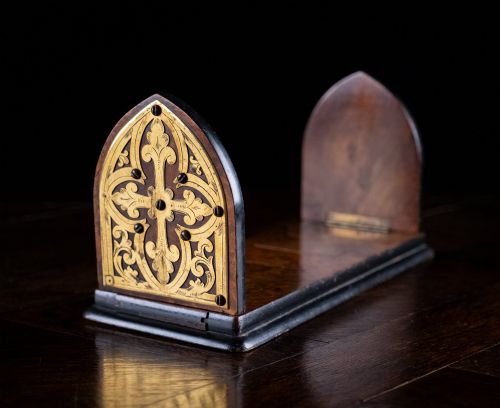
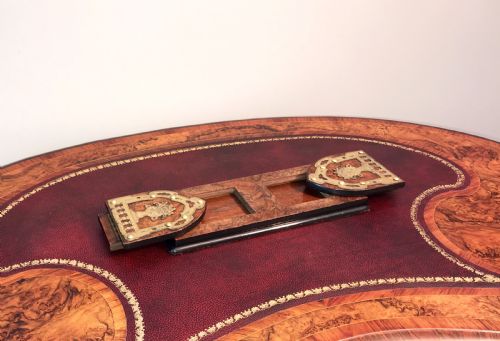
The version you are most likely to meet on this page combines a solid walnut or burr walnut base with brass mounts and extending ends. These materials give the object sufficient weight to support heavy octavo volumes without tipping.
Materials and construction
Makers utilised walnut and burr walnut for the primary chassis, taking advantage of the timber's warm grain and stability. This was frequently combined with brass for the hinges, mounts, and extending slide mechanisms.
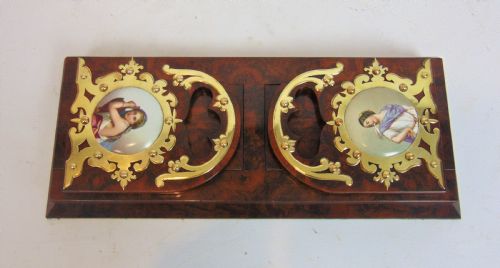
Detailing often included applied porcelain plaques, carved foliage, or inlaid wood mosaic work to add decorative contrast. The moving parts required precise carpentry so the wooden channels extended smoothly without binding.
Listings feature walnut, burr walnut, rosewood, and wood mosaic alongside brass hardware and painted porcelain plaques.
Judging quality and execution
Quality rests in the selection of the timber grain and the precision of the brass hardware fitted to the ends. Better examples use figured burr walnut and substantial gauge brass rather than thin plated metal.
The distinction between standard workshop production and finer work appears in the execution of decorative additions like painted porcelain plaques or carved relief details. Robust sliding actions that move evenly on both sides mark out superior desk pieces.
Betjemanns patent
The Victorian Walnut Book Slide Glossary
- Walnut
- A dense hardwood prized for its rich brown colour and varied grain patterns. It served as the primary timber for high-end nineteenth century desk accessories.
- Burr walnut
- A prized veneer taken from the warted growths on a walnut tree. It produces intricate, swirling grain patterns across the flat surfaces of the base.
- Brass mount
- Metalwork fitted to the corners and extending ends of the wooden frame. It provides structural reinforcement and structural contrast against the dark timber.
- Extending book rest
- The functional mechanism that allows the two ends of the slide to pull apart. This lets the user increase the shelf capacity as volumes are added.
- Porcelain plaque
- A small ceramic insert decorated with painted scenes or floral motifs. These were frequently inset into the brass mounts on library pieces.
Victorian Walnut Book Slide: Frequently Asked Questions
How do book slides work?
The base contains a sliding channel or scissor mechanism that allows the two wooden ends to pull outward. This adjusts the total span to fit anywhere from two to a dozen volumes.
Friction holds the sides at your chosen width so the books remain upright even when the row is only half full.
Where were these used?
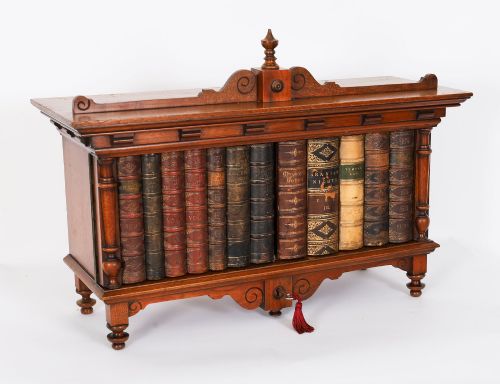
They sat on library tables, executive desks, and parlour Davenport writing boxes throughout the nineteenth century. Their purpose was to keep reference books close at hand without requiring a full wall shelf.
Wealthy households placed them in studies and morning rooms where daily reading materials needed containment.
How do I care for walnut?
Keep the timber away from direct heat sources and strong sunlight to prevent the walnut from drying out or splitting. An occasional application of a suitable wax polish maintains the lustre of the grain.
Polish brass components gently with a dry cloth to avoid marking the surrounding wood finish.
Are all examples Victorian?
The vast majority originate from the nineteenth century, spanning the Victorian period from eighteen sixty onward. Cabinetmakers continued producing variations into the early twentieth century.
Construction methods and hardware styles help distinguish mid nineteenth century pieces from later adaptations.