


Victorian Village Painting
A victorian village painting captures the quiet rhythm of rural life through the focused brushwork of nineteenth-century artists.
Victorian Village Painting
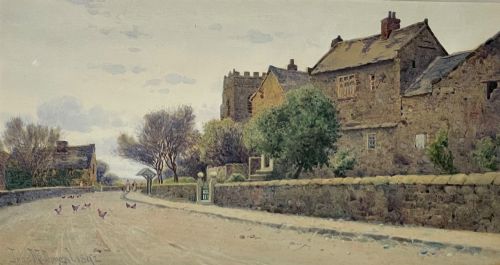
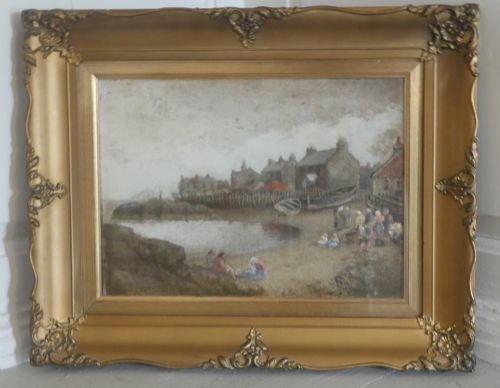
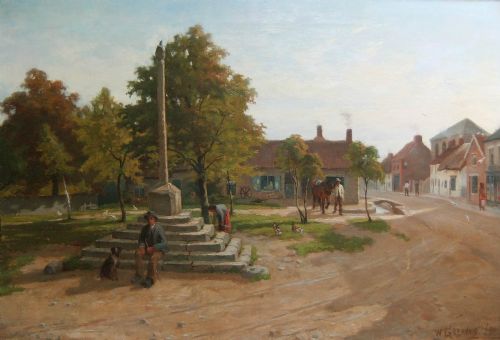
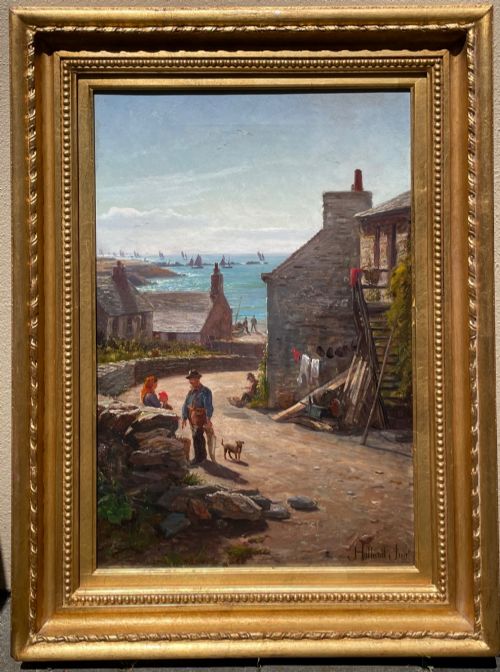
A victorian village painting portrays rural settlements, coastal harbours, and country lanes across Britain and Europe during the nineteenth century. These works depict everyday community life, local inns, parish churches, and agricultural landscapes populated by figures and livestock.
The selections available here are dominated by detailed watercolours on paper and traditional oil paintings on canvas. Many pieces record specific named locations from Yorkshire to Cornwall, alongside coastal views in the Isle of Man and scenes in Wales.
Artists working in this genre often aligned with nineteenth-century British realism, Victorian pastoral, and genre art. They sought to document a changing rural world with careful attention to local architecture and atmospheric lighting.
Materials and technique
The physical objects rely primarily on oil paint applied to stretched canvas or wooden panels, and transparent watercolour pigments worked onto heavy paper support. Oils allowed artists to build rich, textured surfaces depicting rustic walls and shadowy interiors, whilst watercolours captured bright daylight and open skies.
Framing forms an integral part of the survival of these pieces, with many retaining period gilt wood frames that complement the composition. Glazing typically protects the watercolours from environmental moisture and surface damage.
Subtle differences in handling emerge between media, where oil paintings display heavier impasto and visible brush strokes, and watercolours depend on fine washes and preserved paper highlights.
The listings span the nineteenth and early twentieth centuries, featuring works created between 1800 and 1930.
Evaluating the standard
Quality rests upon the artist's command of perspective, draughtsmanship, and the convincing rendering of atmospheric light within the settlement. Stronger compositions balance architectural details with human activity, avoiding static or formulaic village layouts.
The preservation of the original pigment remains vital, as fugitive colours or excessive past cleaning can diminish the subtlety of a watercolour or oil canvas. Intact period gilt frames and clear signatures or documentation further elevate an individual piece.
John McDougal·William Greaves·John Holland·Arthur Tucker·Charles Vickers·Helena Maguire·George Gregory·Frederick G. Coulridge·John Edward Bale·Robert Hollands Walker·David Woodlock·Frank Dadd·Henry Sykes·Robert McGregor·B W Leader·J.V.R. Parsons·John Ritchie·Henry Charles Bryant·Georgina Lara·Carleton Grant·Eugene Battaille·Alfred Rimmer·Joseph Thors·Joseph Hughes Clayton·John Holland Snr
The Victorian Village Painting Glossary
- Watercolour
- A painting method where fine pigment is suspended in a water-soluble binder and applied to paper. It creates luminous, translucent washes that rely on the white of the paper for brightness.
- Oil on Canvas
- A technique utilising pigments bound in drying oils applied to a woven fabric stretched across a wooden frame. This medium permits extensive blending, rich colour depth, and textured impasto.
- Genre Art
- Depictions of everyday subjects and ordinary people engaged in domestic or social activities. In this context, it describes village scenes focused on local inhabitants rather than grand historical narratives.
- Impasto
- Paint applied thickly to a canvas or panel so that the brush or palette knife marks remain clearly raised above the surface. This technique adds tactile dimension and catches light in oil paintings.
- Pastoral
- Artistic works concerning the rural life of shepherds, farmers, and villagers in an idealized or romanticized countryside. These scenes emphasise tranquility and traditional agricultural routines.
Victorian Village Painting: Frequently Asked Questions
What subjects appear in these village paintings?
The compositions generally feature rural cottages, village greens, coastal harbours, local inns, and agricultural landscapes. Artists often included figures such as children fishing, farmers with animals, and travellers along country roads.
These details offer a visual record of nineteenth-century community life across specific British and European regions.
How do I care for antique watercolours?
Watercolours on paper require protection from direct sunlight to prevent fading of sensitive pigments. Keeping them in stable, low-humidity environments prevents foxing and paper deterioration.
Displaying them behind glass with conservation-grade mounts ensures the paper breathes while remaining shielded from atmospheric pollutants.
Are these paintings signed by the artists?
Many examples retain the original signature or monogram of the painter, often placed discretely in a lower corner. Some works also include contemporary inscriptions on the reverse identifying the specific village or region depicted.
Archival records and exhibition histories occasionally help confirm the attribution of unsigned or initialled pieces.
What is the difference between oil and watercolour village scenes?
Oil paintings utilise thick, opaque pigments on canvas or panel, allowing for rich textures, deep shadows, and luminous skies. Watercolours use transparent washes on paper that emphasise light, fluidity, and delicate atmospheric effects.
Both media were widely used by nineteenth-century artists to capture the distinct moods of rural settlements.