

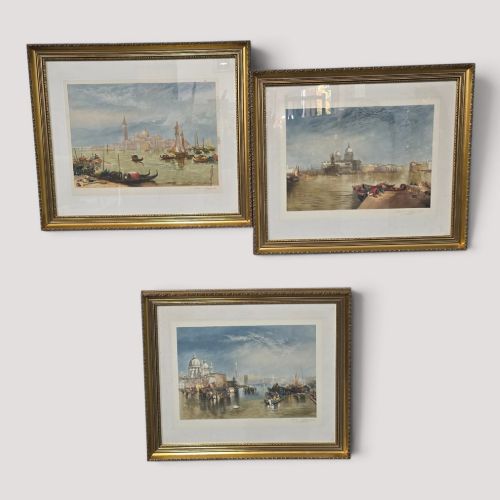


Victorian Venetian Watercolour
These Victorian venetian watercolour paintings capture the enduring allure of the lagoon through delicate pigment and paper.
Victorian Venetian Watercolour
A victorian venetian watercolour depicts the famous canals, lagoons, and architecture of Venice through the medium of delicate paint upon paper. These works capture the changing light and atmosphere of the Italian city as observed by British and European artists during the nineteenth century.
The pieces listed here predominantly date from the nineteenth century, including works from the eighteen-eighties up to nineteen-ten. Common subjects include the Grand Canal, the Giudecca Canal, and notable landmarks such as Santa Maria della Salute.
Collectors encounter various interpretations ranging from maritime views to fine art compositions. The works reflect artistic movements including British Impressionism and nineteenth-century Italian styles.
Materials and technique
Artists executed these works using watercolour pigment and paint applied directly to paper supports. The handling of the medium allowed creators to capture the translucent quality of water and the luminous skies of the Venetian lagoon.
Framing typically involved wood and glass components to protect the delicate paper surfaces from atmospheric moisture and damage. The combination of pigment and paper required precise brushwork as the medium allows little room for later correction.
Victorian Venetian Watercolour Retail Price Guide 2026
Typical asking prices for victorian venetian watercolour among the pieces listed under this phrase on Sellingantiques today, from the lower quarter to the upper quarter. They describe what is for sale here now, not the wider market.
Nineteenth-century artists frequently complained that Venetian mosquitoes bit them faster than their watercolours could dry in the damp air.
Judging quality
Quality rests upon the artist's ability to manipulate watercolour pigment to convey atmosphere and light across the paper. The best examples demonstrate confident brushwork and precise topographical detail without appearing laboured.
The preservation of the paper and the vibrancy of the pigments strongly influence the standing of a piece. Works that retain their original tonal depth without excessive fading or discolouration represent the finer end of the range.
F J Aldridge·Clara Montalba·Benedetto Salviati·Hercules Brabazon Brabazon·Frank Wasley·David Law·George Stanfield Walters·Henry Wimbush·Arthur Severn
The Victorian Venetian Watercolour Glossary
- Watercolour
- A paint consisting of a pigment suspended in a water-soluble vehicle. It is traditionally applied to paper to create translucent layers of colour.
- Lagoon
- A stretch of salt water separated from the sea by a low sandbank or coral reef. In these works, the Venetian lagoon provides the central setting for maritime and architectural views.
- Impressionism
- A nineteenth-century movement characterised by relatively small, thin, yet visible brush strokes and an emphasis on accurate depiction of light. Several works reflect this style through loose handling and atmospheric focus.
- Grand Canal
- The main waterway of Venice, lined with Renaissance palaces. It is one of the most frequently depicted subjects in these nineteenth-century paintings.
Victorian Venetian Watercolour: Frequently Asked Questions
What is a Victorian Venetian watercolour?
These works are paintings created on paper using watercolour pigments during the nineteenth and early twentieth centuries. They focus specifically on the canals, buildings, and maritime scenes of Venice.
Artists from Britain and Europe travelled to Italy to record the unique light and atmosphere of the lagoon. Their output forms a distinct group within nineteenth-century fine art.
How should I frame and display them?
Watercolour paintings on paper require careful framing behind glass to protect them from dust and physical damage. Direct sunlight causes pigments to fade over time, so placement away from bright windows is essential.
Acid-free mounts and backboards prevent chemical degradation of the paper. Proper conservation framing ensures these nineteenth-century works survive for future enjoyment.
How do I identify different artists?
Signatures on the front of the paper often identify the hand of the artist, alongside distinct brushwork styles and palette choices. Reference books and exhibition records help confirm the periods in which specific painters were active in Venice.
Comparing known works by figures such as Clara Montalba or Hercules Brabazon Brabazon reveals individual approaches to capturing light upon the Grand Canal.
What subjects are most common?
Views of the Grand Canal and Santa Maria della Salute appear frequently across these nineteenth-century paintings. Artists also favoured wider panoramas taken from the lagoon looking back towards the city.
Maritime traffic, including gondolas and sailing vessels, regularly populates the waterways depicted in these watercolours.