
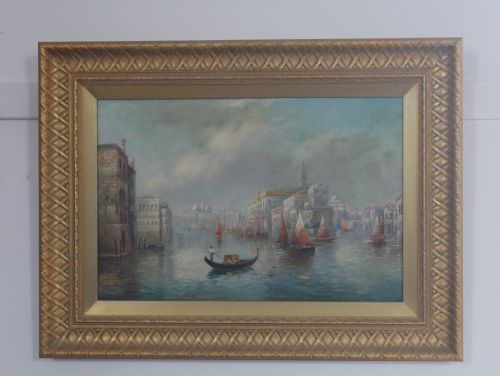


Victorian Venetian View Painting
These Victorian Venetian view painting works capture the grand light of the lagoon, offering a direct window into nineteenth-century Italy.
Victorian Venetian View Painting
When you search for a Victorian Venetian view painting, you are looking at nineteenth-century depictions of canals, palazzos, and famous monuments like the Doge's Palace and the Grand Canal. These works bring the romantic atmosphere of Italy directly into a room.
The pieces on this page primarily take the form of oil paintings on canvas and watercolours, capturing iconic sites such as the Santa Maria della Salute and San Simeone Piccolo. They reflect the fascination that British and European artists held for the architectural splendour of Venice during the nineteenth century.
Most examples date from the later decades of the nineteenth century, aligning with periods of fine art and romanticism. You will encounter townscapes rendered with careful attention to perspective, light, and the distinctive waterways of the lagoon.
Materials and methods
Artists relied primarily on oil on canvas and watercolour pigments applied to paper, capturing the brilliant coastal light and reflections on the water. These mediums allowed for both broad atmospheric washes and fine architectural detail.
Many of these works are housed in wood, giltwood, and gilded frames finished with gold leaf. The framing techniques of the period complement the pictorial depth of the painted scenes.
Materials recorded in the archive include oil on canvas, watercolour, giltwood, and gold leaf.
Assessing quality and execution
Quality rests upon the artist's ability to handle perspective and the luminous atmospheric conditions of the lagoon, distinguishing masterly townscapes from simpler souvenir works. The precision with which architecture like St Mark's Square is rendered plays a major role.
The preservation of the canvas, the clarity of the brushwork, and the originality of the giltwood or gold leaf frame contribute significantly to the standing of each piece.
F.D. Campo·Jane Vivian·Alfred Pollentine·William Raymond Dommersen·Hercules Brabazon Brabazon·Arthur Severn
The Victorian Venetian View Painting Glossary
- Oil on canvas
- A painting medium where pigments bound in drying oil are applied to a stretched cloth support. This technique permits rich colour blending and textured brushwork.
- Giltwood
- Wood that has been treated and coated with a thin layer of gold leaf or metallic powder. It provides ornate decorative framing for nineteenth-century artworks.
- Townscape
- A genre of painting focused on urban views, streets, and architectural landmarks. In this context, it specifically highlights Venetian canals and palazzos.
- Watercolour painting
- A method where water-soluble pigments are used on paper to create translucent layers of colour. It was frequently employed for rapid, luminous impressions of light.
- Romanticism
- An artistic movement emphasising emotion, individualism, and awe of nature and history. It heavily influenced nineteenth-century depictions of historic European cities.
Victorian Venetian View Painting: Frequently Asked Questions
What subjects appear in these paintings?
The works focus heavily on iconic Venetian landmarks, including the Grand Canal, the Doge's Palace, and the lagoon. Artists often depicted specific architectural monuments and bustling waterways.
Scenes range from wide townscapes of the Santa Maria della Salute to intimate watercolours of daily canal life and historic processions.
How do oils and watercolours differ?
Oil paintings utilise pigments suspended in oil on canvas, allowing for deep colour saturation and visible texture. They offer a robust surface that captures the heavy atmosphere of the Venetian air.
Watercolours rely on transparent pigments on paper, producing lighter, more fluid effects that capture transient shifts in natural light.
How should I frame these works?
Many examples retain their period frames made of wood, giltwood, and gold leaf. These original surrounds are chosen to complement the artistic style of the nineteenth century.
When framing is replaced or maintained, selecting traditional gilded mouldings preserves the historic character of the townscape.
Where were these artists active?
The painters travelled from Britain and across Europe to capture the unique light and romantic appeal of Venice. Many exhibited their townscapes in British galleries during the Victorian era.
Their direct observations of the Grand Canal and surrounding lagoon formed the basis of these nineteenth-century compositions.