



Victorian Upholstered Throne Chair
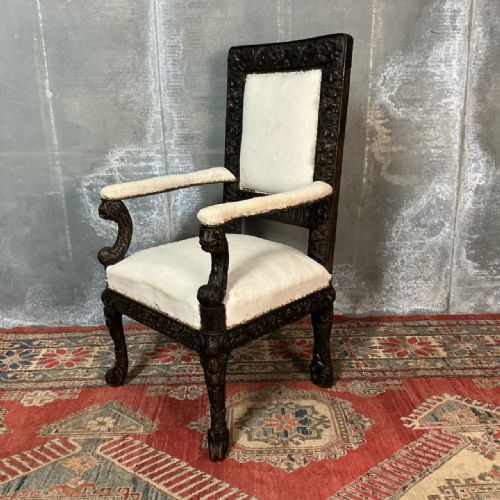
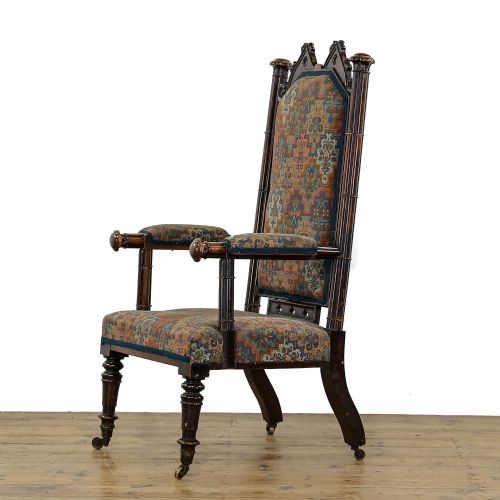
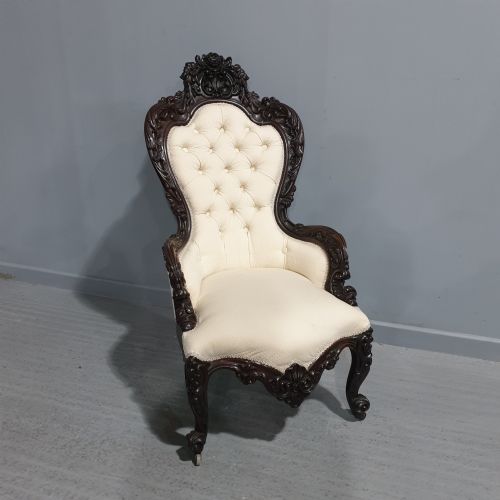
A victorian upholstered throne chair commands attention in a room, offering tall timber frames and deep seating built for presence.
Victorian Upholstered Throne Chair
When you search for a victorian upholstered throne chair, you encounter large timber armchairs defined by high backs and substantial frames. These pieces emerge from the nineteenth century, carrying various revival styles including Gothic, Baroque, and Jacobean influences.
The selection on this page centres on oak and walnut armchairs, often featuring carved details such as Green Man motifs or armorial crests. You find open arms and tall backs designed to create a commanding presence in a hall, library, or study.
While many examples date directly to the Victorian era, related pieces span from the mid-nineteenth century into the early twentieth century. These include high-backed fauteuils, barley twist armchairs, and carved mahogany masters chairs.
Materials and Construction
Makers built these heavy frames primarily from hardwoods such as oak, walnut, and mahogany, supplemented by occasional use of pitch pine and giltwood. Timber sections were joined solidly, often featuring turned supports, barley twist legs, or brass accents.
Carving defines the decoration, with artisans cutting deep relief work directly into the wood to form heraldic designs, foliage, and figural details. Upholstery techniques applied fabric, leather, tapestry, or textile directly to the tall backs and padded seats.
Judging Quality and Craft
Depth and crispness of the timber carving separate standard frames from superior examples. Skilled hand-carved details on walnut and oak show sharp edges and balanced proportions across the arms and crest.
The structural weight and timber selection dictate the integrity of the chair. Dense mahogany, figured walnut, and heavy oak provide stability for large open arm designs without relying on weak supplementary bracing.
The Victorian Upholstered Throne Chair Glossary
- Fauteuil
- An open-armed upholstered armchair originating in France. These pieces feature exposed wooden frames around the padded back and armrests.
- Green Man
- A sculptural architectural ornament depicting a face carved from or entwined with leaves and vines. This motif appears frequently on nineteenth-century Gothic revival woodwork.
- Barley Twist
- A turning technique resembling a rope or helix shape cut into wooden furniture legs and supports. This decorative style recurs across seventeenth-century revivals.
- Gothic Revival
- An architectural and decorative style drawing inspiration from medieval design. It employs pointed arches, heavy timber, and solemn proportions.
- Carolean
- A decorative style relating to the reign of King Charles II, characterised by rich walnut framing, ornate scrolling, and crown motifs.
Victorian Upholstered Throne Chair: Frequently Asked Questions
Where should I place a throne chair?
These large armchairs suit spaces with high ceilings and substantial proportions, such as a grand hallway, a library, or a study. Their tall backs and heavy timber frames demand room to breathe rather than tight corners.
Position one away from direct heat sources and strong sunlight to protect the timber frame and preserve the upholstery fabric or leather over time.
How do I care for the timber?
Maintain the wood by dusting regularly with a soft, dry cloth and applying natural wax sparingly when the surface appears dry. Avoid commercial liquid polishes containing silicones that damage antique finishes.
Check the joints periodically for stability, ensuring the heavy frame remains secure during normal daily use.
Are these chairs comfortable for daily use?
Upholstered throne chairs offer deep seating and padded backrests designed for upright posture rather than lounging. Their substantial height and rigid structure suit formal sitting.
Original padding and upholstery materials vary significantly in firmness depending on the restoration history of each individual piece.
How do I identify a Gothic revival chair?
Gothic revival pieces feature architectural motifs such as pointed arches, tracery, and heavy oak or pitch pine construction. The carving often emphasises solemnity and medieval lineage.
Makers working in this style during the nineteenth century drew inspiration from ecclesiastical furniture and ancient buildings.