
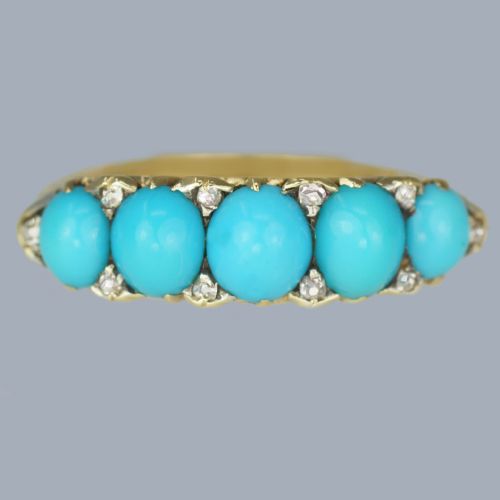


Victorian Turquoise Ring
A victorian turquoise ring brings together the distinctive robin-egg blue of the gemstone and the rich golds of the nineteenth century.
Victorian Turquoise Ring
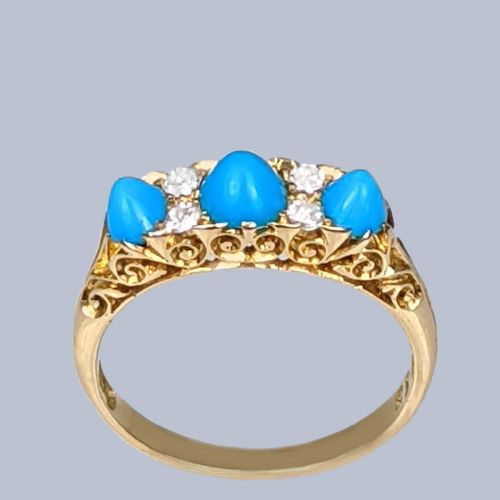
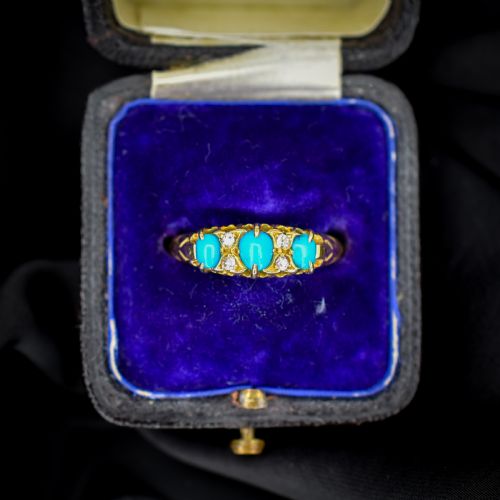
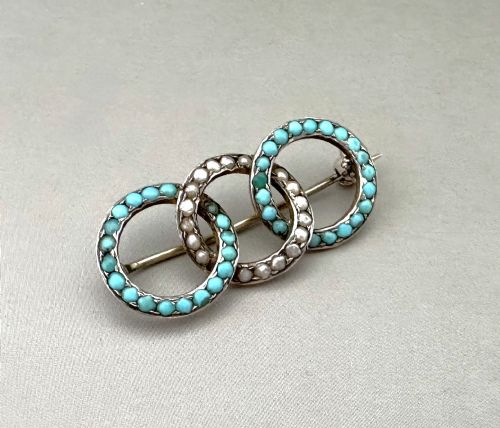
A victorian turquoise ring centres on vibrant blue stones, frequently paired with seed pearls or diamonds in cluster, five-stone, and navette configurations.
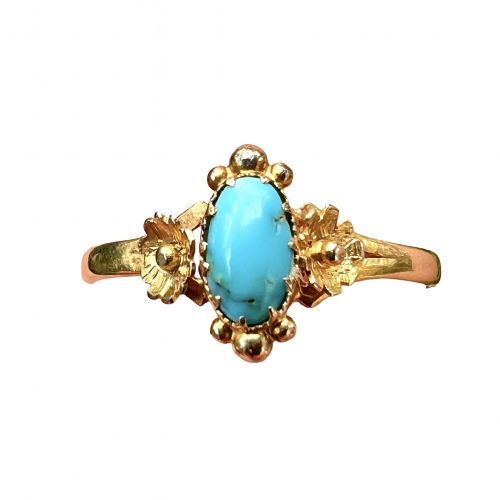
The version most commonly met on this page is fashioned from high-carat yellow or rose gold, often displaying intricate scrollwork or star motifs typical of the period.
Many examples span the nineteenth century into the Edwardian era, encompassing diverse forms such as buckle bands, trilogy arrangements, and gypsy settings.
Materials and construction
Goldsmiths utilised 15ct and 18ct yellow and rose gold for the structural mounts, occasionally incorporating 9ct gold or silver-gilt elements.
Turquoise cabochons were hand-set alongside old-cut diamonds and delicate seed pearls, secured with detailed claw or flush settings.
The fabrication frequently involved chased engraving and hollow or solid band construction, reflecting the prevailing techniques of Victorian workshops.
Victorian Turquoise Ring Retail Price Guide 2026
Typical asking prices for victorian turquoise ring among the pieces listed under this phrase on Sellingantiques today, from the lower quarter to the upper quarter. They describe what is for sale here now, not the wider market.
Materials recorded across the inventory include 15ct gold, 18ct gold, turquoise, diamonds, and seed pearls.
Judging quality and condition
The grade of the turquoise itself dictates much of the value, with stable, un-faded robin-egg blue stones commanding greater respect than those showing heavy green discolouration or matrix cracking.
The integrity of the goldwork and the security of the claw or bezel settings indicate the level of original craftsmanship, distinguishing standard production from finer artisan pieces.
The preservation of paired seed pearls and the minimal wear to hand-cut diamonds further separate modest everyday bands from superior examples.
The Victorian Turquoise Ring Glossary
- Cabochon
- A gemstone shaped and polished with a smooth convex surface rather than faceted. This cut preserves the natural blue colour and opaque character of the stone.
- Navette
- A boat-shaped or marquise ring design featuring an elongated silhouette. It typically displays a cluster of stones tapering to points at each end.
- Trilogy
- A ring featuring three primary gemstones set in a row. In these pieces, turquoise is frequently flanked by diamonds or pearls.
- Gypsy setting
- A mounting style where the gemstone is flush with the metal band, having its edges pushed over to secure it. This technique creates a smooth, continuous surface on the ring.
- Seed pearl
- A very small, naturally occurring pearl used to accent gemstones. They are frequently arranged in floral clusters or double rows around a central blue stone.
Victorian Turquoise Ring: Frequently Asked Questions
How do I care for a turquoise ring?
Turquoise is a porous gemstone that absorbs oils, cosmetics, and moisture easily. Remove the ring before washing hands, applying lotions, or undertaking physical work.
Clean the stone only with a soft, dry cloth and avoid ultrasonic cleaners or chemical dips entirely, as these substances damage the natural surface.
Can I wear my ring every day?
While many nineteenth-century bands were built for daily wear, the softness of turquoise and the delicacy of seed pearls require caution. Reserve the piece for lighter activities to preserve the fragile settings.
Store the ring separately in a lined box to prevent hard gemstones from scratching the gold or the turquoise cabochon.
How do I date a piece accurately?
Dating relies on stylistic clues such as navette clusters, star motifs, and buckle designs characteristic of the nineteenth century. Hallmarks stamped inside the band provide official assay office symbols and date letters for precise verification.
Compare the construction methods, shank thickness, and stone cuts against documented examples from the period to confirm the era of manufacture.
Are the diamonds antique?
Diamonds found in these settings are period-appropriate old-cut or rose-cut stones hand-faceted by nineteenth-century lapidaries. These cuts feature smaller tables and distinct proportions compared to modern brilliant stones.
Each diamond was selected specifically to complement the vibrant blue hue of the surrounding turquoise.