


Victorian Turquoise Band
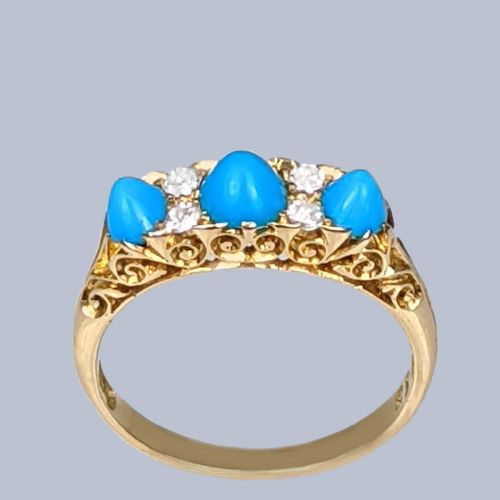
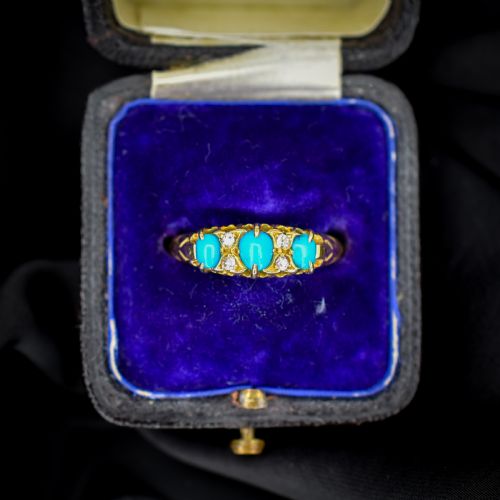
A victorian turquoise band is a distinctive finger ring that combines vibrant blue stones with warm gold, offering an unmistakable piece of period jewellery.
Victorian Turquoise Band
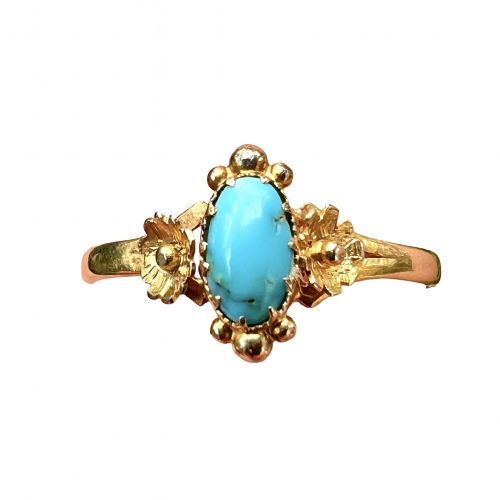
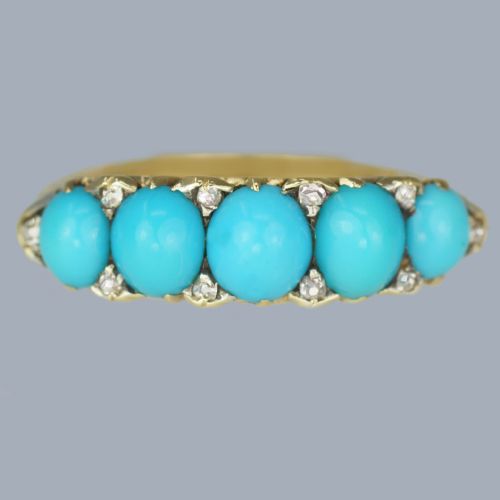
When you search for a victorian turquoise band, you are looking at rings that predominantly date from the Victorian era, alongside related pieces from the Edwardian period and the year 1900. These objects take various forms, including five-stone settings, multi-row bands, buckle designs, and floral cluster arrangements.
The most common version you will meet on this page is the classic gold band set with turquoise cabochons, often alternated with diamonds or seed pearls. These rings utilise bands fashioned from 18ct gold, 15ct gold, or 12ct gold, reflecting the standard metal purities of the nineteenth and early twentieth centuries.
The origins of these bands span specific nineteenth-century decades and stretch into the early twentieth century, showing influences from Georgian styles through to Late Victorian Arts and Crafts movements. The selection concentrates entirely on finger rings, showcasing a variety of stone arrangements from simple single-row hoops to complex harem stacking bands.
How they were made
Jewellers constructed these bands using precious metals such as 18ct gold, 15ct yellow gold, rose gold, and 12ct gold, shaped into solid hoops and detailed settings. Gems were secured into the metal framework alongside decorative elements like engraving and wirework.
The primary decorative components involve natural turquoise stones, frequently paired with old-cut diamonds, seed pearls, and split pearls. These materials were carefully arranged in boat shapes, scroll designs, buckle motifs, and trilogy configurations upon the gold shanks.
Listings show gold purities ranging from 12ct through 15ct to 18ct yellow and rose gold, alongside platinum-free Edwardian and Victorian settings.
What varies in quality
The calibre of a victorian turquoise band depends heavily on the integration of its components, such as the uniformity and natural colour saturation of the turquoise cabochons. Pieces featuring well-matched stones alongside quality old-cut diamonds sit higher in the range than those with mismatched or faded gems.
The substance of the gold work also dictates the standard of the piece, distinguishing heavier 18ct or 15ct gold structures from lighter constructions. Finer examples display crisp engraving, secure claw or flush settings, and robust shanks that have retained their original thickness through decades of wear.
The Victorian Turquoise Band Glossary
- Cabochon
- A gemstone shaped and polished with a smooth, rounded convex surface rather than faceted. This cut was the standard choice for turquoise in nineteenth-century jewellery.
- Old-cut diamond
- A vintage diamond cut featuring a small table, high crown, and large culet, hand-faceted during the eighteenth and nineteenth centuries. These stones exhibit a softer, deeper sparkle under candlelight.
- Seed pearl
- A very small natural or saltwater pearl, often pierced and threaded or glued into Victorian cluster and half-eternity ring designs. They provide a delicate contrast to brighter turquoise and gold.
- Buckle ring
- A ring fashioned in the likeness of a buckled belt, which carried symbolic meanings of loyalty and fidelity during the Victorian era. These bands frequently incorporate turquoise and pearls within the strap motif.
- Trilogy ring
- A ring set with three principal gemstones arranged in a row across the finger. In period pieces, these stones are commonly turquoise flanked by diamonds.
Victorian Turquoise Band: Frequently Asked Questions
How do I clean my ring?
Turquoise is a porous gemstone that absorbs liquids and oils easily, meaning it requires gentle care. Wipe the stones and gold band with a soft, dry cloth rather than soaking the ring in water or chemical cleaning solutions.
Store the piece away from direct sunlight and cosmetics to prevent the blue colour from altering over time. Regular professional checks ensure the security of the stones within their gold settings.
Can I wear this daily?
These antique rings can be worn daily provided you take sensible precautions with them. Remove the jewellery before heavy manual tasks, swimming, or applying hand lotions to protect the softer turquoise stones and pearls.
Because nineteenth-century gold and gemstone settings are delicate, treating the ring with care preserves the structural integrity of the band. Occasional inspection by a jeweller helps maintain the security of the claws.
What does 15ct gold mean?
Fifteen carat gold is a specific metal purity standard used predominantly during the Victorian and Edwardian eras. It contains fifteen parts pure gold alloyed with nine parts other metals to increase durability.
This gold standard was eventually discontinued in Britain in favour of 9ct and 18ct gold. Consequently, finding this specific hallmark helps date a ring securely to the nineteenth or early twentieth century.