
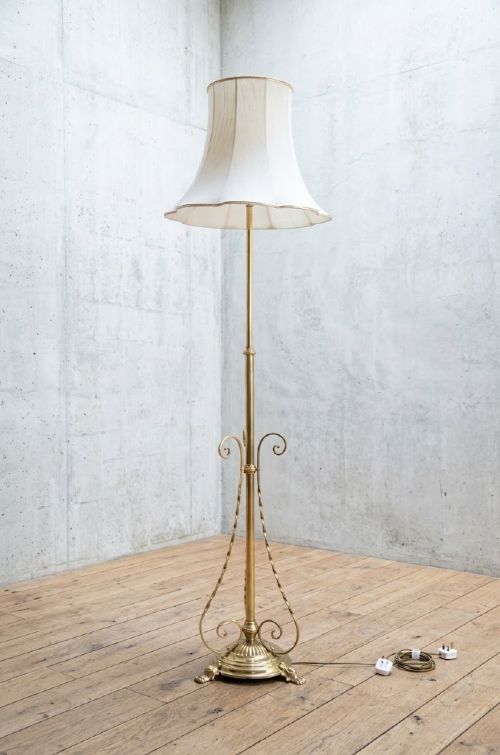
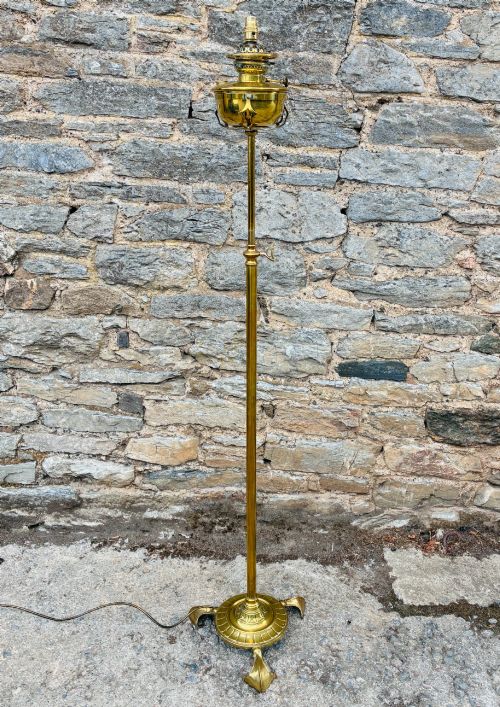
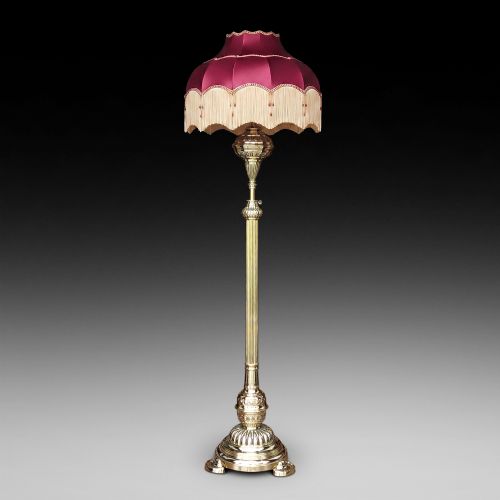


Victorian Telescopic Standard Lamp
A victorian telescopic standard lamp brings adjustable height and period presence to a room, combining practical lighting with nineteenth-century metalwork.

Victorian Telescopic Standard Lamp
A victorian telescopic standard lamp is a tall floor-standing lighting piece designed to alter in height through an extending mechanism. Most examples met here date from the nineteenth century into the early twentieth century, spanning standard Victorian production and Arts and Crafts output.
The dominant material in these pieces is brass, often paired with copper, wrought iron, onyx or marble. Many started life as oil lamps before later conversion to electricity, retaining their original rising columns and heavy weighted bases.
Materials and construction
Makers utilised heavy brass and copper tubing for the sliding telescopic mechanism, allowing the central column to raise and lock securely at various heights. Wrought iron and cast metals appear in alternative stylistic interpretations, particularly within Arts and Crafts examples.
Bases frequently incorporate marble, onyx or ormolu mounts to add stability and decorative contrast to the metal standards. Corinthian columns and turned shafts demonstrate nineteenth-century casting and turning techniques used to give the uprights architectural definition.
Periods represented span from early Victorian production through Arts and Crafts, Edwardian and Art Nouveau designs up to nineteen-twenty.
Judging quality and execution
The distinction between ordinary and superior pieces rests on the weight of the metal and the precision of the extending mechanism. Heavier gauge brass and solid bases provide better balance when the standard is fully raised.
Maker attribution and decorative detail elevate specific examples. Signed mechanisms or columns featuring crisp Corinthian capitals and integrated copper detailing indicate finer workshop production.
Hinks of B'ham·Messenger
The Victorian Telescopic Standard Lamp Glossary
- Telescopic standard lamp
- A floor-standing lamp with an extending shaft that allows the height to be adjusted. These pieces frequently originated as oil-burning lamps before modern conversion.
- Corinthian column
- An architectural column design featuring an ornate capital decorated with acanthus leaves. This motif is common on formal nineteenth-century standards.
- Rise and fall
- An alternative descriptor for a telescopic or height-adjustable lighting standard. The term refers to the vertical movement of the inner shaft.
- Ormolu
- Gilt bronze applied as a decorative mount on furniture and standard lamps. It provides a bright metallic contrast against darker metals or stone.
Victorian Telescopic Standard Lamp: Frequently Asked Questions
Were these originally oil lamps?
Many examples began as oil-burning fixtures with burners at the top before being adapted for electric bulbs.
Conversions allow these historical floor stands to function safely in modern interiors while retaining their original height-adjusting mechanism.
How do I adjust the height?
The inner brass or copper tube slides upward within the outer shaft and is secured at the desired level by a key or screw collar.
Care should be taken to support the upper section firmly by hand while releasing or tightening the mechanism.
What styles are available?
The selection ranges from formal Victorian Corinthian column designs in polished brass to simpler Arts and Crafts wrought iron standards.
French variations introduce mixed materials such as onyx and ormolu, while later pieces show Edwardian and Art Nouveau influences.
How do I choose a stable lamp?
Heavier bases cast in brass, iron or weighted with marble provide the necessary counterbalance when the telescopic shaft is fully extended.
Placing the lamp on a level floor ensures safe operation regardless of the height chosen.