
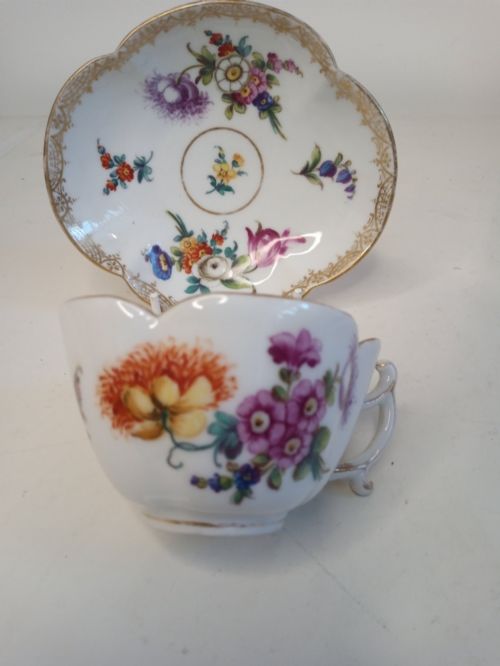


Victorian Teacup and Saucer
These victorian teacup and saucer sets bring the ceremony of nineteenth-century hospitality straight to your table.
Victorian Teacup and Saucer
When you search for a victorian teacup and saucer, you are looking at domestic ceramics shaped by the social rituals of the nineteenth century. The examples on this page span the Victorian era, alongside pieces from related periods like the late 1800s and early 1900s.
You will encounter everything from individual demitasse and pedestal cups to larger tea sets and multi-person afternoon tea services. Forms range from Bohemian and Rococo Revival designs to classical shapes decorated with hand-painted motifs.
Most entries originate from English potteries and continental houses, reflecting the broad reach of nineteenth-century ceramic production. These sets served as both functional vessels for daily tea and decorative objects displayed within the home.
What varies in quality
Quality rests in the precision of the hand-painting and the fineness of the ceramic body. Pieces featuring intricate enamel work and careful gilding demonstrate a higher level of artisan skill than standard transfer-printed wares.
The reputation of the maker also shapes the standing of a piece, with established houses achieving greater refinement in form and decoration. Preservation of the original gilding and enamel intact further distinguishes superior examples.
Listings feature porcelain, bone china, and earthenware across the Victorian period and surrounding decades.
Royal Worcester·Moser·Meissen·Masons·Davenport·Wileman Foley Shelley·Hirsch Dresden·Royal Crown Derby
The Victorian Teacup and Saucer Glossary
- Bone china
- A type of soft-paste porcelain containing animal bone ash, which gives the material strength and a high degree of translucency. It became a staple of English ceramic production during the nineteenth century.
- Demitasse
- A small cup used to serve Turkish coffee or strong espresso. These diminutive vessels often mirror the decorative schemes of larger tea sets.
- Gilding
- The application of gold leaf or gold paint to the surface of ceramics. This technique highlights rims, handles, and painted scenes with metallic lustre.
- Ironstone
- A heavy, durable type of earthenware patented in the nineteenth century as a tough alternative to porcelain. It offered manufacturers a robust body suitable for dense patterns.
- Pedestal cup
- A cup raised on a small foot or stem rather than resting directly on its base. This form adds height and a formal silhouette to the tea service.
Victorian Teacup and Saucer: Frequently Asked Questions
What is a true trio?
A true trio consists of a matching teacup, saucer, and tea plate produced as a single set by the same maker.
These matching components allowed for a unified presentation during afternoon tea.
How do I use antique teacups?
Many collectors use these cups for special occasions, while others display them in cabinets to protect the delicate gilding.
Hand washing is generally required to preserve the hand-painted details and gold leaf.
What is blush ivory?
Blush ivory is a ceramic finish developed in the late nineteenth century that combines a warm cream ground with soft pink and gold tints.
It created a subtle, matte appearance popular among Victorian porcelain manufacturers.
Are these sets for daily use?
While sturdy enough for occasional tea drinking, age and delicate materials mean they require careful handling.
Avoiding dishwashers and microwaves helps protect the historical glazes and enamels.