




Victorian Slate Mantel Clock
A victorian slate mantel clock brings architectural weight and steady mechanical life to a room, built from dense stone to sit firmly on a chimney piece.
Victorian Slate Mantel Clock
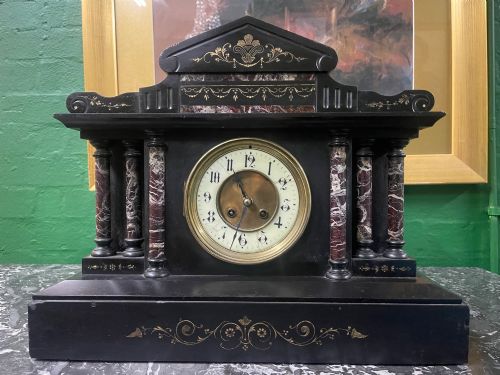
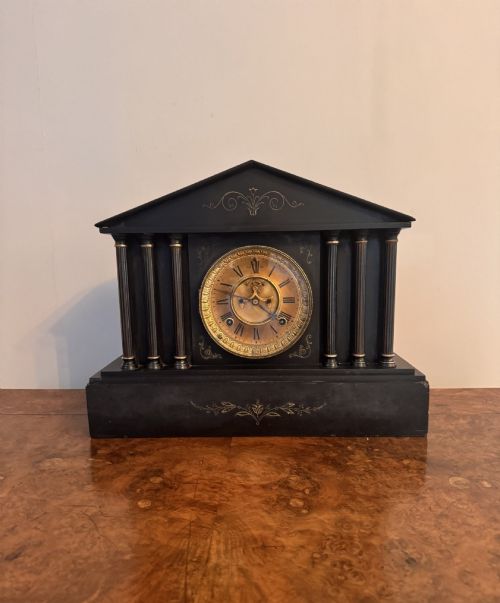
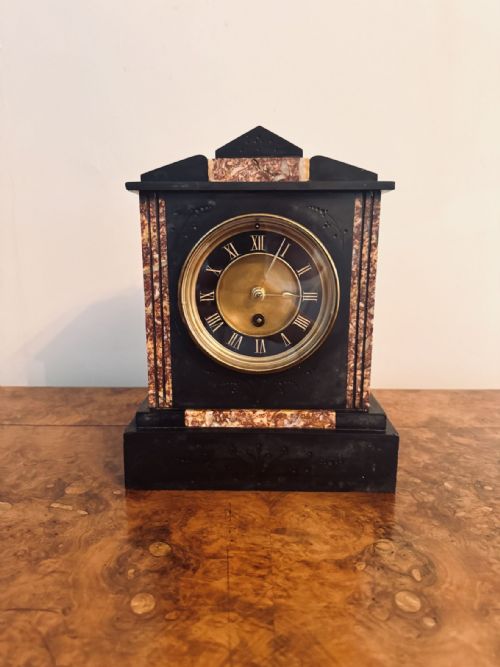
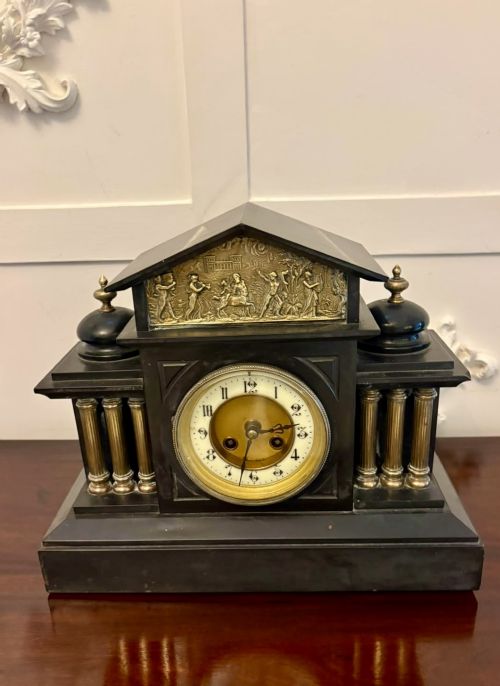
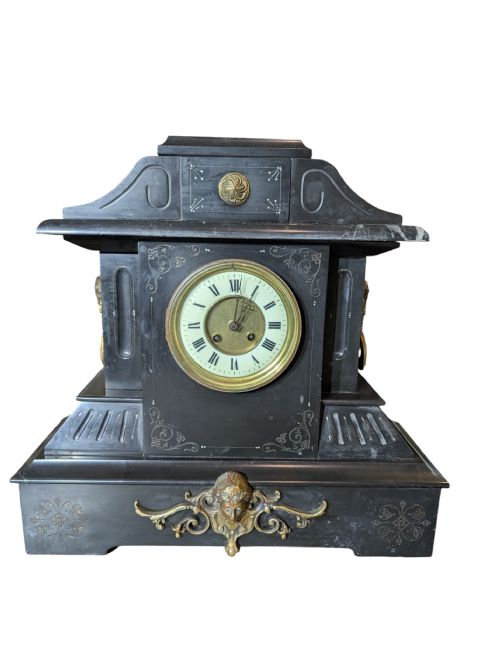
A victorian slate mantel clock is a heavy domestic timekeeper designed to anchor the mantelpiece with architectural presence. These pieces emerge primarily from the nineteenth century, appearing in formats ranging from simple drumheads to substantial architectural garnitures.
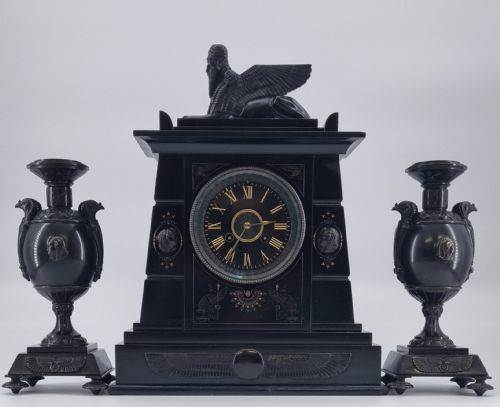
The materials span deep black slate and contrasting marble, often inlaid with coloured stone or mounted with bronze and gilt brass. Many examples show direct influence from classical revivals, including Egyptian motifs and French architectural styles.
Makers and retailers from London, Paris and provincial workshops produced these clocks with eight-day movements, frequently featuring visible escapements or perpetual calendars. They survive as robust functional objects that combine stone masonry with precision horology.
How they were made
The bodies rely on dense blocks of black slate and marble, sawn and polished to resemble monumental stone architecture rather than domestic woodwork. Workshops cut, bevelled and incised the stone surfaces, often filling engraved geometric channels with contrasting coloured marble or slate dust.
Movements were cast in brass and steel, housing spring-driven or fusee mechanisms designed to run for eight days between windings. Cases frequently incorporate gilt brass mounts, bronze figures and enamelled dials protected by bevelled glass bezels.
Victorian Slate Mantel Clock Retail Price Guide 2026
Typical asking prices for victorian slate mantel clock among the pieces listed under this phrase on Sellingantiques today, from the lower quarter to the upper quarter. They describe what is for sale here now, not the wider market.
Several pieces record maritime service, including a clock named for the SS Ethiopia from 1874, keeping time on the rolling seas.
What varies in quality
Quality rests in the architectural ambition of the stone case and the crispness of its marble inlays. Better examples employ finer grades of slate with precise mitres, integrated bronze ornaments and balanced garniture sidepieces rather than plain moulded blocks.
Japy Frères·Philippes Paris·Baby and Jannings·Achille Brocot·Barraud and Lund London·D. Munsey of Cambridge
The Victorian Slate Mantel Clock Glossary
- Garniture set
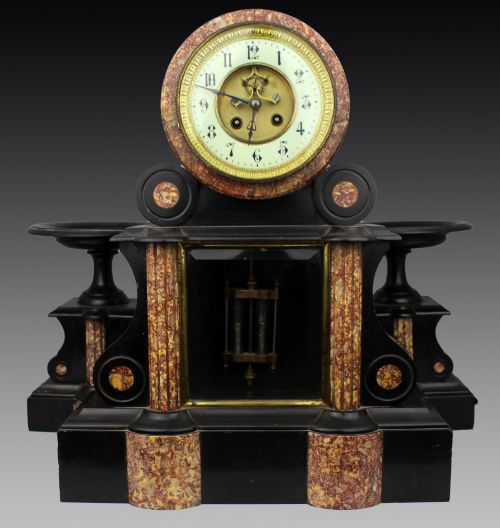
- A clock accompanied by matching side ornaments, typically urns or vases designed to sit together on a mantelpiece.
- Drumhead clock
- A timepiece featuring a circular clock head mounted upon a rectangular or stepped stone base.
- Visible escapement
- An arrangement where the ticking balance wheel is exposed through a glazed aperture on the dial, allowing the movement to be watched in action.
- Fusee
- A conical pulley mechanism connected to the mainspring by a chain, designed to equalise the force delivered to the clock movement as the spring unwinds.
- Perpetual calendar
- A mechanism that automatically tracks the date and month, accounting for the varying lengths of months and leap years.
Victorian Slate Mantel Clock: Frequently Asked Questions
How heavy is a slate clock?
These clocks are constructed from solid stone blocks and weigh considerably more than wooden timepieces. A standard model requires a sturdy shelf and careful placement to support the dense mass.
Lifting and moving them demands two hands and a firm grip, as the combination of slate and marble creates a heavy load.
Do these clocks run on batteries?
Original pieces operate entirely through mechanical brass movements powered by mainsprings or weight-driven systems. They require manual winding with a key every week to maintain time.
Electric conversions exist in some examples, but traditional movements rely on pendulum control and gear trains.
Why do some have side vases?
Matching side pieces, known as garnitures, were created to form a balanced decorative group across a fireplace mantel. The urns or obelisks echo the stone and metal details of the central clock.
Together they formed a formal decorative arrangement popular in nineteenth-century interiors.
How do I wind the movement?
Winding uses a specific square-drive key inserted into the winding holes on the enamelled dial. Care must be taken not to overwind the mainspring.
Most quality movements operate for eight days before needing another turn of the key.