


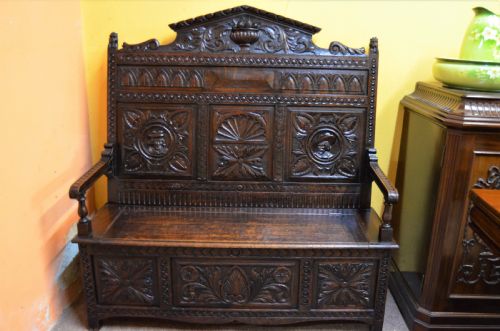


Victorian Settle Table
These Victorian settle table pieces are clever dual-purpose hall seats that convert into flat-topped surfaces, offering genuine period utility.
Victorian Settle Table
When you search for a victorian settle table, you are looking at sturdy wooden benches designed for hallways and living spaces that feature backs capable of pivoting or folding down to form a table. These versatile items appear predominantly as oak or pine monks benches, hall seats, and settles bearing the hallmarks of nineteenth-century craftsmanship.
The pieces listed here span the Victorian era, the nineteenth century, and subsequent revival periods up to the nineteen-thirties. You will most frequently encounter carved oak variants displaying Jacobean or Gothic revival styling, alongside simpler pine examples intended for everyday domestic use.
How they were made
These items are constructed primarily from solid oak and pine, assembled using traditional joinery and reinforced with metal fittings where the pivoting back mechanism meets the arms. Cabinetmakers shaped the timber with hand tools, applying deep relief carving to the panels and backrests.
Surface decoration relies heavily on chip carving, linenfold panelling, and moulded details rather than applied veneers. The timber is left in its natural dark or medium finish, accentuating the grain and the patination accumulated over decades of use.
Victorian Settle Table Retail Price Guide 2026
Typical asking prices for victorian settle table among the pieces listed under this phrase on Sellingantiques today, from the lower quarter to the upper quarter. They describe what is for sale here now, not the wider market.
Some oak benches double as secret tables, ready to serve afternoon tea after you finish tying your boots.
What varies in quality
Quality in these convertible seats rests upon the integrity of the conversion mechanism and the depth of the timber carving. Superior examples exhibit smooth pivoting action in the backrest and crisp, well-defined hand carving across the panels rather than shallow, mechanical stamping.
The choice of primary wood also dictates the tier of the piece, with dense, figured oak commanding greater presence than softer pine utility versions. Better specimens maintain balanced proportions between the bench configuration and the tabletop surface when fully rotated.
The Victorian Settle Table Glossary
- Monk's bench
- A dual-purpose piece of furniture combining a high-backed seat with a hinged top that converts the backrest into a table. This form gained popularity during revival periods inspired by earlier centuries.
- Jacobean Revival
- A nineteenth-century decorative style borrowing heavily from the early seventeenth century. It utilises dark oak, geometric moulding, and heavy turned supports.
- Settle
- A wooden bench with a high solid back, solid arms, and often a box base for storage. This traditional form protects sitters from draughts in entrance halls.
Victorian Settle Table: Frequently Asked Questions
How do I convert the bench into a table?
The high backrest is attached to the arms by wooden pivot pins or metal hinges that allow the entire upper section to tilt forward. Once rotated ninety degrees, the flat rear of the backrest rests upon the arms to form a table surface.
This ingenious mechanism requires gentle handling to ensure the pivot points remain aligned and undamaged during the transformation.
Where were these benches originally placed?
These pieces traditionally stood in the entrance halls or grand corridors of Victorian homes. They provided a place to sit while removing boots and served as a functional surface when space was at a premium.
The dual functionality made them particularly useful in smaller parlours and multi-use domestic spaces.
Are these pieces made of solid oak?
The listings show a strong predominance of solid oak construction, often described as dark oak or carved oak. Some examples utilise pine for utility or regional pieces.
Makers selected timber based on the intended room and budget of the original purchaser, ensuring robust daily service.
How can I tell the age of a monks bench?
Dating relies on examining the timber grain, tool marks, and stylistic revival cues such as Jacobean or Gothic ornamentation. Pieces span the Victorian period, the broader nineteenth century, and early twentieth-century revival dates up to nineteen-thirty.
Wear patterns around the pivot joints and the natural patination of the wood provide further clues to authenticity.