
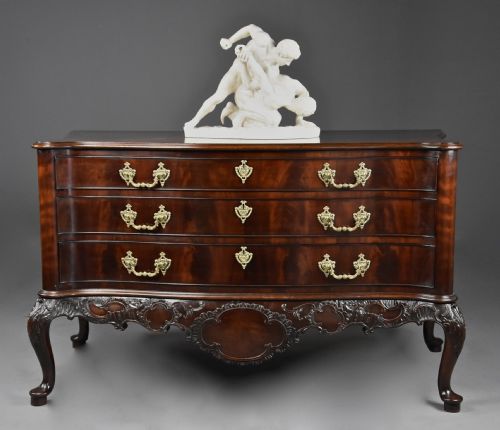


Victorian Serpentine Chest Drawers
A victorian serpentine chest drawers brings a fluid, undulating profile to a room, offering deep storage wrapped in rich timber.
Victorian Serpentine Chest Drawers
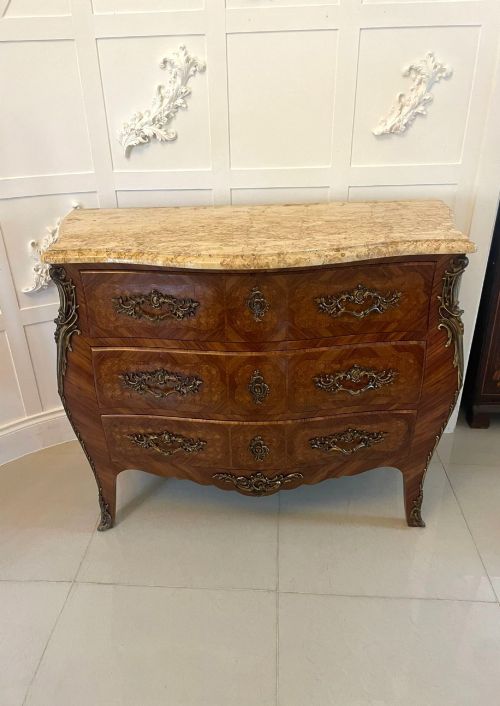
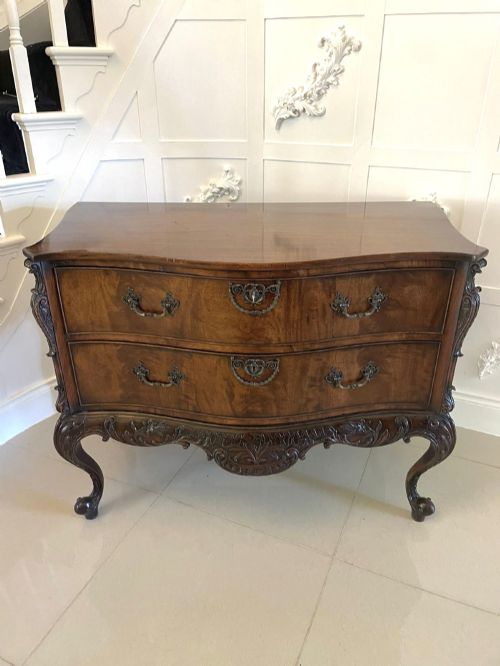
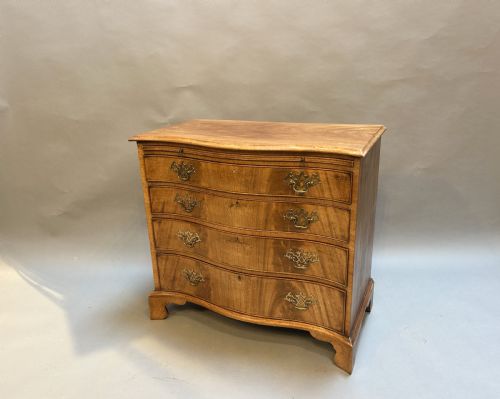
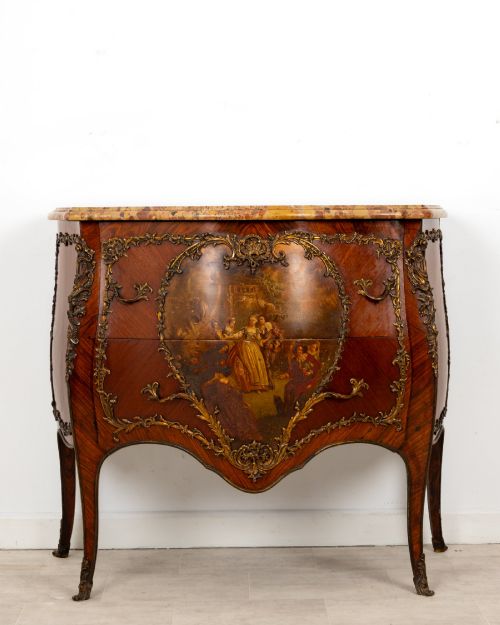
When you search for a victorian serpentine chest drawers, you encounter pieces defined by a distinctive curving front that swells outward at the centre and recedes at the corners. The pieces on this page span the nineteenth century, including specific dates from eighteen fifty to nineteen hundred, alongside items assigned broadly to the nineteenth century.
The dominant forms include standard chests of drawers and commodes, occasionally appearing as chest on chest configurations or Scotch chests. Many examples reflect revivalist impulses, drawing on Louis XV, French Rococo, Chippendale, and Sheraton styles, as well as French aesthetic influences.
Distinguishing Quality in the Range
Quality rests heavily on the handling of the timber and the precision of the curved drawer fronts. Finer examples display carefully selected grain patterns, such as figured or flame mahogany and burr walnut, which follow the contours of the serpentine sweep without distortion.
The integration of secondary decorative elements separates standard workshop production from finer pieces. Heavier cast bronze or ormolu mounts, well-fitted marble slabs, and sophisticated parquetry indicate greater investment of craftsmanship during manufacture.
Listings feature nineteen-century pieces incorporating mahogany, burr walnut, kingwood, marble, and brass.
The Victorian Serpentine Chest Drawers Glossary
- Serpentine front
- A furniture front characterised by a concave central section flanked by convex ends, or the reverse, creating an undulating wave shape. This contour requires precise woodworking to ensure drawers operate smoothly within a curved frame.
- Commode
- A low cabinet or chest of drawers, often referencing French-inspired designs of the eighteenth and nineteenth centuries. In Victorian pieces, the term frequently describes decorative items fitted with marble tops and gilt-bronze mounts.
- Parquetry
- Geometric wood mosaic work used for decorative veneering on tabletops, commodes, and drawer fronts. Small tiles of contrasting timbers are arranged in repeating patterns.
- Ormolu
- Gilt bronze mounts applied to furniture edges, feet, and corners for decorative effect. The technique involves applying a gold amalgam to heated bronze.
- Burr walnut
- Timber taken from the gnarled growths of a walnut tree, yielding highly swirling and mottled grain patterns. It is sliced into thin veneers for high-status cabinet work.
Victorian Serpentine Chest Drawers: Frequently Asked Questions
What is a serpentine chest?
A serpentine chest is a storage piece featuring a distinctively curved front that waves outward and inward. This shape creates visual movement and softens the rigid geometry typical of standard rectangular furniture.
Craftsmen built these pieces to showcase fine timbers like mahogany and walnut, requiring high skill to ensure the curving drawers function correctly.
How do I date a Victorian chest?
Dating relies on observing construction methods, timber choices, and stylistic revival influences. Mid-century pieces often display solid mahogany builds, while later nineteenth-century examples frequently incorporate continental revival styles and marble tops.
Hardware styles and secondary woods inside the drawer construction also provide clues to the decade of manufacture.
Are these chests French or English?
The selection includes both British pieces and French-influenced commodes. English workshops produced many mahogany and walnut examples, sometimes referencing Chippendale or Sheraton traditions.
Items described with parquetry, ormolu, and marble tops typically reflect French Louis styles or Parisian workshop methods popular during the nineteenth century.
How do I care for marble top chests?
Marble surfaces require simple cleaning with a damp cloth and mild, non-acidic soap to protect the polished stone from staining. Avoid placing acidic liquids directly on the marble.
The wooden body underneath benefits from occasional waxing to maintain the lustre of the mahogany or walnut veneer.