

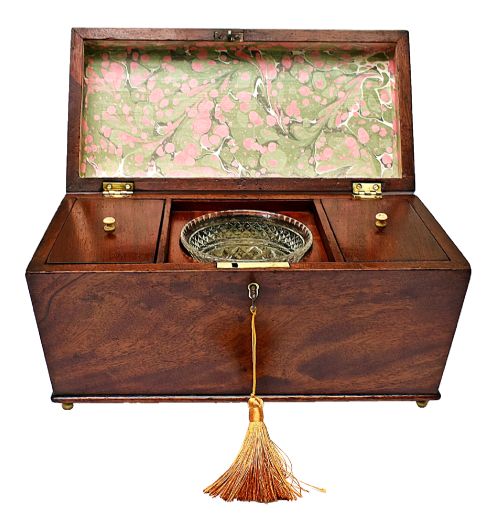


Victorian Sarcophagus Caddy
These Victorian sarcophagus caddy pieces are substantial lidded boxes designed to store tea, with most examples shaped in the distinctive architectural sarcophagus form.
Victorian Sarcophagus Caddy
A victorian sarcophagus caddy is a substantial lidded box designed originally to store and preserve dry tea leaves under lock and key. The form draws its name from classical stone coffins, featuring a heavy, tapered body that sits upon bun feet or a stepped plinth base.
Most examples met on this page date from the nineteenth century, spanning the Victorian period alongside Regency and William IV eras. Alongside traditional tea caddies, the listings encompass related cellarettes, wine coolers, teapoys, sewing boxes, and jewellery boxes sharing the same distinctive sarcophagus silhouette.
Rosewood and mahogany dominate the materials seen across these pieces, frequently enriched with decorative veneers, brass mounts, or intricate inlay work. Buyers find both double tea caddy formats with internal mixing bowls and compartments, and single or multi-purpose storage boxes.
Materials and construction methods
Cabinetmakers constructed these boxes using dense timbers such as mahogany and rosewood as the primary carcase materials, sometimes enhanced by burr walnut or walnut veneers. Internal compartments and decorative highlights often incorporate contrasting boxwood stringing or bone details.
Surface decoration frequently relies on fine woodworking techniques including Tunbridge Ware inlay, brass inlay, and geometric banding. The characteristic sarcophagus shape is achieved through precision joinery, forming curved or stepped lids that fit flush against the tapered body.
Victorian Sarcophagus Caddy Retail Price Guide 2026
Typical asking prices for victorian sarcophagus caddy among the pieces listed under this phrase on Sellingantiques today, from the lower quarter to the upper quarter. They describe what is for sale here now, not the wider market.
The archive shows examples incorporating specialist decorative techniques like Tunbridge Ware inlay alongside plain veneered surfaces.
Factors of distinction
Quality rests heavily upon the selection of timber veneers and the precision of the decorative inlay work, such as Tunbridge Ware panels or brass stringing. Finer pieces display careful grain matching across the domed or stepped lid and the tapered sides of the sarcophagus form.
Internal architecture dictates distinction, with superior examples retaining original fitted compartments, mixing bowls, and working locks with matching keys. The crispness of the carving on bun feet, mouldings, and handles further separates standard production boxes from exceptional workshop pieces.
Henry Hollamby·Freemans of Norwich
The Victorian Sarcophagus Caddy Glossary
- Sarcophagus form
- A container shape featuring a tapered body and a heavy, domed or stepped lid reminiscent of classical stone monuments. This architectural silhouette defines the primary profile of these nineteenth-century boxes.
- Tea caddy
- A small lidded box or chest originally built to store loose tea leaves securely. They often include internal partitions and a central recess for a glass mixing bowl.
- Cellarette
- A large freestanding or box-form container historically used for chilling and storing bottles of wine. In this selection, they share the heavy tapered proportions of the sarcophagus style.
- Tunbridge Ware
- A type of decorative woodwork characterised by tiny coloured wood mosaic tiles forming pictorial or geometric patterns. It appears frequently as intricate inlay on nineteenth-century rosewood boxes.
- Teapoy
- A pedestal table fitted with a large storage box on top for holding tea equipment. These pieces combine the function of a tea caddy with a supporting pillar and base.
Victorian Sarcophagus Caddy: Frequently Asked Questions
What were victorian sarcophagus caddy pieces used for?
These boxes served primarily to store valuable tea leaves safely under lock and key in the formal rooms of nineteenth-century houses. Tea was an expensive commodity, requiring secure storage away from servants and dampness.
Over time, many of these containers transitioned into general storage for jewellery, sewing equipment, or letters. Their robust internal compartments made them versatile receptacles for small personal valuables.
How do I identify a Victorian sarcophagus caddy?
Look for the characteristic tapered body and heavy domed or stepped lid that mimics classical architectural sarcophagus styling. The proportions are typically substantial, often raised on bun feet or a stepped plinth base.
Materials will generally point to nineteenth-century cabinetmaking, featuring dense hardwoods like rosewood or mahogany. Many examples also include internal compartments and escutcheons for locks.
Are these caddies suitable for modern tea storage?
While original interiors often feature foil-lined or divided wooden compartments, modern tea storage requires airtight conditions to preserve freshness. Using them for dry tea today is possible if the inner containers are clean and dry.
Most modern buyers repurpose these boxes to store trinkets, stationery, or contemporary accessories while keeping the historic interiors intact.
How do I care for rosewood and mahogany boxes?
Keep wooden boxes away from direct sunlight and sudden temperature shifts to prevent the timber veneers from drying out and cracking. Maintain a stable indoor environment to protect the delicate inlays and joints.
Apply a light application of appropriate furniture wax occasionally to nourish the wood surface and preserve the polished finish. Avoid using liquid polishes or harsh chemical cleaners.