

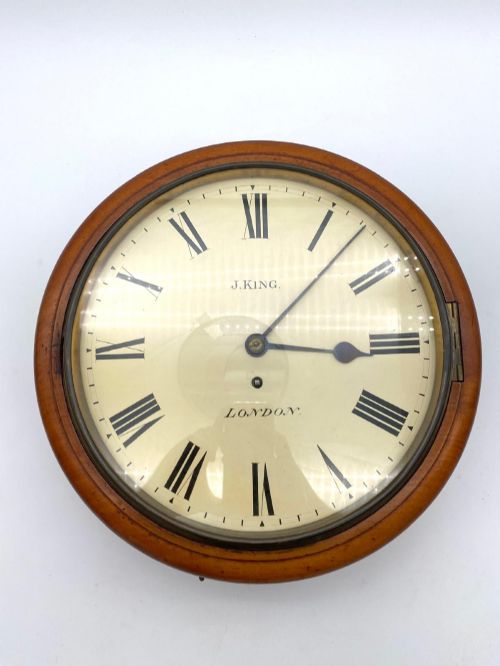
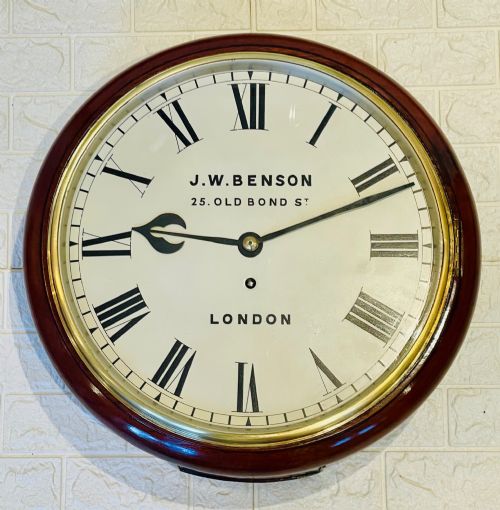
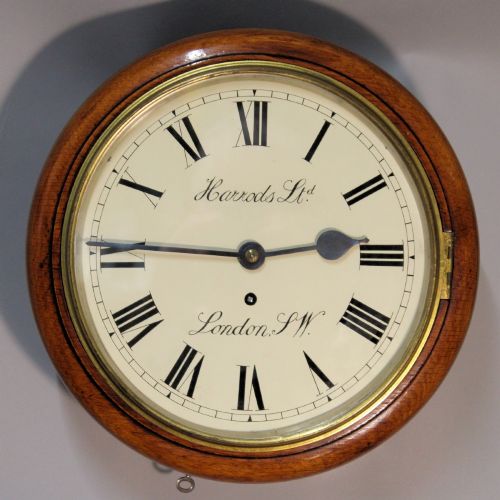
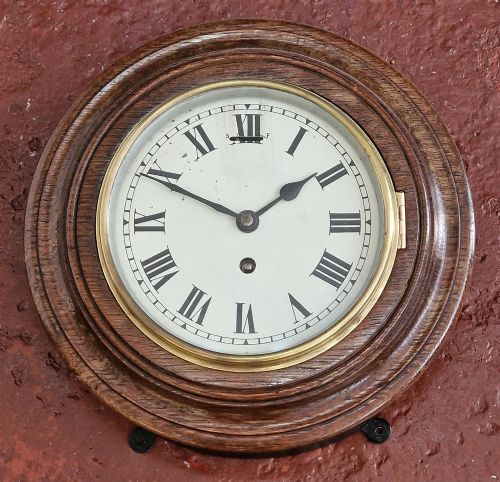
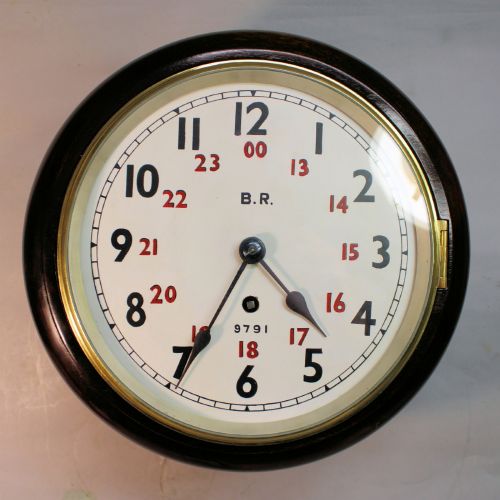


Victorian Round Dial Clock
A victorian round dial clock brings mechanical timekeeping from the railway station or schoolroom directly into a domestic hallway.
Victorian Round Dial Clock
When you search for a victorian round dial clock, you are looking at practical timekeepers designed for public spaces, offices and railways rather than grand drawing rooms. The pieces here span the nineteenth century and into the early decades of the twentieth century, appearing primarily as wall-mounted clocks with clear circular faces. Mahogany and oak cases predominate, often built with substantial bezels and glass covers to protect the dial.
The version you are most likely to meet on this page is the fusee wall clock housed in a mahogany or oak case, often associated with railway stations, schools or municipal offices. These range from small dial variants measuring six inches across to much larger formats spanning fifteen inches or more. Makers and retailers such as John Walker and Harrods frequently stamped their names directly onto the painted enamel dials.
Materials and construction
The cases rely heavily on dense hardwoods like mahogany and walnut, alongside golden oak, turned with solid brass bezels to house the protective glass fronts. Movements are driven by fusee or striking mechanisms made from brass and steel components, engineered to maintain consistent power distribution as the mainspring unwinds.
Victorian Round Dial Clock Retail Price Guide 2026
Typical asking prices for victorian round dial clock among the pieces listed under this phrase on Sellingantiques today, from the lower quarter to the upper quarter. They describe what is for sale here now, not the wider market.
Many a station clock bears the quiet scars of hurried platform guards nudging the brass bezel with railway keys.
Distinctions in quality
Quality separates the standard utility office clock from the precision timepiece supplied to a major railway terminus or notable retailer. Superior examples display crisp dial signwriting, finely figured mahogany or walnut veneers, and robust fusee movements built for exacting timekeeping under heavy daily use.
Simpler models made for schools or smaller offices often feature plain oak cases and basic striking trains without the refined adjustments found in high-grade London station pieces. The clarity of the painted enamel dial and the weight of the cast brass bezel indicate the original tier of manufacture.
John Walker·Payne of Tunbridge Wells·Balbiani Brookley·Anglo Swiss Watch Co.·Wyatt Bournemouth
The Victorian Round Dial Clock Glossary
- Fusee
- A conical pulley connected to the mainspring by a chain or cord that equalises the driving force as the spring relaxes. This mechanism ensures steady timekeeping throughout the running cycle.
- Dial
- The visible face of the clock where numerals are painted or applied. On these wall clocks, dials are usually protected by a hinged brass bezel and glass.
- Bezel
- The metal rim that holds the glass door protecting the dial. Brass is the standard material seen across these nineteenth-century pieces.
- Drop-dial
- A clock case featuring a circular dial at the top attached to a lower wooden trunk or box that encloses the pendulum swing. This silhouette is common in London railway and office clocks.
Victorian Round Dial Clock: Frequently Asked Questions
Where were round dial clocks used?
These clocks hung primarily in railway stations, schools, municipal offices and public institutions where clear timekeeping was essential for large groups.
Their robust wooden cases and legible painted dials were designed to withstand busy environments and daily operational demands.
How do fusee movements work?
A fusee movement uses a conical drum and a chain to regulate the pull of the mainspring.
As the spring loses tension, the chain moves to a wider part of the cone, maintaining even power delivery to the gear train.
Are these clocks suitable for home walls?
Their clean circular shapes and warm mahogany or oak timber cases suit hallways, kitchens and studies.
Their secure wall-mounting design keeps them safely off tabletops while serving as a striking focal point.
How can I date a dial clock?
Dating relies on case timbers, dial inscriptions, and movement construction methods visible behind the bezel.
Mahogany fusee pieces often date to the Victorian era, while later twentieth-century examples incorporate alternative striking mechanisms.