
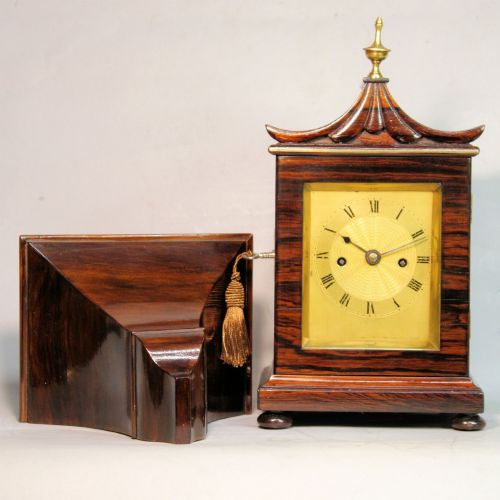


Victorian Rosewood Table Clock
A victorian rosewood table clock is a handsome timepiece housed in rich, dark timber, offering both practical timekeeping and striking nineteenth-century domestic elegance.
Victorian Rosewood Table Clock
When you search for a victorian rosewood table clock, you encounter a selection of nineteenth-century timepieces spanning Victorian, Regency, and French styles, along with specific forms like portico, bracket, and library clocks. These pieces combine rich dark timber cases with intricate details such as lemon wood inlay, brass mounts, and glass panels.
The version most commonly met on this page is the French portico or English library clock, often featuring striking mechanisms and enamel dials. Dating primarily from the middle and late nineteenth century, these objects range from miniature carriage timepieces to important twin fusee bracket clocks.
What varies in quality
Quality in these clocks rests upon the complexity of the movement and the precision of the cabinetwork. Twin fusee or year-going movements and delicate marquetry sit at the upper end, while simpler timepiece movements represent the standard.
The integration of precious materials like ormolu and fine lemon wood stringing distinguishes finer decorative examples from plain utilitarian boxes. Furthermore, signed movements by established makers elevate the standing of a piece considerably.
Listings feature rosewood timepieces spanning multiple nineteenth-century aesthetic movements, including Regency, French Restoration, Napoleon III, and William IV.
S Simpson Southampton·Arnold and Frodsham·Paul Garnier·Walker and Hall·L.Donne Birchin Lane Cornhill London·Dumont
The Victorian Rosewood Table Clock Glossary
- Fusee
- A conical pulley used in spring-driven clocks to equalise the torque of the mainspring as it unwinds. This mechanism improves timekeeping accuracy across the duration of the wind.
- Portico clock
- A distinct architectural clock style featuring two side pillars supporting a central entablature that houses the dial. These French designs often utilise rich wood veneers and ormolu mounts.
- Bracket clock
- A portable table clock originally designed to sit on a wall bracket to project sound more effectively. Many examples retain their matching wall brackets.
- Library clock
- A compact timepiece intended for domestic study rooms, often featuring glass panels that expose the internal escapement. English five-glass models are particularly typical of this type.
- Ormolu
- Gilded bronze applied as decorative mounts and feet on nineteenth-century clock cases. The technique involves mercury amalgamation to achieve a durable golden finish.
Victorian Rosewood Table Clock: Frequently Asked Questions
What is a fusee movement?
A fusee movement uses a conical drum to regulate the pull of the mainspring, ensuring even power delivery as the spring relaxes.
This sophisticated mechanical arrangement is a hallmark of better-quality British clockmaking from the nineteenth century.
Where should I place a table clock?
These clocks belong on stable, level surfaces away from direct sunlight, drafts, and sources of excessive heat.
Placing them securely on mantelpieces, sideboards, or dedicated wall brackets ensures the pendulum or balance wheel beats evenly.
How do I distinguish French and English styles?
French models frequently adopt portico, architectural, or ornate marquetry designs with bell-striking or platform escapements.
English pieces tend to favour classic bracket or library shapes with robust fusee movements and understated timber cases.