

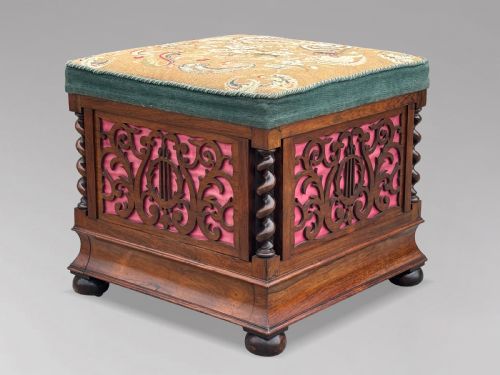


Victorian Rosewood Music Seat
These Victorian rosewood music seat examples offer solid timber framing and adjustable heights for players, bringing period character directly to the instrument bench.
Victorian Rosewood Music Seat
A victorian rosewood music seat combines dense tropical timber with adjustable mechanisms designed specifically for keyboard players and harpists. These pieces appear in forms such as revolving piano stools, rise and fall benches, and specialised harpists chairs spanning the nineteenth century.
The specimens on this page cover the Victorian era with dates ranging through the mid and late nineteenth century, including specific years like eighteen-fifty, eighteen-sixty, and eighteen-ninety. Styles stretch from Victorian Arts and Crafts to Neoclassical Revival and Regency influences.
Makers and workshops of the period produced both simple revolving tops and complex screw mechanisms housed within sturdy rosewood frames. Buyers encounter various seating top configurations upholstered in textile, fabric, velvet, and tapestry.
Materials and construction methods
Makers utilised dark, durable rosewood for the primary frames, often incorporating boxwood inlay for surface enrichment. Supporting elements frequently integrate brass hardware within the adjustable screw pillars and revolving mechanisms.
Upholstery techniques applied to these seats employed traditional textile coverings including velvet, fabric, and tapestry over padded foundations. Giltwood accents also appear alongside the dominant rosewood timber construction.
Victorian Rosewood Music Seat Retail Price Guide 2026
Typical asking prices for victorian rosewood music seat among the pieces listed under this phrase on Sellingantiques today, from the lower quarter to the upper quarter. They describe what is for sale here now, not the wider market.
Distinctions in craftsmanship and design
Quality varies according to the precision of the mechanical rise and fall or revolving mechanism and the integrity of the rosewood timber frame. Examples featuring boxwood inlay or specific maker attribution demonstrate higher artisan input.
The refinement of the stylistic details, from Victorian Arts and Crafts flourishes to Neoclassical Revival lines, dictates the visual standing of each individual stool.
Charles Nosotti
The Victorian Rosewood Music Seat Glossary
- Rosewood
- A heavy, dense tropical timber valued for its dark grain and durable qualities in nineteenth century furniture making. It forms the primary structural material for these music seats.
- Revolving
- A mechanical property allowing the seat top to turn freely on a central threaded screw. This enables the player to adjust height or position while seated at the instrument.
- Rise and Fall
- An adjustable mechanism operated by a handle or screw action to raise or lower the seating platform. It provides customisable height settings for pianists.
- Boxwood Inlay
- Contrasting pale wood inserted into recesses on the darker rosewood surface to create decorative patterns. This technique highlights finer cabinet work.
- Harpists Chair
- A specialised seating form designed with specific back or arm configurations to accommodate the playing posture of harp performers. These pieces represent uncommon variants within nineteenth century music furniture.
Victorian Rosewood Music Seat: Frequently Asked Questions
How do revolving piano stools work?
Revolving piano stools operate through a central wooden or metal screw mechanism hidden beneath the upholstery. Turning the seat top rotates it along the thread to alter the seating height.
This design allowed nineteenth century musicians to quickly adjust their position before playing without needing loose tools or levers.
What is a rise and fall piano stool?
A rise and fall piano stool uses an internal mechanical screw or rack system operated by a side handle or by turning the top. This raises the seating platform uniformly.
Such mechanisms provided stable, heavy-duty height adjustment for players practising for extended periods.
Where were these music seats used?
These seats were placed beside upright pianos, grand pianos, and harps in Victorian drawing rooms and music parlours. They served performers during practice and formal recitals.
Because music was a central part of nineteenth century domestic life, these seats were built to match other high-status room furnishings.
How do I identify a Victorian rosewood piece?
Victorian rosewood furniture is characterised by a heavy, dense timber with a deep reddish-brown grain and polished finish. Pieces from this period often incorporate decorative elements like boxwood inlay or brass hardware.
Construction details and turning styles align with nineteenth century cabinet-making practices found across Victorian and Arts and Crafts examples.