

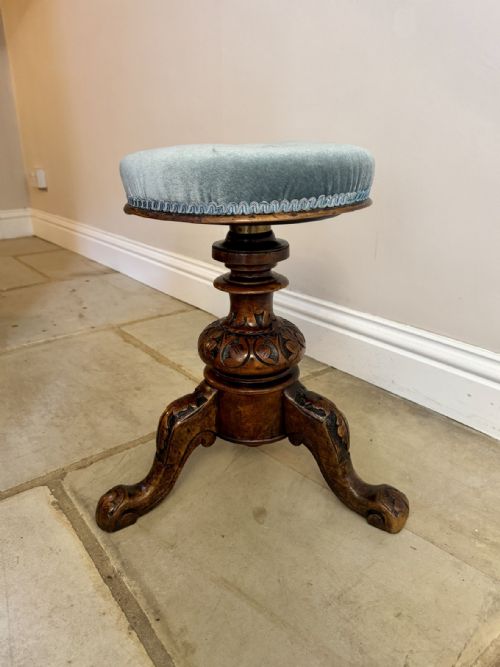


Carved Tripod Music Stool
A carved tripod music stool stands ready at the keyboard, offering adjustable comfort and steady three-legged support for the pianist.
Carved Tripod Music Stool
A carved tripod music stool is a specialised seat designed for musicians at the piano or dressing table, featuring a central column raised on three supportive legs. These pieces emerge predominantly from the Victorian era and the Georgian period, bringing period charm to interior spaces.
Most examples encountered on this page date from the nineteenth century, utilising rich timbers such as walnut and rosewood. The form encompasses revolving tops, rising seats, and adjustable height mechanisms that served practical domestic functions in period parlance.
How they were made
Cabinet makers utilised dense hardwoods like walnut and rosewood, applying hand-carved detailing to the central pedestal and tripod base. These timbers provided the structural rigidity necessary for heavy daily use at the instrument.
Revolving and rise-and-fall mechanisms integrated metal and brass components to enable smooth height adjustment. Upholstery in velvet and various fabrics completed the seat, secured over padding for player comfort.
Carved Tripod Music Stool Retail Price Guide 2026
Typical asking prices for carved tripod music stool among the pieces listed under this phrase on Sellingantiques today, from the lower quarter to the upper quarter. They describe what is for sale here now, not the wider market.
Current listings feature Victorian and Georgian pieces constructed primarily from walnut and rosewood, incorporating velvet and brass elements.
What varies in quality
The sophistication of the hand-carving defines the upper tier of these pieces, distinguishing robust workshop output from simpler utilitarian items. Crisp detailing on the tripod legs and central pedestal demonstrates superior craftsmanship.
The engineering of the adjustable mechanism dictates the mechanical integrity of each stool. Smooth operation of the revolving screw or rising seat separates refined examples from stiffer, more basic variations.
The Carved Tripod Music Stool Glossary
- Tripod base
- A support structure comprising three legs radiating from a central column. This configuration ensures stability on uneven floorboards.
- Rise and fall
- A mechanical system allowing the seat height to be adjusted by turning the top. This permitted different family members to sit at the correct playing height.
- Revolving stool
- A seat designed to turn in a complete circle on its central axis. Pianists utilised this motion to reach sheet music or face the room.
- Pedestal
- The central vertical pillar supporting the seat platform. It often bears the principal decorative carving of the piece.
Carved Tripod Music Stool: Frequently Asked Questions
What is a music stool?
A music stool is an adjustable seat designed specifically for musicians playing keyboard instruments like the piano. They provided the correct height and freedom of movement during practice.
Many examples feature revolving tops or rising mechanisms to accommodate different players. Their compact tripod footprint made them practical for nineteenth-century parlours.
How do adjustable piano stools work?
Adjustable piano stools typically use a central wooden or metal screw mechanism operated by turning the seat itself. This raises or lowers the platform smoothly.
Some Victorian and Georgian pieces rely on a rise and fall screw action hidden beneath the upholstery. This allowed precise height tuning for the performer.
What woods were used for piano stools?
Cabinet makers predominantly selected dense, richly grained hardwoods such as walnut and rosewood for fine piano stools. These timbers supported intricate carving.
Hardwood construction ensured the tripod base could withstand the shifting weight and movement of a pianist over decades of use.
Where were music stools placed?
Music stools stood beside pianos and organs in the principal rooms of nineteenth-century homes. Their compact tripod design allowed them to tuck neatly away when not in use.
Some multi-functional variants also served at dressing tables for grooming and writing. This versatility kept them in constant domestic demand.