


Victorian Repeating Clock
These pieces are a victorian repeating clock, mechanical portable timepieces engineered to chime the last hour on demand.
Victorian Repeating Clock
A buyer examining a victorian repeating clock is looking at portable mechanical timepieces designed to sound the hours and quarters when a plunger or button is pressed. These objects originate predominantly from French horological workshops during the nineteenth century, often retailed through British establishments.
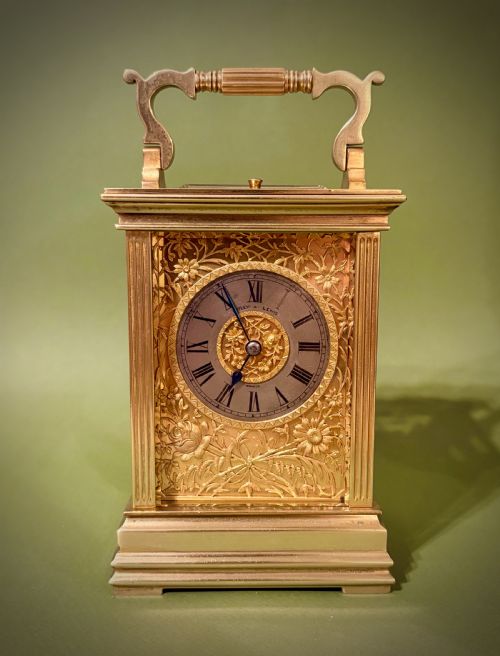
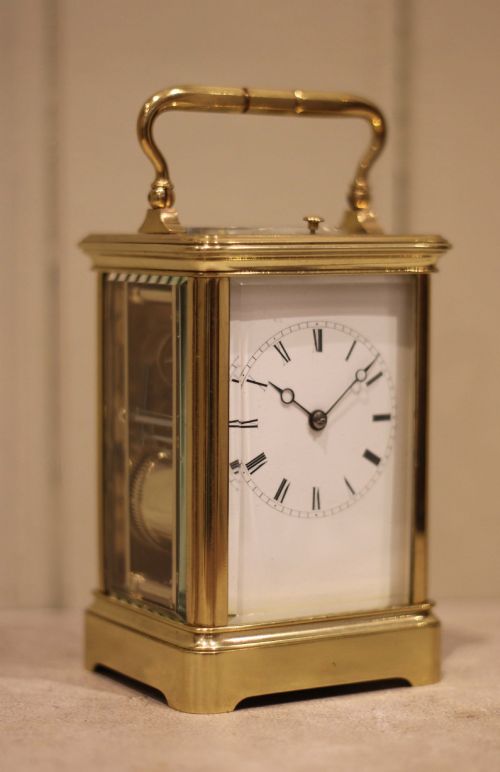
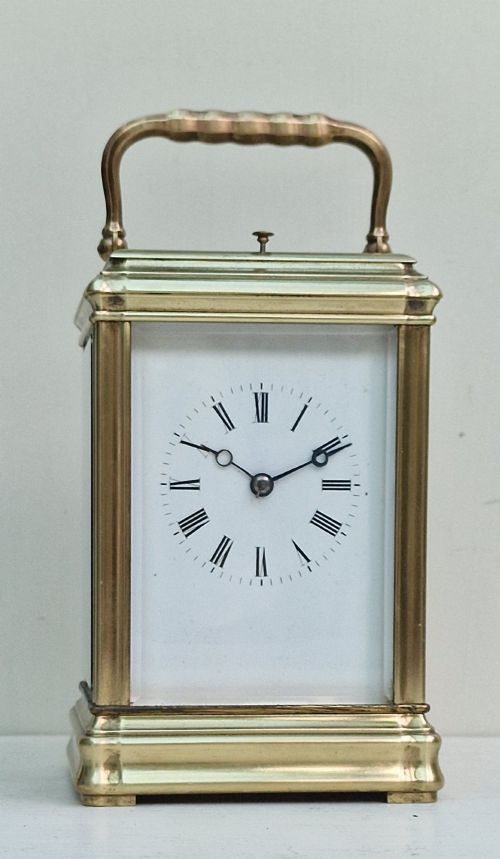
The most common form encountered on this page is the brass carriage clock featuring a glass-panelled gorge or oval case. These pieces combine heavy brass casting with white enamel dials, housing complex striking trains driven by internal spring barrels.
The aesthetic bridges utilitarian travel utility with decorative domestic ornament, reflecting the stylistic shifts from mid-Victorian restraint to late-century engraved luxury.
Materials and Construction
Brass serves as the structural foundation for both the heavy exterior frames and the internal movement plates, frequently finished with fire gilding or plating. Glass panels fit into bevelled apertures to protect the white enamel dial and expose the jewelled escapement.
Steel components drive the repeating mechanism, springs, and arbours, requiring precise tempering to maintain tension over decades of use. Enamel is applied to copper dials and sometimes decorative bands, fired at high temperatures to achieve a durable, glossy white or painted surface.
Listings show a primary reliance on brass, gilt brass, and glass, supplemented by enamel panels and steel components.
Assessing Quality and Craftsmanship
Quality in these portable timepieces rests upon the complexity and execution of the internal movement, moving from simple hour repeaters up to grand sonnerie systems that chime automatically. The presence of platform escapements with jewelling and fine adjustment separates standard production from superior workshop output.
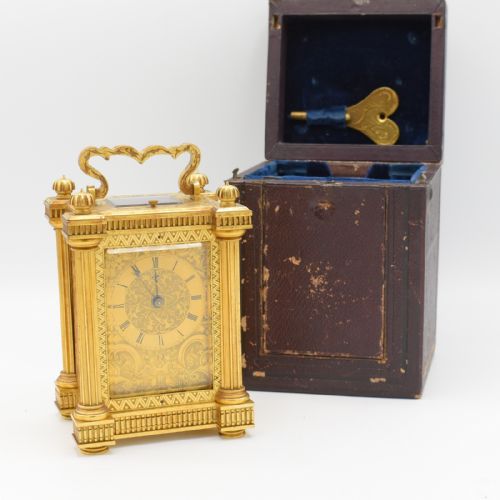
External casing decoration dictates the visual tier, ranging from plain polished brass to heavily engraved gorge or oval frames set with painted enamel panels. The integration of original gilding and signed backplates by known makers elevates the integrity of the piece.
Howell & James London·DROCOURT·DWERRIHOUSE & BELL·Moser·Henry Jacot
The Victorian Repeating Clock Glossary
- Repeating mechanism
- A train of gears and hammers operated manually by a plunger to sound the last elapsed hour and quarters. This complication allowed owners to check the time in darkness without lighting a candle.
- Gorge case
- A heavy brass carriage clock case characterised by stepped, moulded top and bottom cornices. This architectural profile is typical of better French horology.
- Grand sonnerie
- A striking system that chimes both the hours and the passing quarters automatically on bells or gongs. It represents a high level of mechanical ingenuity.
- Platform escapement
- A self-contained module holding the balance wheel and hairspring mounted visibly on top of the movement. It replaced the pendulum for portable timekeeping.
- Enamel dial
- A copper disc coated with powdered glass fused by heat to create a smooth, permanent white face. Roman numerals are typically painted onto this surface.
Victorian Repeating Clock: Frequently Asked Questions
How do I operate the repeater?
Press the plunger or button located on top of the case firmly downwards until it stops, which releases the internal mechanism to strike the hours and quarters on the internal bell or gong.
Allow the sequence to finish completely before moving or winding the clock to prevent jamming the striking train.
How often should it be wound?
Most examples require winding every eight days using the appropriate key inserted into the backplate arbours.
Take care not to overwind the mainsprings, stopping as soon as firm resistance is felt.
Where were these clocks made?
The majority of movements and cases were manufactured in French workshops, particularly in Paris, during the nineteenth century.
Many were subsequently imported and retailed by prominent British jewellers and horologists who often inscribed their own names on the dials or backplates.