



Victorian Recording Barograph
A Victorian recording barograph measures atmospheric pressure continuously on paper charts, combining scientific utility with handsome cabinet work.
Victorian Recording Barograph
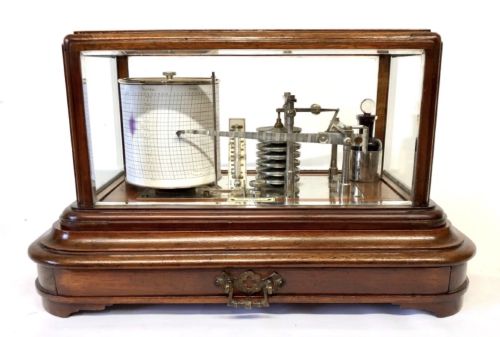
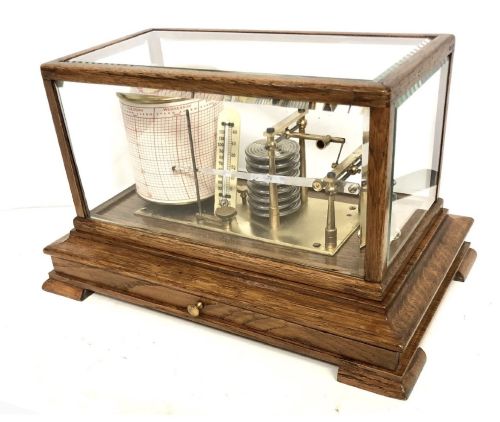
A Victorian recording barograph sits beneath bevelled glass panels within a wooden case, tracking the pressure of the air mechanically onto a rotating drum. These scientific instruments appear across several periods including the Victorian era, Edwardian years, and the early twentieth century.
Most examples house brass mechanisms paired with a thermometer and a lower chart drawer, presented in housings of mahogany, oak, or walnut. Makers such as Negretti and Zambra, Short and Mason, and Gaupp and Co populate the listings, alongside wall-mounted variations and miniature formats.
Makers fashioned these weather instruments in styles ranging from Late Victorian to Edwardian scientific, reflecting the domestic and professional interiors of the nineteenth and twentieth centuries. The typical survival pairs a sturdy timber foundation with delicate recording arms and paper charts.
Materials and construction
Craftsmen built the housings using solid timbers such as mahogany, oak, and walnut, frequently incorporating bevelled glass to display the inner workings. These woods were joined to form glazed cases, often fitted with drawers below to store spare recording charts.
The mechanical movement combines brass and steel components, relying on vacuum chambers that expand or contract with atmospheric changes to move an inked arm across a paper cylinder. Thermometers mounted on the wooden beds supplement the pressure records with temperature data.
Victorian Recording Barograph Retail Price Guide 2026
Typical asking prices for victorian recording barograph among the pieces listed under this phrase on Sellingantiques today, from the lower quarter to the upper quarter. They describe what is for sale here now, not the wider market.
Listings feature woods including mahogany, oak, and walnut, paired with brass and glass across Victorian, Edwardian, and early twentieth-century periods.
Assessing quality and craftsmanship
Quality reveals itself in the precision of the brass mechanism and the depth of the timber cabinet work, where heavier bevelled glass and well-figured mahogany or walnut elevate the piece. Signed instruments by established makers command attention for their engraved dials and crisp lettering.
GAUPP & CO HONGKONG & SINGAPORE·NEGRETTI & ZAMBRA LONDON·SHORT & MASON, LONDON·BAINES HARROGATE·Robson of Newcastle·Antoine Redier·RICHARD FRERES
The Victorian Recording Barograph Glossary
- Barograph
- An instrument that records atmospheric pressure continuously over time onto a paper chart. It uses an aneroid mechanism connected to an inked arm.
- Chart drawer
- A small compartment built into the base of the wooden case to hold spare recording papers. This keeps consumables stored neatly beneath the movement.
- Bevelled glass
- Glass panes with cut and polished edges fitted into the frame of the case. This detail catches the light and frames the brass movement clearly.
- Aneroid
- Operating without liquid, using flexible metal chambers that respond to changes in air pressure. This principle drives the recording arms inside the instrument.
- Thermometer
- A temperature-measuring scale mounted alongside the main barometer mechanism. It provides supplementary weather data within the wooden enclosure.
Victorian Recording Barograph: Frequently Asked Questions
How does a barograph work?
A series of sealed metal boxes expand and contract as air pressure rises and falls. This movement transfers through levers to an arm holding an ink nib.
The nib traces a continuous line onto a paper chart wrapped around a clockwork drum, giving a visual history of weather changes over the week.
Where were these instruments placed?
Owners kept them in libraries, hallways, or studies where guests could observe the scientific mechanism at work beneath the glass. Most sat on tabletops, though wall-mounted versions also exist.
The handsome wood cases ensured they blended easily with domestic furniture of the period.
Do these instruments still record weather?
Many examples remain in working order and continue to track atmospheric pressure accurately when fitted with fresh paper charts and ink. Proper calibration allows the mechanical linkage to respond to daily barometric shifts.
Collectors often maintain them as functional scientific objects rather than purely decorative items.
How do I change the chart paper?
The brass cylinder lifts out or the clockwork drum opens to allow a fresh weekly paper chart to be wrapped around it. Owners store their spare papers in the dedicated drawer beneath the movement.
After securing the new sheet, the inked arm is gently repositioned to match the current air pressure.