

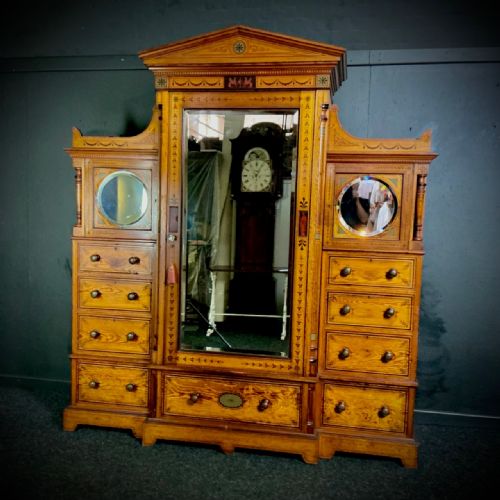
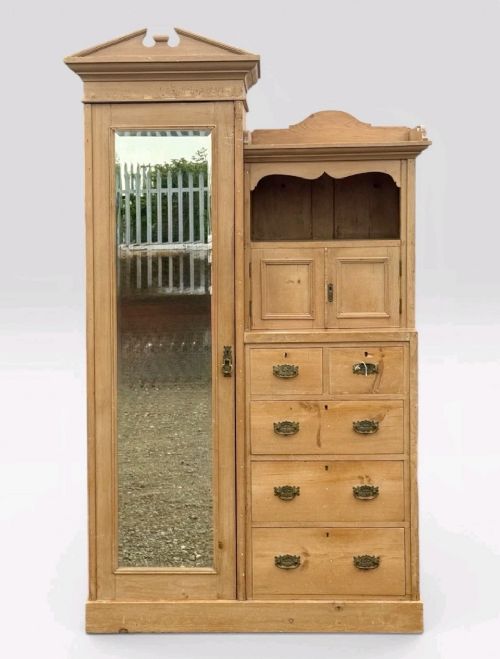


Victorian Pine Chest Mirror
A victorian pine chest mirror brings warmth and simple utility to a room, offering the practical storage of a low chest topped by an adjustable glass.
Victorian Pine Chest Mirror
When you search for a victorian pine chest mirror, you are looking at nineteenth-century bedroom furniture that combines a drawer base with a pivoting glass plate. These pieces span the Victorian and Edwardian eras, emerging in forms like dressing chests, dressing tables, and compact chifferobes.
The most common version you will meet on this page pairs a rectangular softwood chest of drawers with an upright swing mirror held by side arms. They range from plain country items to decorated or stencilled examples and the distinctive Victorian faux bamboo style.
Makers built these pieces primarily as functional dressing furniture for domestic bedrooms, using accessible timbers like pine and pitch pine. Their origins stretch from rustic farmhouse workshops to more finished Victorian urban cabinet-making.
Construction and materials
Makers relied heavily on pine, softwood, and pitch pine to build the sturdy carcasses of these dressing chests and tables. These woods provided a reliable, workable base that could be left plain, painted, or finished with decorative scumble glaze.
Glass forms the central mirror plate, held within wooden frames and supported by pivoting brass fixtures that allow the glass to tilt. Metal hardware like brass fittings appears alongside ceramic elements on the drawers and mirror supports.
Victorian Pine Chest Mirror Retail Price Guide 2026
Typical asking prices for victorian pine chest mirror among the pieces listed under this phrase on Sellingantiques today, from the lower quarter to the upper quarter. They describe what is for sale here now, not the wider market.
Materials recorded across the inventory include glass, pine, brass, pitch pine, paint, marble, softwood, and ceramic.
Markers of quality
Quality in these mirrors and chests rests on the integrity of the timber and the retention of original surface treatments such as paint or scumble glaze. Pieces that retain their original glass and matching brass hardware stand apart from those altered over time.
The sophistication of the construction, from simple rustic farmhouse builds to refined Victorian stencilling and faux bamboo turning, dictates the distinction between everyday utility items and more decorative examples.
The Victorian Pine Chest Mirror Glossary
- Pine
- A softwood commonly used throughout the nineteenth century for domestic furniture carcasses and drawer linings. It offers a pale grain that takes paint and glaze well.
- Pitch pine
- A denser, more resinous pine variety appreciated for its durability and stronger grain pattern. It appears frequently in nineteenth-century bedroom furniture.
- Scumble glaze
- A decorative surface technique where a translucent coloured layer is manipulated over a pale base to imitate finer woods. This finish was popular on Victorian utility furniture.
- Faux bamboo
- A decorative style where pine is turned and carved to resemble natural bamboo stalks. It reflects the Victorian fascination with exotic design.
- Dressing chest
- A low chest of drawers fitted with an upright mirror for grooming. It served as a space-saving alternative to a full dressing table.
Victorian Pine Chest Mirror: Frequently Asked Questions
What is a victorian pine chest mirror?
It is a nineteenth-century bedroom piece combining a pine chest of drawers with an attached swivelling mirror. These items served as practical dressing units in period homes.
They appear in various forms, including dressing tables and stencilled chests, using softwoods and pitch pine.
How do I date a pine dressing chest?
Dating relies on construction methods, timber choice, and stylistic clues such as faux bamboo turnings or stencilled decoration. Pieces span the Victorian and Edwardian eras.
Evidence from nineteenth-century and early twentieth-century examples shows shifts from plain rustic builds to more decorative glazed surfaces.
Were these mirrors originally attached to the chests?
Yes, the mirrors typically fixed to the top of the chest using wooden upright arms and brass pivot screws. This allowed the user to adjust the angle of the glass.
Many surviving pieces retain these original support structures, though some mirrors separated from their bases over time.
How do I care for antique pine furniture?
Keep pine and pitch pine pieces away from direct heat sources and drastic humidity changes to protect the softwood and any painted finishes. Gentle dusting and occasional wax maintenance preserve the surface.
Avoid harsh chemical cleaners, particularly on pieces with scumble glaze or stencilled decoration.