


Victorian Patent Desk
These Victorian patent desk pieces are clever mechanical answers to nineteenth-century needs, built to adjust, unfold, and work harder for their owner.
Victorian Patent Desk
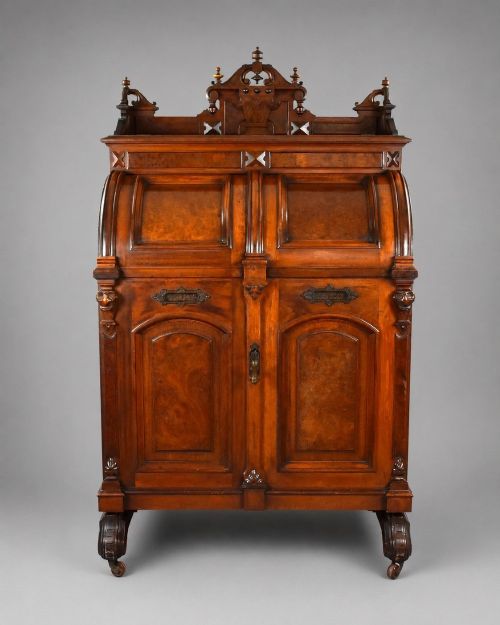
A Victorian patent desk represents the pinnacle of nineteenth-century ingenuity, combining heavy timber construction with clever mechanical action. When searching for a Victorian patent desk, buyers encounter sophisticated walnut and mahogany writing furniture designed to transform and adapt to the user.
The evidence shows these pieces span from the mid-nineteenth century into the Edwardian era, taking the form of elaborate cabinets, metamorphic writing tables, and adjustable reading surfaces. Walnut, burr walnut, and rich mahogany form the primary carcasses of these writing desks, frequently fitted with ingenious folding compartments and secret drawers.
While the search term points specifically to desks, the broader family of patent pieces includes related library and desk accessories like brass-mounted book slides, stamp boxes, and reading tables. The versions most commonly met on this page are substantial walnut writing cabinets and adjustable tables bearing the marks of period inventors.
How they were made
Cabinet makers utilised dense native and imported timbers, particularly figured walnut, burr walnut, and solid mahogany, to build the heavy structural carcasses. These woods were selected for their stability and grain pattern, providing a durable foundation for complex internal mechanisms.
Makers integrated brass and steel hardware to operate the sliding leaves, rising actions, and folding compartments. Metal fittings such as hinges, brackets, and stamped maker plaques were screwed directly into the timber to control the intricate moving parts without compromising the exterior finish.
The site's archive demonstrates that patent engineering extended beyond desks into marine barometers, stamp dispensers, and adjustable reading tables.
What varies in quality
The standard of a piece depends heavily on the ambition of the mechanism and the precision of its assembly. Finer examples feature smooth, effortless movement in their expanding surfaces and folding sections, whereas lesser pieces suffer from stiff actions and poorly aligned joints.
Timber selection and cabinetwork set the better examples apart from standard production. Superior items display well-figured burr walnut veneers, clean brass mounts, and crisply stamped maker details that indicate skilled workshop execution.
Antoine Redier of Paris·Betjemanns·Carter·Mc Gary·MacNeills·Watkins·Wells Fargo·Wooton
The Victorian Patent Desk Glossary
- Patent
- A government licence conferring a right or title for a set period, protecting a new mechanical invention. Makers stamped these names onto their mechanisms to signal originality and advanced design.
- Metamorphic
- Describing furniture designed to transform into another form, such as a desk converting into a table. These pieces rely on concealed hinges and folding leaves.
- Book slide
- An expanding stand used to hold books upright on a desktop, often fitted with folding ends and metal mounts. They adjust in length to accommodate varying numbers of volumes.
- Burr walnut
- Timber taken from the abnormal growth of a walnut tree, producing highly figured, swirling patterns. Cabinet makers prized this wood for decorative veneering on high-end surfaces.
- Mahogany
- A durable, reddish-brown tropical hardwood widely used for nineteenth-century furniture framing and solid desk construction. It resists warping and takes a fine polished finish.
Victorian Patent Desk: Frequently Asked Questions
What is a Victorian patent desk?
A Victorian patent desk is a nineteenth-century writing cabinet or table incorporating mechanical innovations protected by a period patent. These pieces use folding leaves, rising compartments, and expandable frames to offer multiple functions within a single footprint.
Makers built them from dense timbers like walnut and mahogany, fitting them with brass hardware to operate the moving parts. They represent a high point in utilitarian furniture design.
How do metamorphic desks work?
Metamorphic desks operate through hidden hinges, sliding tracks, and folding panels that allow the furniture to change shape or size. Owners can expand a writing surface or alter the configuration by releasing simple latches and pivoting sections.
This clever engineering allowed Victorian users to save space in crowded studies or libraries while maintaining a full-size working area when needed.
How do I identify a patent piece?
Identification relies on locating stamped maker names, patent numbers, or brass plaques attached directly to the mechanism or timber frame. These marks often include the inventor's name alongside the word patent.
The presence of complex brass levers, folding brackets, and sliding actions also points directly toward a patented design rather than standard workshop production.
What woods were used for these desks?
Cabinet makers relied primarily on walnut, burr walnut, and mahogany for the construction of these patent desks. These timbers provided the structural strength needed to support heavy moving parts while offering an attractive surface grain.
Secondary woods were used for internal drawers and framing, while brass and steel components formed the mechanical skeleton hidden within the timber.