





Victorian Officer Clock
A victorian officer clock is a portable brass timekeeper designed for travel, combining precision mechanics with robust housing.
Victorian Officer Clock
When searching for a victorian officer clock, a buyer encounters portable timepieces housed in sturdy cases designed for transit during the nineteenth century. These instruments frequently originate from French workshops and retail establishments of the period, reflecting continental manufacturing methods.
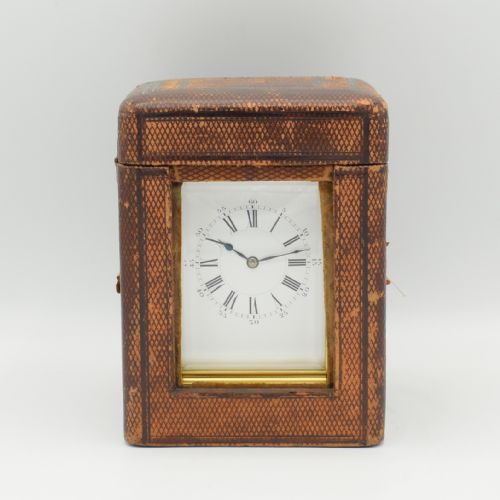
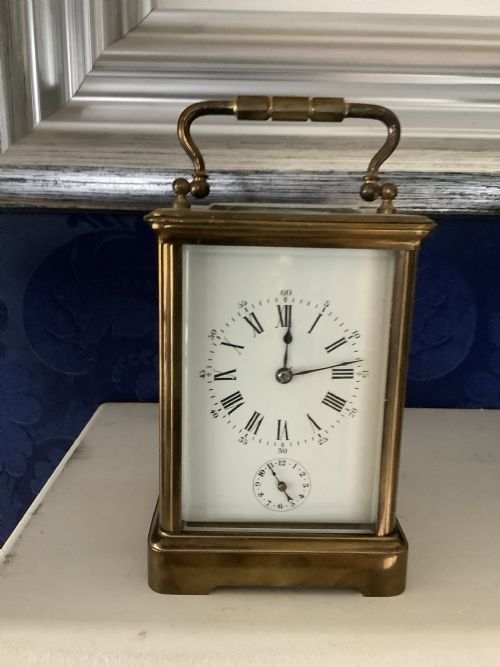
The objects commonly manifest as carriage clocks constructed with glass panels and metal frames, occasionally accompanied by travel cases in leather or wood veneer. Variations span simple timepieces to complex examples featuring striking mechanisms, alarms and calendar functions.
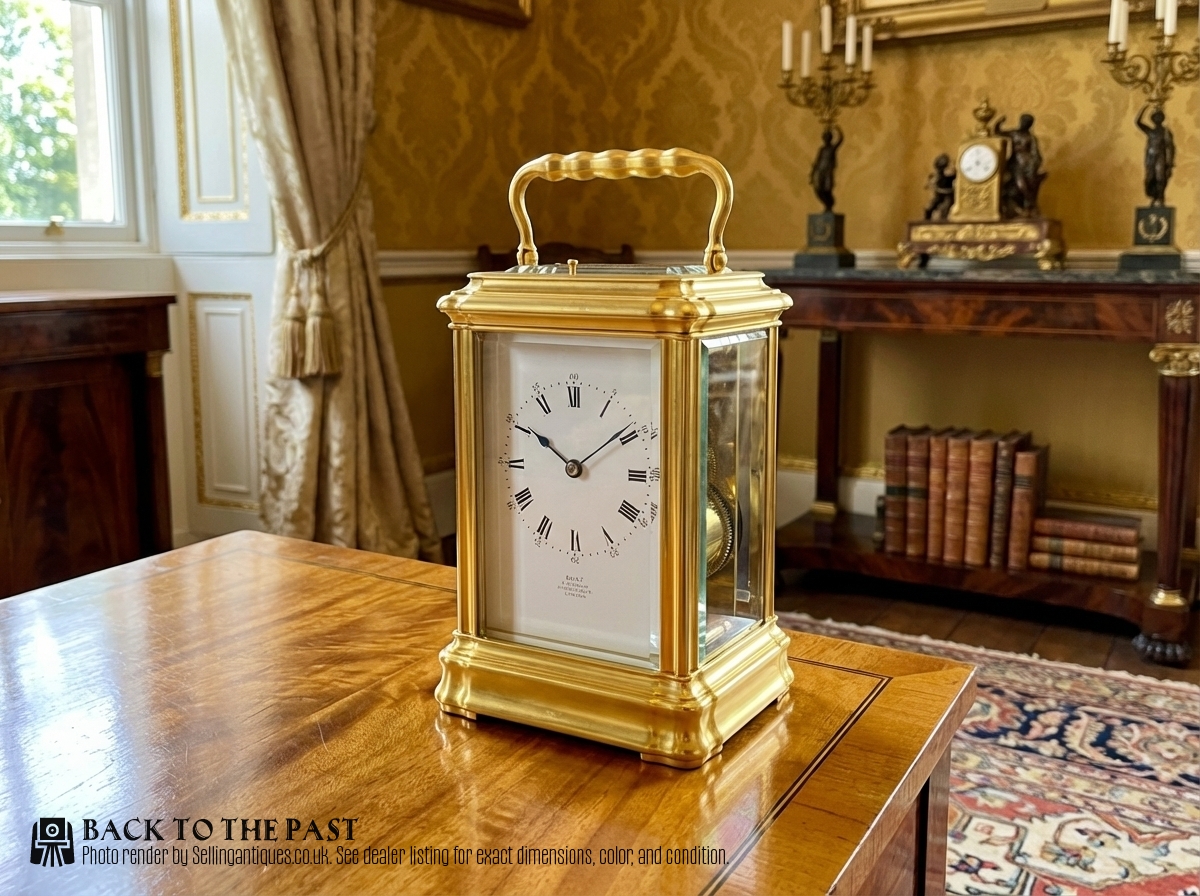
Examples on this page draw from the wider Victorian era and late nineteenth century, encompassing simpler brass designs alongside gilt brass and ormolu specimens. The selection captures both unpretentious travel timekeepers and elaborate grande sonnerie models.
Materials and construction
Construction relies primarily on brass and gilt brass frameworks fitted with glazed bevelled panels to protect the internal gear trains and escapements. Enamel dials provide clear legibility for numerals, while rosewood and leather feature in protective outer travel cases.
Makers utilised heavy cast metal chassis to withstand the rigours of transport, housing complex eight-day movements with sophisticated striking and repeating complications. Gilt or ormolu surface treatments were frequently applied to the brass components to enhance visual appeal.
Victorian Officer Clock Retail Price Guide 2026
Typical asking prices for victorian officer clock among the pieces listed under this phrase on Sellingantiques today, from the lower quarter to the upper quarter. They describe what is for sale here now, not the wider market.
Listings incorporate brass, gilt brass, ormolu, and rosewood alongside leather travel cases.
Quality and execution
Superior examples distinguish themselves through the complexity of their movements, such as grande sonnerie striking or integrated alarm and calendar complications. The reputation of the maker, from established Parisian workshops to renowned retailers, also influences the standing of a piece.
Finishing touches on the metalwork and the clarity of the enamel dial contribute to the overall refinement of the clock. The presence of a matching numbered outer travel case further elevates the completeness and integrity of the object.
Henri Jacot·C. Detouche·J. F. Bautte Et Cie·Leroy Paris·Tiffany·Drocourt·E.J.Dent·Paul Garnier·J.W.BENSON·Joseph Soldano
The Victorian Officer Clock Glossary
- Carriage clock
- A portable spring-driven timepiece designed for travel, enclosed in a brass case with glass panels. These instruments were developed in France during the nineteenth century.
- Grande sonnerie
- A complex striking mechanism that chimes the hours and quarters automatically on the passage of time. Such movements represent a higher tier of horological execution.
- Ormolu
- Finely ground high-carat gold applied to a bronze or brass object using a mercury-gilding technique. This surface treatment imparts a rich metallic lustre to the clock frame.
- Platform escapement
- The tiny self-contained assembly holding the balance wheel and escapement visible through the upper glass panel. It replaced the pendulum to allow portable timekeeping.
- Repeating movement
- A mechanism that repeats the last struck hour or quarter when a button or lever is pressed. This function allowed time checks in the dark.
Victorian Officer Clock: Frequently Asked Questions
What is a victorian officer clock?
A victorian officer clock is a portable mechanical timekeeper housed in a brass and glass case, often equipped with a handle for transport.
These devices were engineered during the nineteenth century for travellers and military personnel who required reliable timekeeping on the move.
How do carriage clocks work?
Carriage clocks utilise a spring-driven movement regulated by a platform escapement rather than a swinging pendulum, allowing them to operate while being moved.
Energy is stored in a mainspring barrel and transmitted through a train of gears to drive the hands and any striking complications.
Were these clocks made in France?
Many fine carriage clocks of this period were manufactured in Paris by specialist workshops and later retailed across Britain and Europe.
French makers established rigorous standards for portable horology, producing both simple timepieces and intricate complications.
How should I wind my clock?
Wind the mainspring using the appropriate key inserted into the winding squares on the backplate, turning gently until resistance is felt.
Care should be taken not to overwind the mechanism, and hand adjustments should follow the proper directional guidelines for the specific movement.