


Victorian Oak Study Furniture
Victorian oak study furniture brings robust character and serious utility into a room, offering desks and writing tables built to last generations.
Victorian Oak Study Furniture
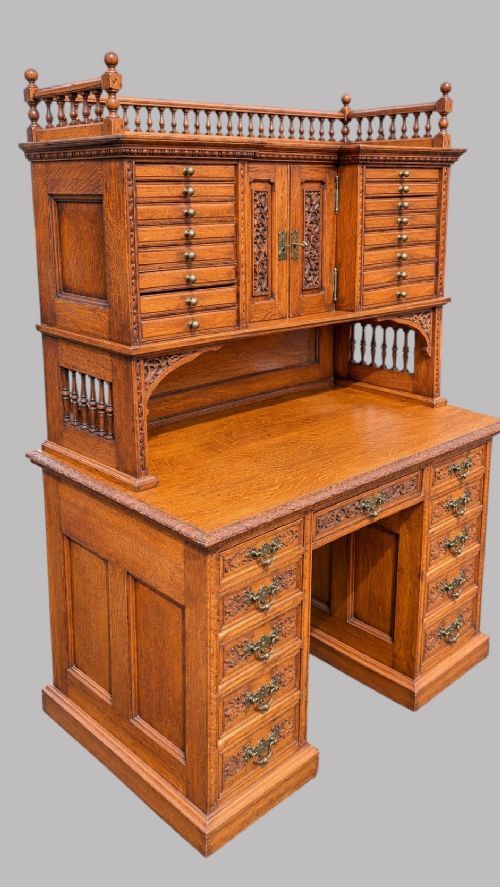
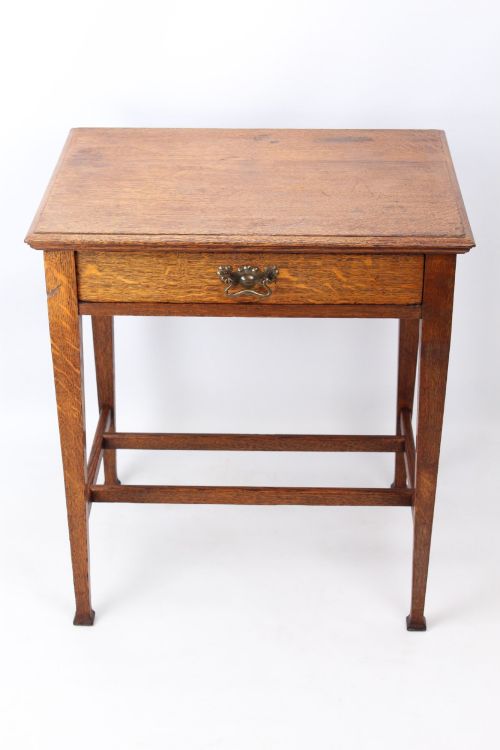
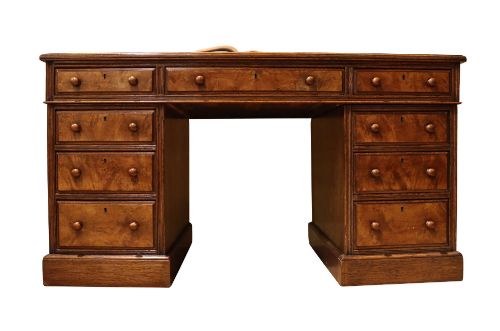
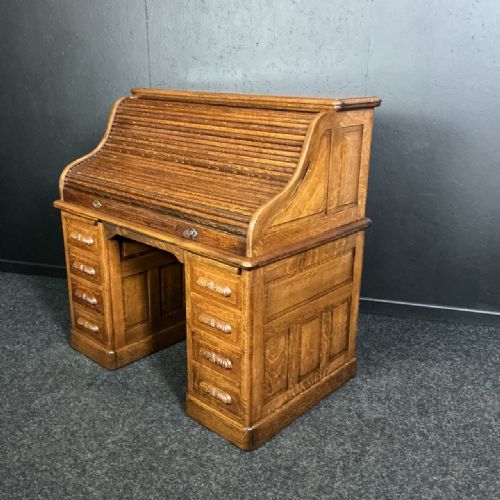
Victorian oak study furniture encompasses heavy writing desks, pedestal tables, kneehole desks, and Davenport models designed for domestic and estate administration. The pieces on this page span the Victorian and Edwardian periods, stretching from the mid nineteenth century into the opening years of the twentieth.
Pedestal desks and writing tables dominate the selection, often featuring banks of drawers alongside inset leather writing surfaces. Stylistic influences vary widely, taking in Gothic Revival, Aesthetic Movement, Arts and Crafts, and Tudor Revival interpretations.
Woods extend beyond standard oak to include pollard oak, ash, and occasional combinations with walnut and mahogany. Buyers encounter everything from compact ladies' morning room desks to substantial partner desks intended for central placement in a room.
Materials and Construction
Makers relied primarily on solid oak and pollard oak, frequently pairing the timber with brass hardware and tooled leather skivers. Secondary woods such as mahogany and burr maple appear in internal drawer linings and cabinet interiors.
Joinery methods reflect robust nineteenth-century workshop practices, employing heavy carvings, panelled sides, and solid drawer construction. Drawer configurations range from simple single banks to complex nine-drawer pedestal arrangements.
Estate managers needed sturdy drawers to withstand the daily weight of countless ledgers and ink pots.
Distinctions in Execution
Quality reveals itself in the selection of timber figures, such as highly figured pollard oak or burr walnut panels, contrasted against plain utility stock. The crispness of carved details in Gothic and Tudor styles separates standard workshop output from exceptional cabinet work.
The integration of maker attribution, specialised hardware like brass drop handles, and secondary woods such as burr maple linings elevate certain examples. Structural integrity in heavy pedestals and the preservation of original leather writing surfaces dictate the standing of individual pieces.
Blyth and Son London·Howard and Son's·Gillows of Lancaster·James Lamb Manchester
The Victorian Oak Study Furniture Glossary
- Pedestal desk
- A freestanding desk with two supporting pedestals of drawers beneath the work surface. These units typically feature multiple small drawers flanking a central kneehole.
- Partner desk
- A large double-sided desk designed for two people to work opposite one another. Such pieces incorporate drawers and cupboards accessible from both sides.
- Davenport desk
- A compact Victorian writing desk featuring a sloping top hinged over a set of side drawers. The interior often conceals small compartments and pigeonholes.
- Skiver
- A piece of split sheepskin or goat leather inset into the top of a desk to provide a writing surface. These are frequently gold-tooled along the perimeter.
- Kneehole desk
- A desk with a central recess for the user's legs, flanked by pedestals containing drawers or cabinets. This form became standard for domestic studies during the nineteenth century.
Victorian Oak Study Furniture: Frequently Asked Questions
What is a partner desk?
A partner desk is a large double-sided writing table designed with drawers and cupboards on both faces, allowing two people to work opposite each other. These substantial pieces sat in the centre of large libraries and estate offices.
They require ample floor space to be appreciated fully from all angles. Their dual-access design makes them exceptionally practical for shared studies.
How do I identify a Davenport desk?
A Davenport desk is a compact writing cabinet featuring a sloping lid that lifts to reveal stationery compartments. A bank of drawers opens along one side while dummy drawers balance the opposite flank.
Their smaller footprint made them popular as ladies' morning room desks during the Victorian era. Despite their compact size, they offer considerable concealed storage.
Where were these desks used?
Victorian study furniture was built for institutional offices, grand country houses, and domestic studies. Estate managers, solicitors, and private individuals used them for daily administration and correspondence.
Heavier Gothic and Tudor revival pieces suited formal libraries, while lighter Aesthetic or Arts and Crafts models furnished private sitting rooms.
How do I care for leather desk inserts?
Leather skivers require occasional gentle cleaning and conditioning to prevent the material from drying and cracking over time. Avoid harsh chemical cleaners and excessive moisture during maintenance.
Using blotters when writing helps protect the historic surface from ink stains and deep impressions. Natural wax formulations help maintain the supple texture of the leather.