
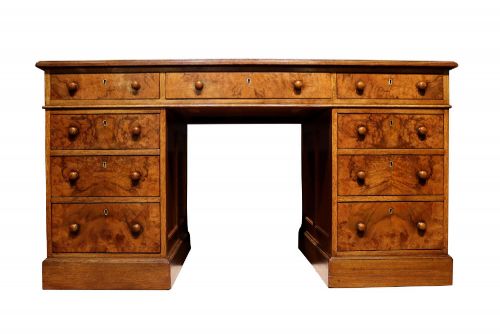
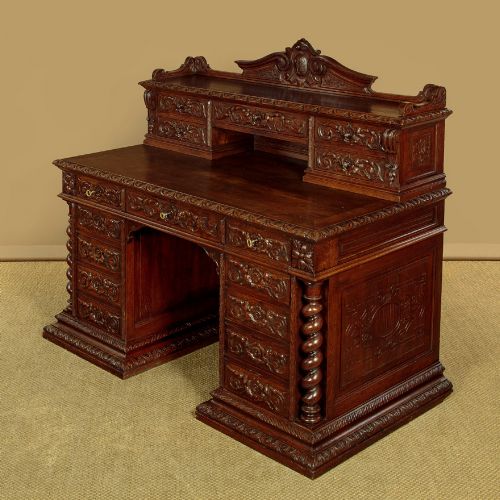


Victorian Oak Kneehole Desk
A victorian oak kneehole desk provides a sturdy, practical writing surface built with the pedestal arrangement that defined nineteenth-century studies.
Victorian Oak Kneehole Desk
A victorian oak kneehole desk is a substantial workspace constructed primarily during the nineteenth century, featuring a central recess flanked by banks of drawers or cupboards. The pieces listed here span the Victorian era, with particular concentration around the eighteen-eighties and eighteen-nineties, alongside related forms like estate desks and library pieces.
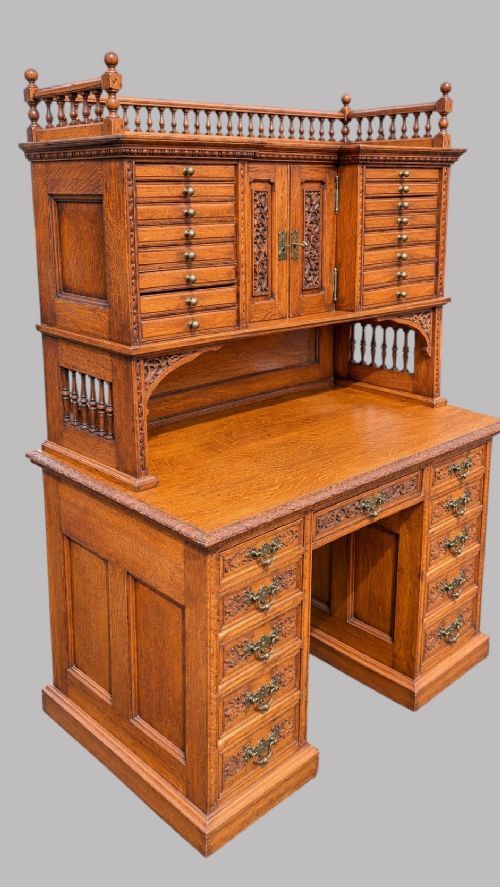
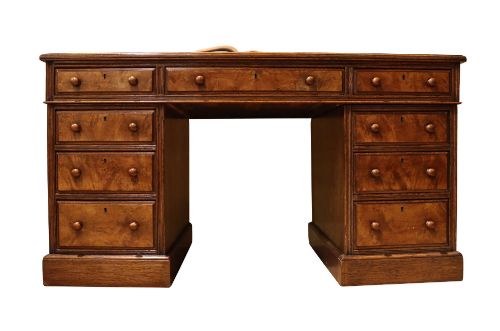
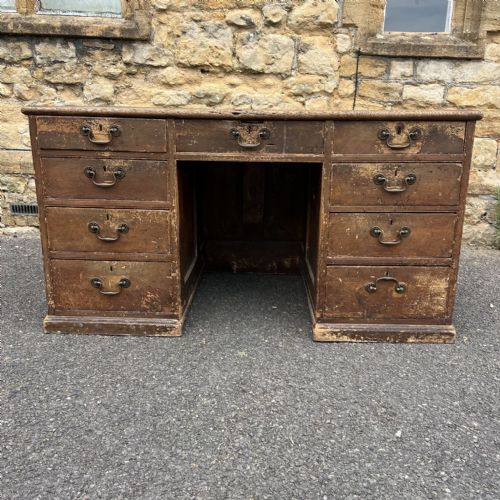
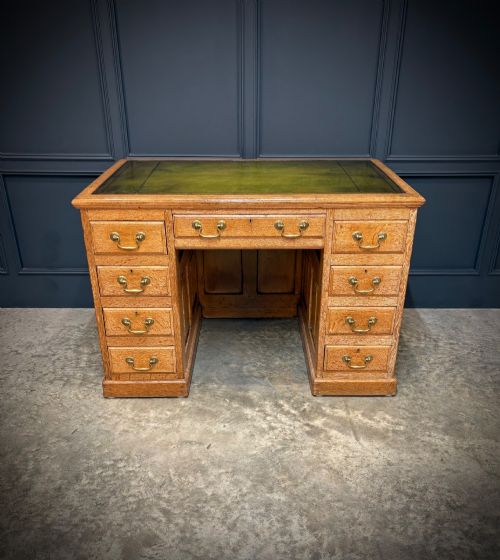
Most examples follow a twin pedestal configuration, housing multiple drawers beneath a writing surface that often incorporates leather or burr walnut panels. The form ranges from utilitarian estate manager desks to heavily carved library pieces and refined golden oak examples.
While primarily designed for writing and administration, the category extends to include country house pieces and occasional variations influenced by the Aesthetic Movement or Gothic styles. Buyers encountering these pieces will find both plain, robust working desks and ornamented versions featuring brass handles and carved details.
How They Were Made
Construction relies heavily on solid oak and pollard or golden oak veneers, often paired with secondary pine carcases for drawer linings and internal framing. Workshops utilised brass for drawer pulls, drop handles, and campaign-style hardware, while writing surfaces frequently received inserts of leather.
Joinery techniques combined traditional dovetailed drawer construction with robust framing to support heavy timber tops and loaded pedestals. Carved ornamentation, when present, was worked directly into the solid oak framework, displaying the grain patterns characteristic of tiger oak and burr walnut accents.
Listings feature pedestal desks, writing tables, and side cabinets in solid oak, burr walnut, and ebonised wood across the Victorian era.
What Varies In Quality
Quality in a victorian oak kneehole desk rests upon the selection of timber, the crispness of any carved detailing, and the integrity of the original construction. Pieces utilising figured golden oak, burr walnut highlights, or pollard oak sit higher in the range than standard utility versions.
Internal execution distinguishes finer workshop output from standard commercial production, visible in the neatness of dovetailing, the presence of maker stamps or paper labels, and the retention of original brass hardware and stencilled decoration. The balance of proportions and the weight of the solid timber dictate the overall presence of the piece.
Gillow & Co·Thomas Turner·Howard & Son
The Victorian Oak Kneehole Desk Glossary
- Kneehole desk
- A writing table featuring a central recess for the legs, positioned between two supporting pedestals of drawers or cupboards. This layout became standard for executive and library furniture during the nineteenth century.
- Pedestal desk
- A freestanding desk comprising two supporting columns of drawers beneath a single top board. They typically offer substantial storage capacity on both sides of the central user space.
- Partners desk
- A large scale pedestal desk designed with drawer units on both long sides, allowing two people to work opposite one another. These were traditionally utilised in professional offices and large libraries.
- Campaign desk
- Portable furniture built for travel, featuring recessed brass handles, flush fittings, and often separable sections. Surviving nineteenth-century examples reflect military or colonial usage.
- Pollard oak
- Timber taken from trees that have been pollarded, producing a gnarled grain pattern filled with knots and swirls. Cabinetmakers valued this wood for decorative drawer fronts and veneers.
Victorian Oak Kneehole Desk: Frequently Asked Questions
What is a kneehole desk?
A kneehole desk is a freestanding pedestal writing table with a central opening for the legs, flanked by banks of drawers.
This configuration provides generous storage while maintaining a compact footprint suitable for studies and libraries.
How do I identify a Victorian desk?
Victorian desks are identified by their nineteenth-century construction methods, typically employing solid oak, hand-cut dovetails, and traditional brass hardware.
Stylistic markers range from heavy carved Renaissance Revival details to clean aesthetic movement lines, often anchored by period specific proportions.
Where were these desks used?
These desks served primarily in country house libraries, estate offices, and gentleman's morning rooms throughout the nineteenth century.
They provided dedicated workspace and secure document storage for estate managers, professionals, and writers.
How do I care for an oak desk?
Caring for an antique oak desk involves keeping the timber away from direct heat sources and sudden humidity changes to prevent wood movement.
Regular dusting with a dry cloth and occasional application of appropriate wax will preserve the finish and the grain of the oak.