

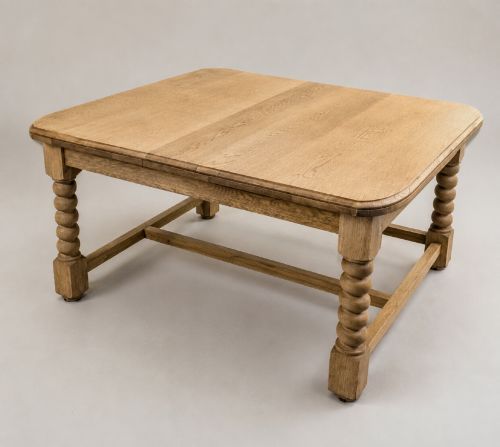
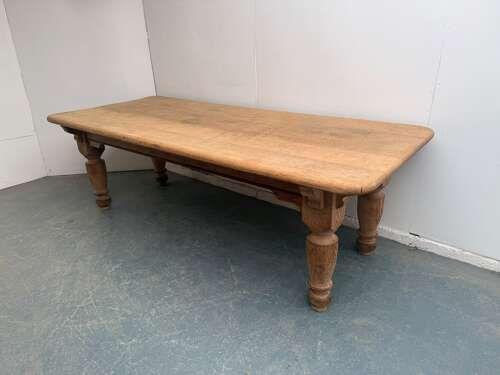


Victorian Oak Farmhouse Table
A victorian oak farmhouse table brings honest grain and sturdy timber into modern rooms, offering generous space for daily meals and gatherings.
Victorian Oak Farmhouse Table
A victorian oak farmhouse table is a heavy utilitarian surface built for domestic service, kitchen preparation and communal dining during the nineteenth century. These pieces emerge in styles ranging from plain rustic country forms to more deliberate gothic revival designs.
Buyers encounter refectory formats, extending mechanisms, prep benches and smaller kitchen tables originating across the nineteenth century, most frequently dated between eighteen fifty and eighteen ninety. Oak dominates the construction, often paired with secondary woods like pine, pitch pine or ash.
The surviving examples display the honest wear of daily use, showing distinct plank constructions, pegged joints and deep patination accumulated through generations of domestic labour.
Construction and materials
Carpenters constructed these tables using solid oak for the primary tops and structural frames, frequently utilising two or more thick planks joined edge to edge. Secondary timbers such as pine, pitch pine, elm or ash appear in drawer linings, underskirts and internal framing.
Joinery relied on traditional pegged mortise and tenon joints to withstand the heavy downward pressure of kitchen work and communal dining. Surfaces were left natural, waxed or scrubbed clean, while some examples incorporate iron hardware or functional side drawers.
Victorian Oak Farmhouse Table Retail Price Guide 2026
Typical asking prices for victorian oak farmhouse table among the pieces listed under this phrase on Sellingantiques today, from the lower quarter to the upper quarter. They describe what is for sale here now, not the wider market.
Listings feature nineteenth-century oak alongside pitch pine, ash, elm and iron components.
Judging quality and proportion
Quality rests in the thickness of the top planks, the structural integrity of the frame and the selection of timber, particularly where figured oak or substantial refectory stretchers are present. Tables retaining their original surface treatments and unblemished timber thickness sit at the upper end of the scale.
Proportion and scale dictate desirability, with longer ten-seater formats, extending mechanisms and tables featuring multiple drawers commanding greater attention than simpler utility boards.
The Victorian Oak Farmhouse Table Glossary
- Refectory table
- A long narrow dining table traditionally used for communal meals. This form provides substantial length and unhindered legroom.
- Pegged joint
- A method of securing mortise and tenon connections using wooden dowels rather than metal fasteners. It allows timber to move naturally with humidity changes.
- Plank top
- A table surface constructed from individual boards joined longitudinally. The number of planks affects the visual weight of the surface.
- Patina
- The surface sheen and colour developed by wood through age, handling and wax application. It represents the authentic physical history of the object.
- Gothic Revival
- An architectural and decorative style drawing on medieval forms. Tables in this style often incorporate pointed arches, heavy chamfers or tracery motifs.
Victorian Oak Farmhouse Table: Frequently Asked Questions
How do I seat ten people comfortably?
Longer refectory formats and extending tables provide the linear footage required for large seating arrangements. Measure the distance between table legs to ensure chairs slide underneath.
Check the height of the underskirt to confirm adequate knee clearance for guests seated along the sides.
Can I use a prep table for dining?
Bread prep tables function well for casual dining provided the height and knee clearance match standard chair dimensions. Many historical utility tables share similar proportions to dedicated dining furniture.
Inspect the depth of any integrated drawers to ensure they do not obstruct seated diners.
How do I care for antique oak?
Maintain the wood by applying natural beeswax periodically to nourish the dry grain and protect against moisture. Avoid placing timber surfaces near direct heat sources or strong sunlight.
Use coasters and placemats to prevent liquid rings and thermal shock on the antique finish.
How do I distinguish 1870 from 1890 pieces?
Earlier pieces from around eighteen seventy often display simpler country construction with pegged frames and thick single-board or two-plank tops. Later Victorian examples from eighteen ninety may incorporate factory-assisted extending mechanisms or mixed secondary timbers like pitch pine.
Stylistic cues such as heavy gothic mouldings or simpler turned legs help place the piece within the broader nineteenth-century timeline.