



Victorian Music Canterbury Cabinet
A victorian music canterbury cabinet organises scores and sheets with partitioned tiers below closed or open storage, bringing nineteenth-century utility to a modern interior.
Victorian Music Canterbury Cabinet
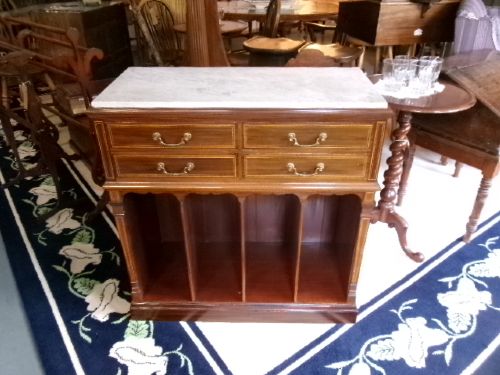
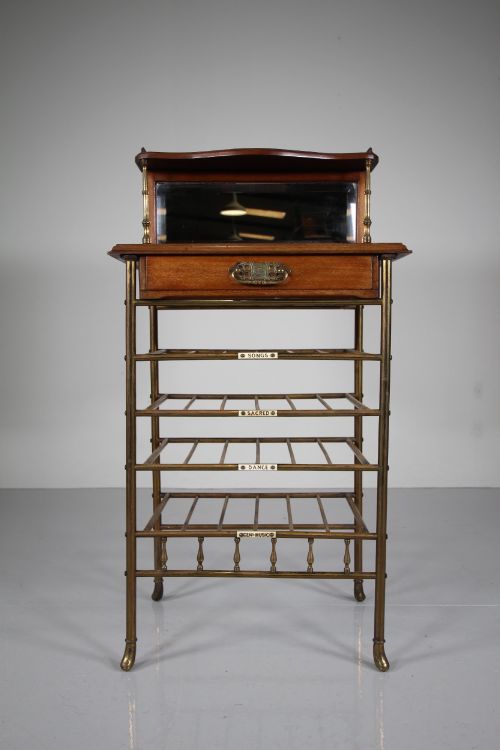
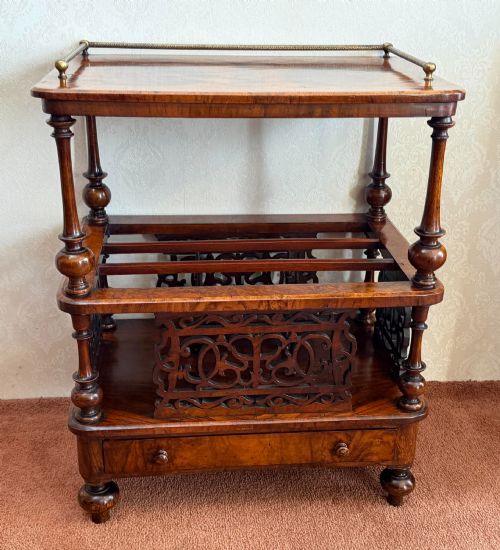
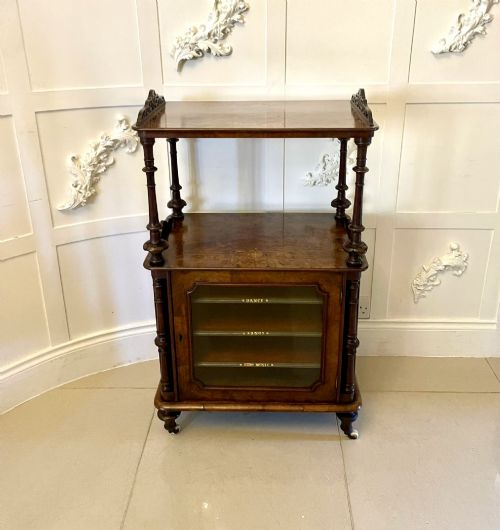
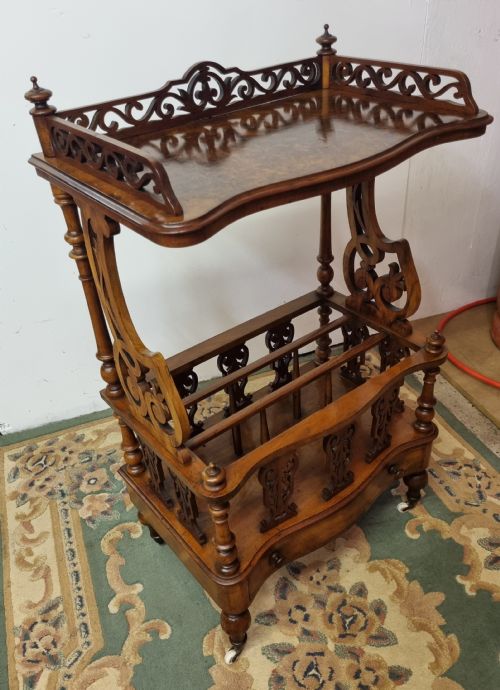
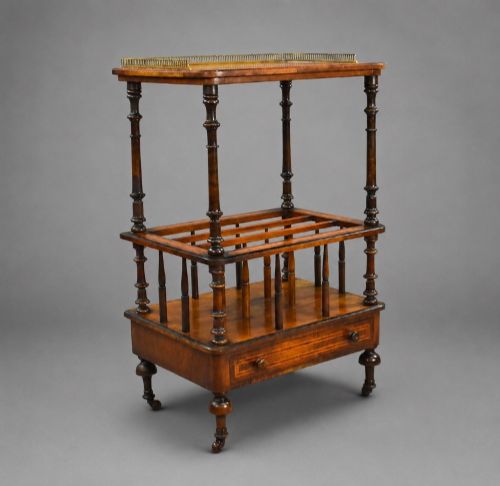
A victorian music canterbury cabinet combines the open slatted tiers designed for sheet music with enclosed cupboards, drawers, or drop fronts. Most examples seen here date from the nineteenth century, rendered in walnut, burr walnut, and rosewood, often incorporating lower drawers and brass castors.
Makers adapted the form across several decades, producing serpentine shapes, occasional table tops, and combined etagere or whatnot structures. Pieces range from straightforward mahogany racks to inlaid marquetry designs reflecting aesthetic movement and gothic revival tastes.
Materials and Construction
Cabinet makers utilised dense hardwoods such as mahogany, rosewood, and walnut, frequently applying burr walnut veneers to display intricate grain patterns. Marquetry inlay in lighter woods and brass fittings provide contrast and structural detail.
Open partitions were constructed with slender vertical spindles or shaped dividers, while enclosed music cabinets utilised hinged fall fronts, panelled doors, and dovetailed drawers supported by castors.
Victorian Music Canterbury Cabinet Retail Price Guide 2026
Typical asking prices for victorian music canterbury cabinet among the pieces listed under this phrase on Sellingantiques today, from the lower quarter to the upper quarter. They describe what is for sale here now, not the wider market.
Some nineteenth-century makers doubled down on multifunctionality by turning the top of a music rack into an oval lamp table.
Assessing Design and Execution
Quality rests upon the choice of timber and the precision of the marquetry inlay. Plain mahogany versions rely on proportion and timber figure, whereas burr walnut and rosewood pieces depend on symmetrical veneer matching across serpentine fronts.
The sophistication of the secondary functions separates standard items from exceptional examples. Integrated drawers, turned brass supports, and multifunctional tabletops demonstrate superior workshop output.
Henry Ogden and Son
The Victorian Music Canterbury Cabinet Glossary
- Canterbury
- A low stand with partitioned vertical sections designed originally for holding sheet music or portfolios.
- Whatnot
- An open set of multiple shelves for displaying small objects, frequently mounted above a canterbury base.
- Marquetry
- Decorative patterns formed by the insertion of contrasting veneers into a wood background.
- Serpentine
- A curved line of furniture styling featuring a convex centre flanked by concave curves.
- Fall Front
- A hinged panel that drops forward to reveal interior storage or a writing surface.
Victorian Music Canterbury Cabinet: Frequently Asked Questions
What is a music canterbury?
A music canterbury is a specialised nineteenth-century piece of furniture featuring vertical partitions to hold sheet music upright. Many examples include lower drawers for smaller accessories.
Over time, cabinet makers merged the open rack design with enclosed cupboards and flat table tops, creating multifunctional storage for the parlour.
How do I date a canterbury cabinet?
Dating relies upon timber choices, decorative styles, and construction methods. Mid nineteenth-century pieces often display figured burr walnut and serpentine shapes.
Later Victorian examples introduce varied influences such as aesthetic movement details or brass hardware, reflecting changing tastes towards the end of the century.
Where were they used in the home?
These cabinets sat principally in drawing rooms and music rooms where instruments and sheet music were kept. Their compact footprint allowed placement beside pianos or seating areas.
Whatnot variants also functioned as display stands for ornaments while keeping reading material close to hand.
Are music cabinets sturdy enough for daily use?
Solid hardwoods like mahogany, rosewood, and walnut provide robust frames designed for regular household handling. The vertical partitions remain strong enough to support paper scores and folios.
Care should be taken with castors and veneered surfaces when moving the cabinet across uneven floor surfaces.