

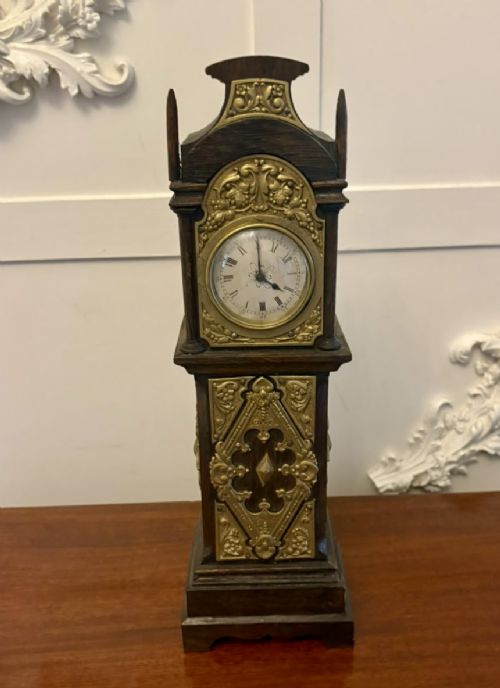


Victorian Miniature Brass Clock
A victorian miniature brass clock packs the presence of a full-size mantel piece into a fraction of the scale, combining heavy metalwork with precise portable timekeeping.
Victorian Miniature Brass Clock
A victorian miniature brass clock brings portable mechanical timekeeping into domestic interiors, frequently taking the form of a carriage clock designed for travel or bedside use. These pieces measure only a few inches in height, housing intricate gear trains within compact metal frames.
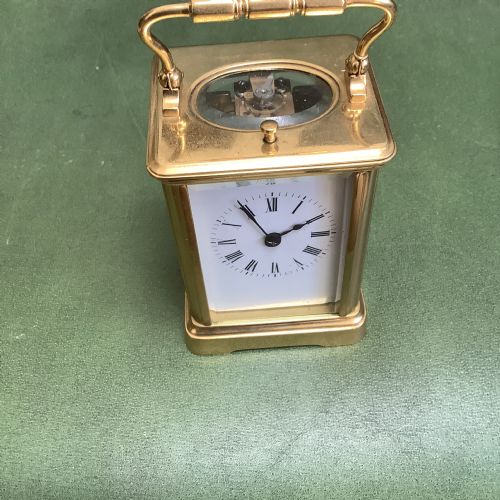
The version most commonly met on this page is the French carriage clock, often enclosed in bevelled glass panels that reveal the escapement inside. Alongside these, English bracket styles, skeleton clocks, and diminutive wall or mantel pieces appear across the inventory.
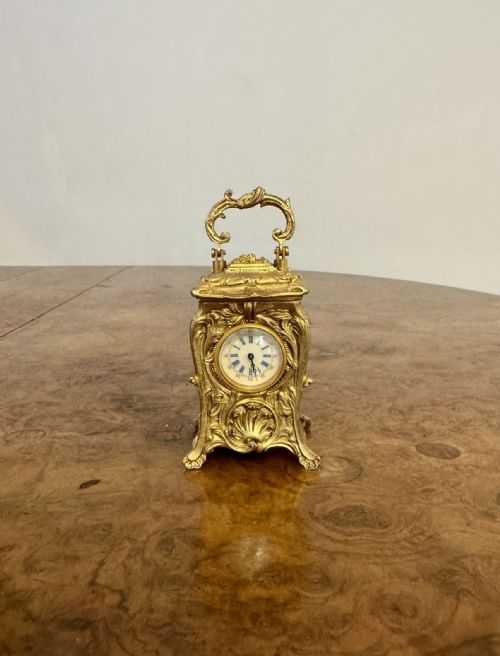
The period production spans the late nineteenth century into the Edwardian era, incorporating styles from plain brass housings to ornate rococo revival framing. Pieces often retain travelling leather cases or original winding keys, preserving their complete domestic context.
Materials and construction
The primary material combination relies on solid brass and gilt bronze cast into robust frames, frequently fitted with bevelled glass windows to enclose the dial and movement. Enamel dials, sometimes painted with roman numerals or decorated with limoges panels, provide a contrasting white or coloured face.
Movements utilise steel pinions and brass wheels, driven by mainsprings or fusee chains depending on the workshop origin. Cases receive hand engraving, chrysalis gilding, or polished brass finishes that require careful assembly by skilled horologists.
Victorian Miniature Brass Clock Retail Price Guide 2026
Typical asking prices for victorian miniature brass clock among the pieces listed under this phrase on Sellingantiques today, from the lower quarter to the upper quarter. They describe what is for sale here now, not the wider market.
Listings feature brass, gilt brass, and bronze housings paired with enamel dials, glass panels, and wooden or leather cases.
Judging quality and craftsmanship
Quality rests upon the crispness of the brass casting and the depth of hand engraving across the case panels. Superior examples display clean, sharp botanical or geometric incisions rather than shallow, machine-pressed patterning.
The complexity of the movement further distinguishes finer pieces, particularly those featuring alarm mechanisms, striking trains, or platform escapements with visible jewelled pivots. Original travelling cases and legible maker signatures elevate the standing of a clock.
Richard co maker·McCabe London·JJ Elliot
The Victorian Miniature Brass Clock Glossary
- Carriage clock
- A portable spring-driven timepiece originally designed for officers travelling in carriages during the nineteenth century. These clocks typically feature a rectangular brass housing with a handle on top and glass panels on all sides.
- Fusee
- A conical pulley used in mechanical clocks to maintain even power as the mainspring unwinds. This mechanism ensures more accurate timekeeping throughout the duration of the spring's tension.
- Skeleton clock
- A timepiece designed with an open metal framework that exposes the entire gear train and movement to view. They are usually mounted on a plinth under a glass dome.
- Platform escapement
- A self-contained escapement unit mounted on a small platform inside the clock movement. This innovation allowed portable clocks to keep accurate time in various positions without needing a pendulum.
- Ormolu
- Gilt bronze ornamentation applied to clock cases to provide a rich golden decorative finish. The technique involves fusing an amalgam of mercury and gold onto a bronze base.
Victorian Miniature Brass Clock: Frequently Asked Questions
Were these clocks meant for travel?
Many examples were built specifically for journeys, arriving with fitted leather outer travelling cases to protect the glass panels and brass frame. The folding handle on top facilitates carrying.
More delicate skeleton or fusee bracket varieties remained stationary on library shelves or mantelpieces rather than accompanying owners on the road.
How do I tell French and English pieces apart?
French production typically favours bevelled glass carriage clock forms with platform escapements and gilt brass housings. English variants more commonly use fusee movements, wooden or bronze cases, and bracket or library formats.
Signatures on the dial or backplate often confirm the London or continental workshop origin.
What is a platform escapement?
A platform escapement is a tiny, self-contained regulating assembly containing the balance wheel and hairspring. It replaced the pendulum, making portable clocks independent of a stationary surface.
This innovation allowed carriage clocks to maintain accurate time while resting on bedside tables or travelling in carriages.