
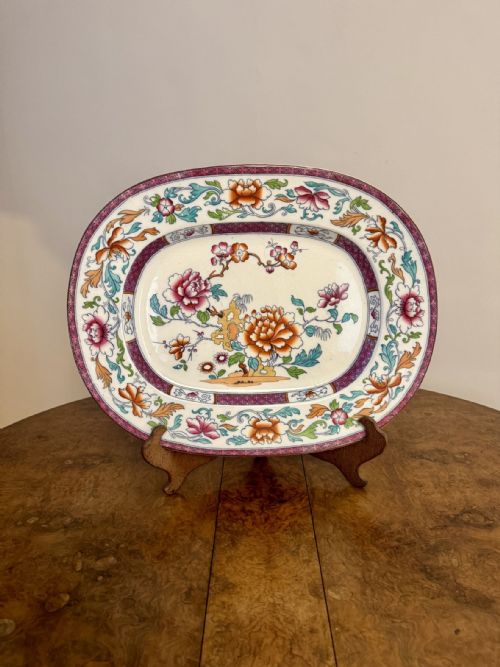


Victorian Meat Tray
A victorian meat tray is a sturdy serving vessel designed for substantial joints, combining practical utility with grand nineteenth-century dining style.
Victorian Meat Tray
A victorian meat tray appears across this page as a large serving platter, often featuring specialised elements like wells, trees, reservoirs, or draining trays designed to manage juices during carving.
The forms range from generous earthenware and ironstone platters decorated in blue and white or Chinoiserie patterns to heavy silver plated warming dishes.
These pieces originate from the nineteenth century, including specific dates across the 1800s, 1830s, 1840s, 1850s, 1880s, and 1890s.
How They Were Made
Pottery examples utilise earthenware, ceramic, pearlware, and ironstone, finished with glazes that often display transfer-printed blue and white designs or Imari palettes.
Metal variations employ silver plate applied to a base metal foundation, shaping substantial trays and warming dishes intended for heavy daily use.
Some platters include internal draining grilles so elaborate they resemble metal lace.
What Varies in Quality
The standard of a victorian meat tray rests on the crispness of the transfer printing, the depth of the modelled wells and drainage channels, and the weight of the ceramic body or silver plating.
Superior examples retain intricate patterns such as Chinese Tree or Byron Views with sharp detail, whereas simpler plates offer plain glazed surfaces.
Copeland and Garrett·Minton·Mason·Elkington·Elkin Knight and Bridgwood
The Victorian Meat Tray Glossary
- Well and tree
- A platter featuring a central well and channels carved into the surface to drain meat juices away from the carving area. This keeps the joint elevated and dry.
- Mazarine
- A pierced draining insert placed inside a serving dish or tray to hold meat above its own juices. It works alongside the main platter.
- Ironstone
- A durable type of heavy earthenware patented in the nineteenth century to imitate Chinese porcelain. It resists chipping and staining.
- Pearlware
- A refined earthenware developed with a bluish glaze that pools slightly in recesses. It bridges creamware and later white ironstone.
- Ashet
- A Scottish and northern English term for a large meat platter or serving dish. The word derives from the French assiette.
Victorian Meat Tray: Frequently Asked Questions
How do I use a meat tray today?
These large nineteenth-century platters suit modern dining as centrepieces for serving roast joints, whole poultry, or large quantities of food.
They also function as decorative wall plates or sideboard displays when not in active culinary use.
How do I distinguish ironstone from earthenware?
Ironstone is noticeably heavier, denser, and thicker than standard earthenware, designed to withstand the rigours of heavy Victorian service.
It rings slightly when tapped gently and shows less crazing in the glaze over time.
What is the difference between a platter and a warming dish?
A standard platter is a single flat or channelled ceramic plate meant for serving cooked meat directly to the table.
A warming dish incorporates silver plating and a compartment for hot water to keep the meat warm throughout a long meal.