
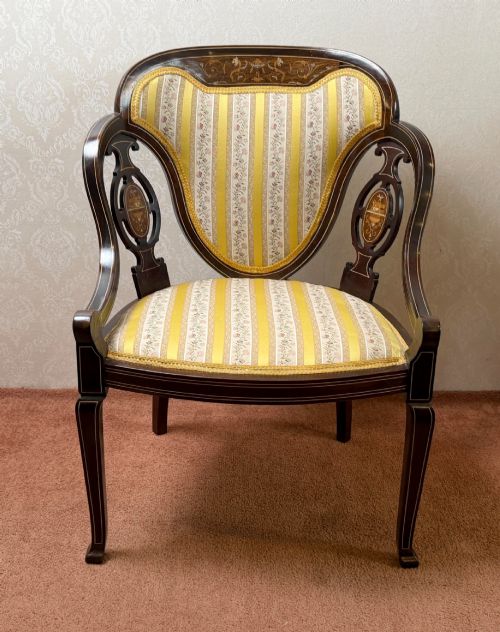
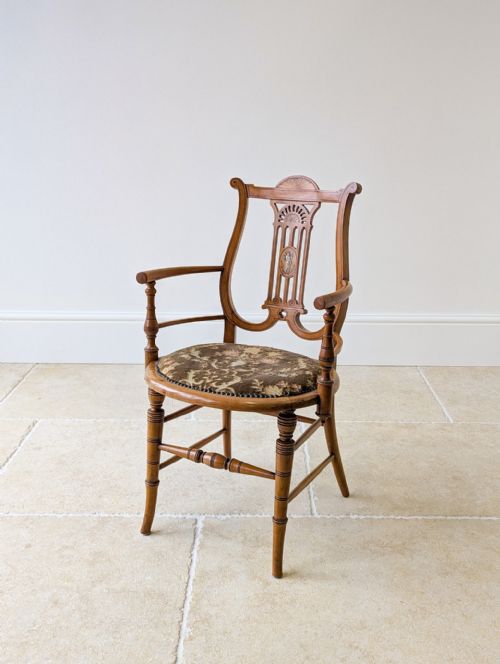


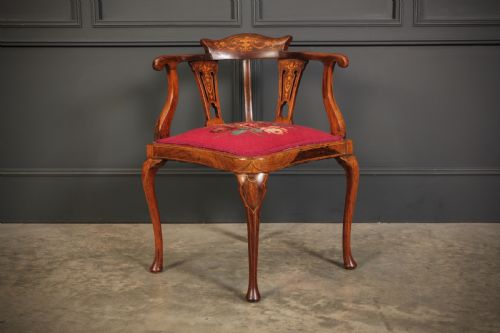


Victorian Marquetry Armchair
A victorian marquetry armchair brings together rich timber and precise wood inlay to anchor a room with period character.
Victorian Marquetry Armchair
A victorian marquetry armchair combines functional seating with intricate surface decoration, appearing across styles from Sheraton Revival to Aesthetic Movement and Moorish Revival. These pieces take forms such as standard armchairs, desk chairs, rocking chairs, and salon suites.
The materials span mahogany, satinwood, walnut, and rosewood, often enhanced by contrasting wood inlay. Most examples date from the nineteenth century, including specific decades like the 1880s and 1890s, alongside Edwardian interpretations.
How they were made
Constructed primarily from hardwoods like mahogany, walnut, satinwood, and rosewood, these chairs rely on solid timber frames combined with decorative wood inlay and marquetry techniques. Carving frequently defines the structural elements, such as high backs or tub shapes.
Upholstery forms a key component of the construction, utilising fabrics, velvet, and leather supported by brass details where appropriate. Swivelling mechanisms and complex joinery appear in specialised seating like ships chairs and desk chairs.
Some maritime-minded Victorians enjoyed swivelling in inlaid mahogany ships chairs while miles away from the nearest wave.
What varies in quality
The precision and complexity of the wood inlay define the upper tier of these armchairs, where crisp floral or geometric marquetry contrasts sharply with simpler, sparser decoration. Timber selection also dictates the standard, with richly grained satinwood, rosewood, and figured mahogany commanding attention over plain woods.
Structural integrity and the retention of original components, from fabric or leather upholstery to brass fittings and carved frames, separate standard production pieces from finer examples. The harmony between the underlying style - whether Sheraton Revival, Art Nouveau, or Aesthetic Movement - and the cabinetmaker's execution determines the overall success of the piece.
Jas / James Shoolbred·Jenks & Wood
The Victorian Marquetry Armchair Glossary
- Marquetry
- Decorative veneer applied to a furniture structure to form intricate pictures or patterns. It uses different coloured woods to create visual depth.
- Satinwood
- A durable, lustrous timber with a golden yellow sheen, frequently utilised for fine inlay and high-status nineteenth-century furniture.
- Aesthetic Movement
- A late nineteenth-century design style emphasising visual beauty and artistic expression over strict historical revivalism.
- Sheraton Revival
- A late nineteenth-century style drawing on the lighter, neoclassical furniture designs of eighteenth-century designer Thomas Sheraton.
- Tub chair
- An upholstered armchair with a rounded, curved back that wraps continuously around the sides to form the arms.
Victorian Marquetry Armchair: Frequently Asked Questions
What styles of victorian marquetry armchair exist?
These armchairs appear across several distinct aesthetic movements, including Sheraton Revival, Art Nouveau, Aesthetic Period, and Moorish Revival. Each style brings different proportions and decorative motifs to the foundational woodwork.
Cabinetmakers adapted the basic armchair form into various specialised seating types, such as desk chairs, library chairs, rocking chairs, and components of larger salon suites.
How do I identify the wood used?
Makers employed a variety of timbers, most commonly mahogany, walnut, satinwood, and rosewood. The natural grain and colour tone usually identify the primary wood used in the frame.
Contrasting lighter and darker woods form the marquetry and inlay patterns, adding visual complexity to the surfaces of the backrest and arms.
Were these chairs used at desks?
Certain forms, particularly those described as lyre-back desk chairs or swivelling ships chairs, served specific working functions within nineteenth-century interiors. They combine the decorative marquetry of the parlour with functional mobility.
Other variations, such as library chairs and standard armchairs, were intended for general relaxation and reading in domestic rooms.
How do Edwardian pieces differ from nineteenth-century ones?
Pieces dating towards the turn of the twentieth century and into the Edwardian period often reflect lighter proportions and refined revival styles. They continue the tradition of wood inlay established during the Victorian era but apply it with slight shifts in silhouette.
Both periods share a reliance on quality timbers like satinwood and mahogany, detailed with contrasting marquetry.