





Victorian Mahogany Coin Cabinet
A victorian mahogany coin cabinet is a compact, multi-drawer housing designed for secure numismatic storage, prized for its dense timber and precise craftsmanship.
Victorian Mahogany Coin Cabinet
When searching for a victorian mahogany coin cabinet, buyers encounter small-scale chests designed to house numismatic collections, medals, and small specimens safely. These pieces originate across the nineteenth century, including specific decades from the mid-Victorian era through to nineteen hundred.
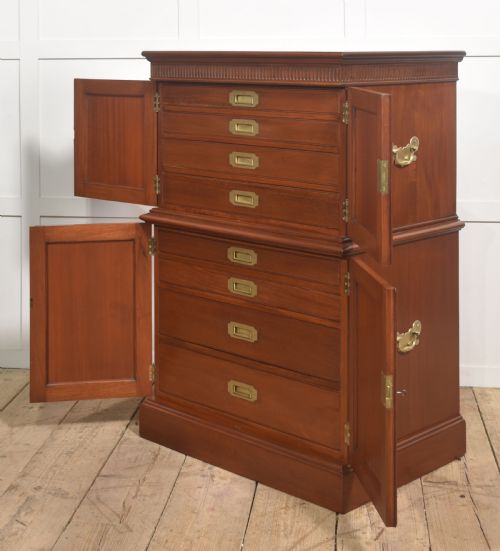
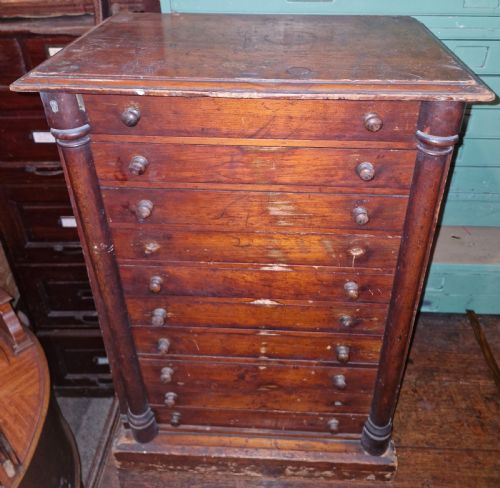
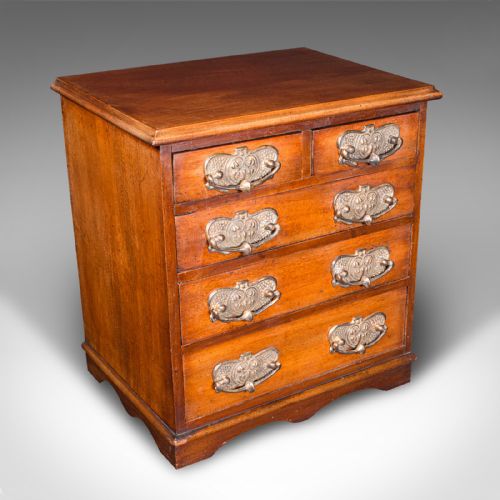
The form typically appears as a desktop miniature chest of drawers or a larger standing cabinet, often with internal banks of shallow drawers tailored for individual items. Surviving examples encompass simple utilitarian chests as well as substantial multi-drawer structures intended for serious collections.
Makers and cabinetmakers of the period utilised dense hardwoods to construct these specialised pieces, frequently pairing solid timber carcasses with fine drawer linings and brass hardware. While some examples remain purely functional, others incorporate glazed doors or campaign-style handles for portability.
Judgments of Quality
Quality rests in the precision of the drawer construction and the density of the timber selected for the carcass. Finer specimens display carefully matched grain across multiple drawers and intact internal linings designed to cushion delicate objects.
The presence of original hardware, working locks, and secondary decorative elements like satinwood stringing or glass-fronted doors elevates an example. Simpler provincial pieces differ from substantial workshop productions through the scale of the drawer count and the complexity of the internal configuration.
Several cabinets offer forty individual drawers, providing a dedicated slot for an astonishingly vast assortment of tiny treasures.
The Victorian Mahogany Coin Cabinet Glossary
- Specimen Cabinet
- A multi-drawer chest built to house geological, botanical, or numismatic collections in shallow, partitioned trays. These units prioritize internal organisation and protection over display.
- Campaign Style
- A design approach featuring recessed brass handles and reinforced corners intended for travel and military use. Such pieces offer robust construction and portability.
- Standish
- A maker or form associated with multi-drawer storage units produced during the nineteenth century. These cabinets often feature numerous shallow drawers for organised categorization.
- Figured Mahogany
- Timber exhibiting distinctive grain patterns such as flame or curl, utilised on primary display surfaces. This wood was selected for its decorative visual impact.
- Boxwood Inlay
- Fine lines or geometric patterns of pale wood contrasting against darker carcass surfaces. This decorative technique highlights the edges and panels of the cabinet.
Victorian Mahogany Coin Cabinet: Frequently Asked Questions
What were these cabinets originally used for?
These cabinets stored valuable collections of coins, medals, and small historical specimens in secure, organised environments.
The shallow drawers kept items separated to prevent friction damage while allowing collectors to review their pieces easily.
How do I secure the drawers?
Most traditional cabinets utilise a locking side stile or a hinged locking door that secures all drawers simultaneously when closed.
A key turned in the primary lock engages a bar that holds every internal tray firmly in place.
Can these cabinets hold modern items?
The shallow drawer depths make them suitable for jewellery, watches, small trinkets, and flat collectibles.
Collectors frequently repurpose the partitioned spaces for contemporary storage while retaining the historic exterior.
How do I date a Victorian piece?
Dating relies on construction methods, drawer linings, hardware styles, and any accompanying provenance or maker signatures.
Mid-century examples often display simpler lines, whereas later Victorian iterations sometimes incorporate glass doors or expanded drawer counts.