


Victorian Liquid Measure
These Victorian liquid measure pieces are hardworking tavern and kitchen items in copper, pewter and bronze that bring authentic period barware into a modern home.
Victorian Liquid Measure
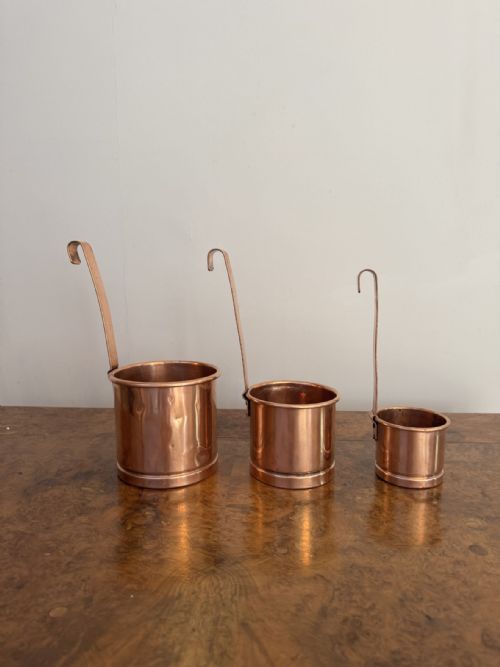
A victorian liquid measure is a functional tavern or kitchen vessel designed to hold precise volumes of spirits, beer or other liquids for trade and domestic use. Buyers seeking a victorian liquid measure encounter utilitarian objects shaped as tankards, bell-shaped jugs, haystack pitchers and graduated sets.
The pieces on this page span the nineteenth century and incorporate regional British and Irish forms marked for official use. Most examples belong to the broader Victorian period alongside nineteenth century items, featuring imperial capacities such as pints and quarts.
Makers and municipal authorities stamped these metal vessels with verification ciphers like VR to guarantee accurate measures in public houses and markets. Collectors and decorators select these items for their industrial character and robust metal construction.
How they were made
Metals such as copper, pewter, bronze and brass form the structural body of these measures, shaped through hammering, casting and soldering. Pewter and bronze components provide heavy walls and stability, while copper surfaces often feature contrasting brass fittings.
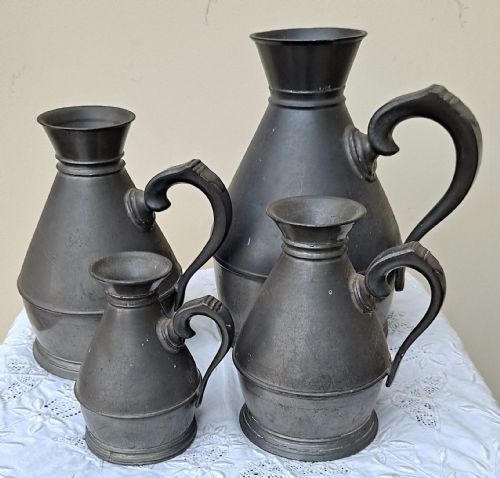
Makers formed distinctive shapes like the Irish haystack silhouette and bell-shaped tankards by joining sheet metal or casting molten metal into specialised moulds. Official inspectors then punched verification marks directly into the metal surface to certify the volume.
Some copper and brass Imperial measures bear specific municipal stamps for Blackpool, tracing a direct line to seaside holiday trade.
What varies in quality
Quality in these measures rests upon the crispness of the original form and the preservation of authentic surface marks and verification stamps. Complete graduated sets demonstrate a higher level of historical interest than isolated individual pieces.
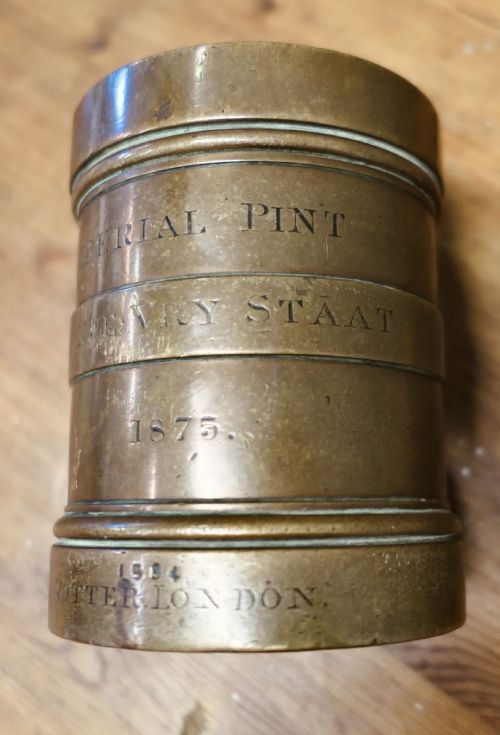
The clarity of maker details, such as foundry stamps like Potter of London, distinguishes standard utility items from more identifiable workshop productions. Heavier gauge metal and balanced proportions separate utilitarian vessels intended for rough tavern use from finer surviving examples.
Potter of London
The Victorian Liquid Measure Glossary
- Haystack measure
- A traditional Irish pewter jug shape featuring a bulbous body tapering towards the rim, resembling a stack of hay.
- Imperial measure
- A volumetric standard introduced in British legislation to unify liquid capacities across trade and commerce.
- Tavern measure
- A durable vessel utilised in public houses for serving ale or spirits directly to patrons.
- VR mark
- A royal cipher stamp denoting Victoria Regina, applied to verify that the vessel met legal calibration standards.
- Graduated set
- A nested series of vessels decreasing in size, designed to fit inside one another for storage and accurate scaling.
Victorian Liquid Measure: Frequently Asked Questions
What were victorian liquid measures used for?
These vessels served publicans and merchants as dependable tools for measuring and serving ales, spirits and other liquids in taverns and markets.
They ensured customers received accurate portions while functioning as durable everyday equipment in bustling Victorian commercial environments.
How do you clean copper measures?
Most collectors prefer to leave a natural aged patina on copper and brass surfaces rather than polishing them to a bright shine.
Gentle washing with warm soapy water removes dust without stripping away the historical surface character accumulated over generations.
What does a VR mark mean?
A VR stamp stands for Victoria Regina, indicating that the piece passed official government inspection and met legal capacity standards.
Inspectors applied these marks to guarantee honesty in trade within British public houses and markets.
How do haystack measures differ?
Haystack measures are defined by their distinctive Irish profile, featuring a wide curved base that tapers upward toward the mouth.
This regional pewter form provides a heavier and more decorative silhouette than standard cylindrical tavern tankards.