



Victorian Lidded Vases
Victorian lidded vases bring ornamental presence to a room, combining porcelain, ceramic, or glass bodies with matching covers.
Victorian Lidded Vases
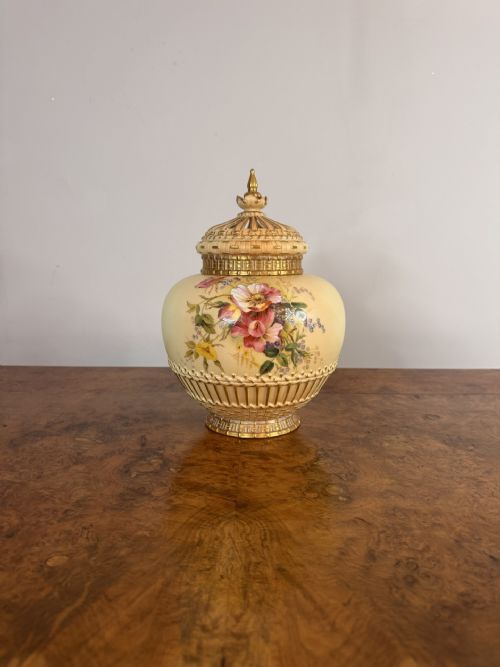
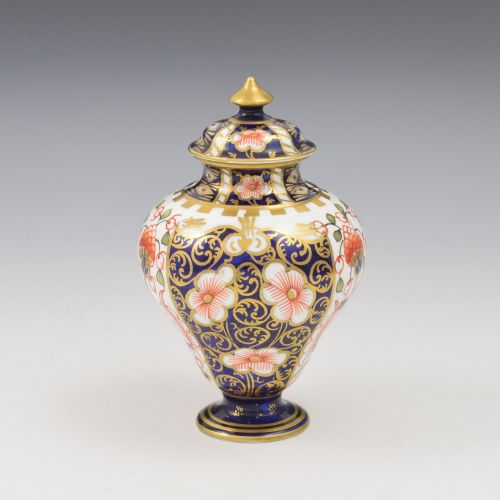
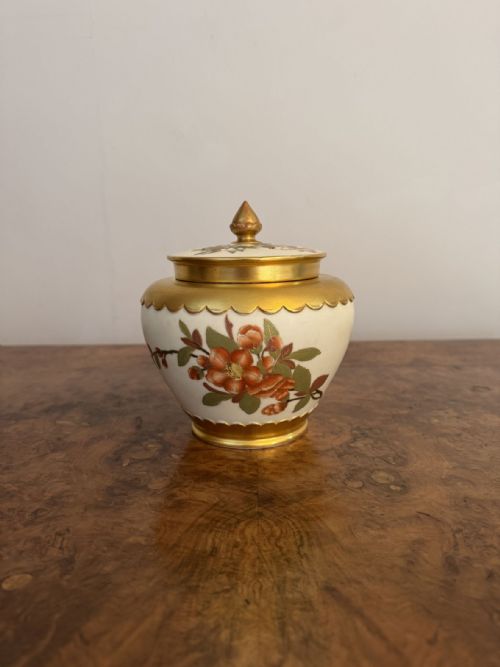
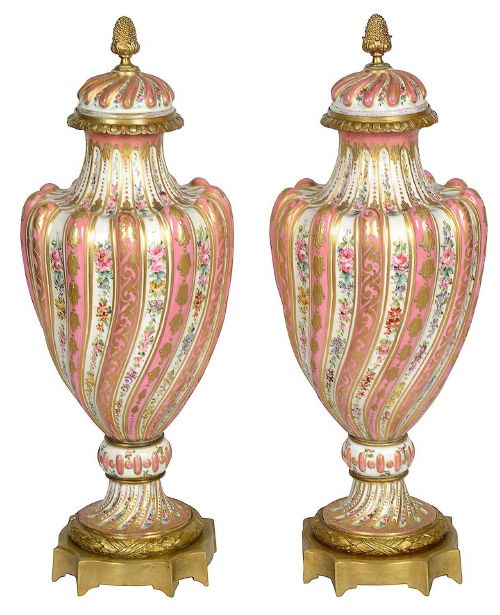
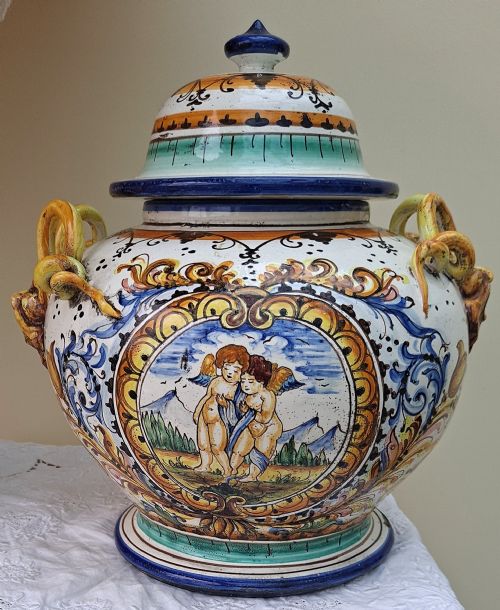
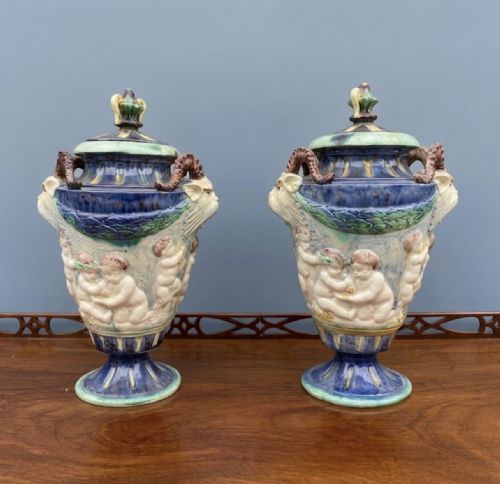
Victorian lidded vases encompass a broad selection of covered vessels designed for ornamental display rather than holding cut flowers, frequently taking the form of potpourri jars, classical urns, and ginger jars. The pieces appearing here span the nineteenth century and extend into the Edwardian period, originating from English potteries as well as continental factories.
English works by factories such as Royal Worcester and Royal Crown Derby sit alongside continental porcelain from Dresden, Sevres style pieces, and Italian maiolica. Collectors encounter pairs as well as single monumental examples, utilising forms shaped by styles ranging from Rococo Revival and Neoclassical to Art Nouveau.
Materials and Technique
Makers utilised porcelain, earthenware, ironstone, and glass, shaping bodies that received hand-painted decoration, enamel work, and gilding with gold leaf. Potpourri jars often feature pierced covers designed to release fragrance, while metal pieces involve cast bronze.
Firing techniques allowed for complex polychrome scenes, such as Watteau panels on Dresden porcelain and blush ivory finishes on Worcester bodies. Etched and cut glass variants demonstrate skilled cold-working applied to translucent blanks.
Victorian Lidded Vases Retail Price Guide 2026
Typical asking prices for victorian lidded vases among the pieces listed under this phrase on Sellingantiques today, from the lower quarter to the upper quarter. They describe what is for sale here now, not the wider market.
Among the wood-turner's art, a solitary treen vase and cover from 1850 stands out in a sea of porcelain.
Evaluating Quality
Quality rests upon the crispness of the modelling, the precision of the hand-painted detailing, and the preservation of original gilding and enamel colours. Factory marks and painter signatures indicate workshop standards, separating standard production output from superior exhibition pieces.
The balance of the form and the integrity of the matching cover dictate visual success. Pieces retaining undamaged pierced sections on potpourri lids or flawless painted panels command greater appreciation.
Royal Worcester·Royal Crown Derby·William Moorcroft MacIntyre·Helena Wolfsohn Dresden·Sitzendorf Porcelain·Mason’s Ironstone·Hadley’s Worcester·KPM
The Victorian Lidded Vases Glossary
- Maiolica
- Tin-glazed earthenware produced in Italy or decorated in the Italian manner. It provides an opaque white ground for painted historical or botanical scenes.
- Potpourri
- A mixture of dried petals and spices placed inside a vessel with a pierced cover. The holes allow scent to diffuse into a room.
- Gilding
- The application of gold leaf or gold powder to ceramic, glass, or metal surfaces. It highlights rims, handles, and raised relief details.
- Garniture
- A set of three or more matching vases or urns designed to be displayed together on a mantelpiece or sideboard.
- Ironstone
- A type of durable earthenware patented in the nineteenth century. It mimics porcelain while offering robust utility.
Victorian Lidded Vases: Frequently Asked Questions
What were lidded vases used for?
These vessels served primarily as decorative ornaments for mantelpieces, tables, and cabinets. Some specific forms functioned as potpourri containers, holding scented mixtures beneath pierced covers.
Larger urns and jars acted as standalone focal points in nineteenth-century interiors, demonstrating the owner's taste and the manufacturer's skill.
How do I identify Victorian pieces?
Examination of the base often reveals factory registration numbers, maker's marks, or impressed ciphers that date the ceramic body. Stylistic cues such as Rococo revival scrolls or blush ivory finishes point directly to the nineteenth-century manufacturing period.
Weight, paste composition, and the style of hand-painted decoration further assist in confirming the era of production.
Are these vases always found in pairs?
Surviving examples appear both as single statement pieces and as matched pairs or garnitures. Pairs were originally intended to create symmetry when displayed on either side of a clock or mirror.
Individual vases often survived independently due to damage or separation over the decades.
How should I clean porcelain lidded vases?
Dusting with a soft, dry brush removes surface particles safely without risking delicate gilt or enamel work. Water and harsh cleaning agents must be avoided, particularly on antique overglaze decoration.
Handling the cover requires care, lifting it straight up to prevent chipping the rim.