


Victorian King Charles Spaniel
These Victorian King Charles Spaniel pieces are charming ceramic, painted, and needlework tributes to the breed that bring nineteenth-century warmth to any mantelpiece.
Victorian King Charles Spaniel
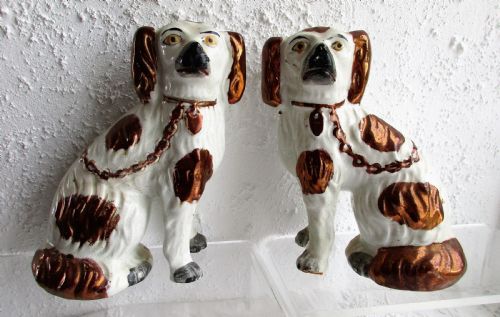
A search for Victorian King Charles Spaniel brings up a delightful array of nineteenth-century decorative figurines, paintings, and textiles. Buyers most frequently meet ceramic earthenware comforter spaniels seated in pairs, modelled to watch over the hearth.
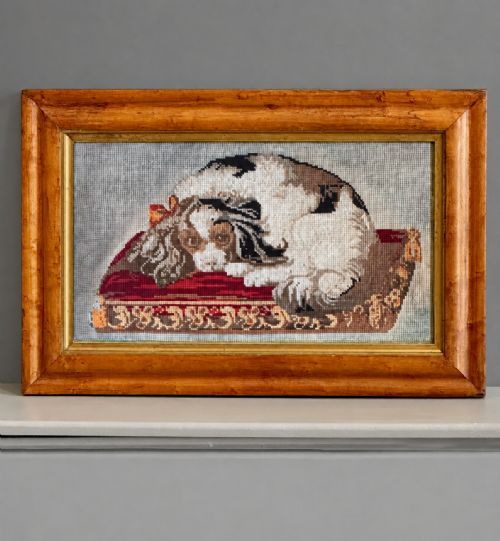
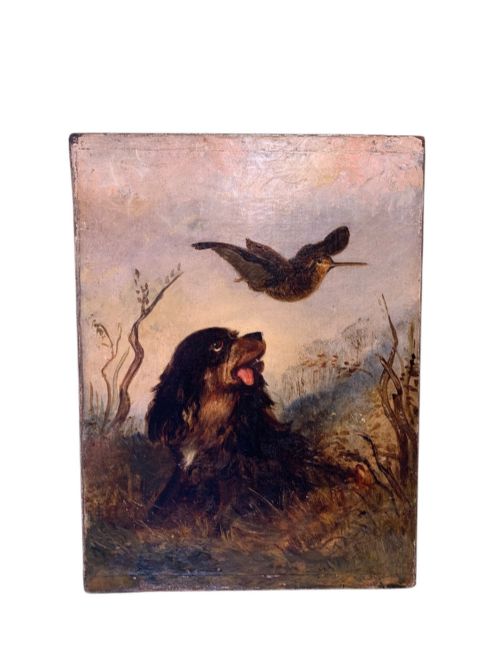
Beyond the standard pottery pairs, the evidence includes framed needlework Berlin work, oil paintings, watercolours, and even cast iron doorstops and bronze inkwells. These diverse objects reflect how deeply the breed captured the Victorian imagination across various mediums.
Most items on show hail from the nineteenth century, spanning from early earthenware through to later Victorian interpretations. Collectors encounter everything from Staffordshire pottery jugs to detailed canvas portraits and glazed ceramic figures.
Materials and methods
Potters shaped these earthenware and ceramic figures by hand or in moulds, finishing them with hand-painted glaze to pick out the distinct facial markings and lock chains.
Painters used oil and watercolour on canvas and paper to capture the lifelike portraits of the spaniels, often framing them in burr maple.
Metalworkers cast iron and bronze to create functional pieces like doorstops and inkwells, while needleworkers stitched wool on canvas for Berlin work displays.
A cast iron dog stands ready to hold your door open, proving even nineteenth-century guards appreciated a sturdy stance.
Judgements of quality
Quality rests primarily on the crispness of the modelling in ceramic figures and the fine detail of brushwork in paintings. Stronger examples display expressive painted eyes and clean, well-defined glaze work.
Pairs matched originally command greater interest than assembled ones, showing consistent sizing and identical potting traits. The preservation of original framing on needlework and canvas adds notable character.
The choice of medium alters the experience, shifting from simple earthenware mantel ornaments to intricate bronze inkwells or layered oil paintings in period frames.
Beswick·Frederick Tayler·Samuel John Carter
The Victorian King Charles Spaniel Glossary
- Comforter spaniel
- A ceramic figurine modelled after the King Charles spaniel, traditionally placed on either side of the fireplace in nineteenth-century homes. These dogs often appear facing left and right as matching pairs.
- Berlin work
- A style of needlework popular in the nineteenth century using wool on canvas following a coloured charted grid. The technique allowed makers to create detailed portraits and pictorial scenes.
- Staffordshire pottery
- Earthenware produced in the potteries of Staffordshire, England, famous for domestic figures and animal groups. These pieces formed the backbone of Victorian mantelpiece decoration.
- Burr maple
- A decorative wood veneer showing knotted growths, prized for its swirling grain patterns. It was frequently utilised for framing nineteenth-century needlework and mirrors.
- Toby jug
- A pottery jug shaped like the full figure of a seated person or animal. In this context, it takes the form of a spaniel.
Victorian King Charles Spaniel: Frequently Asked Questions
Are Staffordshire spaniels always found in pairs?
Many ceramic spaniels appear as matching pairs designed to sit at opposite ends of a mantelpiece, though single figures and collections of four also surface.
Buyers frequently encounter these traditional pairs guarding the hearth together, reflecting how potters originally marketed them for Victorian homes.
What mediums were used for these dogs?
Makers worked in glazed earthenware, ceramic, and stoneware, alongside canvas oil paintings and watercolours.
Other surviving examples take the form of wool needlework, cast iron doorstops, bronze inkwells, and even ceramic jugs.
How do I date a Staffordshire spaniel?
Dating relies on stylistic clues, potting methods, and glaze characteristics from the nineteenth century, particularly the transition of Victorian manufacturing styles.
Pieces often point to specific decades between eighteen hundred and nineteen hundred through their painting style and clay body.
Where were these spaniel figures placed?
Victorian households traditionally positioned ceramic spaniel pairs on the mantelpiece above the fireplace to watch over the room.
Other items like inkwells and doorstops served practical functions on desks and floors while maintaining the canine theme.