



Victorian Kidney Dressing Table
A victorian kidney dressing table brings elegant curved lines and fitted surfaces to a bedroom, offering both a practical workspace and a decorative centrepiece.
Victorian Kidney Dressing Table
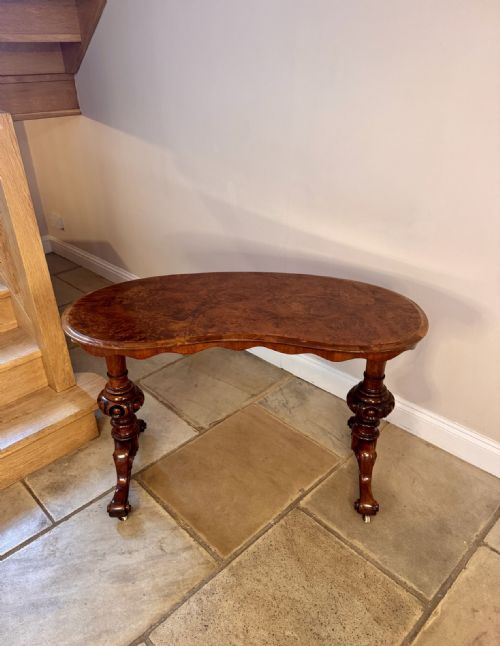
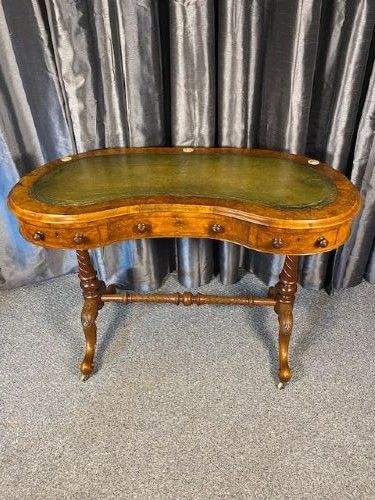
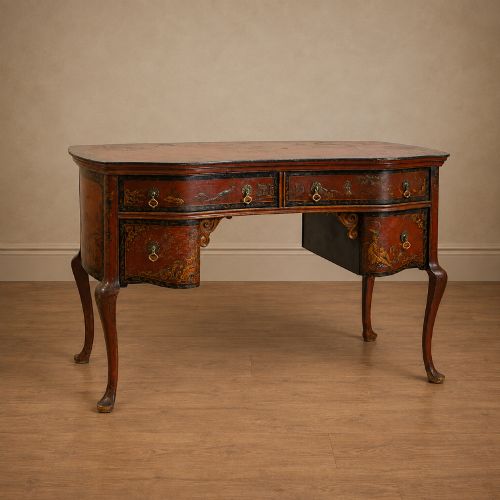
A victorian kidney dressing table is defined by its characteristic curved, bean-shaped outline designed to wrap comfortably around the user. The pieces catalogued here span the nineteenth century, including mid-Victorian and late Victorian examples alongside Sheraton Revival and Chinoiserie interpretations.
Forms vary between dedicated dressing tables with mirrors, side tables, and writing desks sharing the same distinctive serpentine footprint. Most examples encountered on this page rely on rich timbers such as mahogany, walnut, and satinwood, occasionally finished with lacquer or painted decoration.
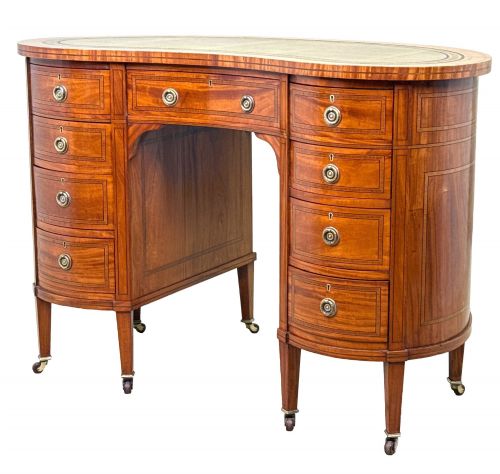
The layout typically incorporates a central kneehole flanked by pedestals of small drawers, offering a compact footprint that suits smaller rooms. Buyers seeking this form will find pieces ranging from utilitarian writing desks to highly decorative satinwood and lacquered specimens.
Materials and construction
Cabinet makers utilised dense hardwoods like mahogany and walnut as the structural foundation, often applying finer timbers such as satinwood for decorative veneers. The curved front edge required precise carpentry to shape solid timber rails and bend veneers smoothly around the kidney outline.
Surface decoration frequently involved intricate wood inlay, brass mounts, and occasionally painted lacquer in the Chinoiserie taste. Writing surfaces were regularly inset with panels of tooled leather to provide a durable writing area.
Joinery techniques combined traditional drawer construction with specialised framing to support the characteristic concave curve of the kneehole. Structural elements relied on solid oak and secondary woods for drawer linings and internal framing.
Victorian Kidney Dressing Table Retail Price Guide 2026
Typical asking prices for victorian kidney dressing table among the pieces listed under this phrase on Sellingantiques today, from the lower quarter to the upper quarter. They describe what is for sale here now, not the wider market.
Listings for this search phrase span from mid-century walnut and mahogany forms to late nineteenth-century satinwood and Chinoiserie lacquered dressing tables.
Judging quality in curved nineteenth-century furniture
Quality rests primarily on the crispness of the timber selection and the precision of the curved joinery. Superior examples display carefully matched grain patterns across the kidney top and seamless integration of inlaid banding.
The finesse of the secondary decoration, such as hand-painted Chinoiserie motifs or finely executed mahogany crossbanding, separates standard production from finer cabinet work. Drawer construction, particularly the tightness of the dovetails and the quality of the brass hardware, indicates the original maker's skill.
The Victorian Kidney Dressing Table Glossary
- Kidney shaped
- A curved furniture top resembling a kidney bean, designed to fit closely against the user. This shape became popular during the nineteenth century for writing desks and dressing tables.
- Satinwood
- A pale, lustrous timber native to India and Ceylon, prized for its golden sheen. It was frequently utilised during the Sheraton Revival period for high-status tables and desks.
- Inlay
- A decorative technique where pieces of contrasting wood, shell, or metal are inserted into recesses in the primary surface. Late Victorian pieces often feature delicate floral or geometric lines.
- Kneehole
- A central recessed space beneath a desk or dressing table designed to accommodate the user's legs. Flanking banks of small drawers usually frame this central opening.
- Chinoiserie
- A European decorative style reflecting Chinese artistic influences, featuring hand-painted motifs such as figures, pagodas, and landscapes on lacquered grounds.
Victorian Kidney Dressing Table: Frequently Asked Questions
What is a kidney dressing table?
A kidney dressing table is a nineteenth-century furniture form characterised by its curved, bean-shaped top and central kneehole space. These pieces were designed to provide a comfortable, wrap-around surface for grooming or writing.
They combine decorative appeal with compact proportions, making them a versatile addition to period interiors.
How do I date a victorian dressing table?
Dating relies on examining the timber species, secondary woods, construction methods, and stylistic cues such as inlay or revival motifs. Mid-century examples often feature solid mahogany and simpler lines, while late nineteenth-century pieces may display satinwood veneers or Chinoiserie lacquer.
Hardware styles and the condition of internal linings also offer clues to the exact decade of manufacture.
Where were these tables used?
These tables were primarily designed for ladies' bedrooms or boudoirs as personal dressing and writing stations. Their finished backs and refined proportions meant they could also sit away from the wall in a prominent position.
Today, they function equally well as compact desks or decorative console tables in living spaces.
How should I care for antique mahogany furniture?
Antique mahogany benefits from consistent indoor humidity and protection from direct sunlight to prevent timber splitting and fading. Regular dusting with a soft, dry cloth maintains the finish without building up heavy wax residues.
Leather inserts require specific conditioning to keep the surface supple and free from cracking.