


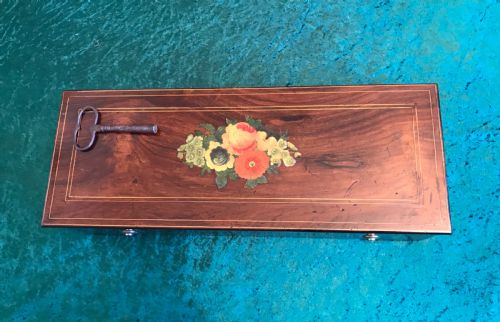

Victorian Inlaid Musical Box
These victorian inlaid musical box examples bring mechanical artistry and rich wood cabinet work together into a single room.
Victorian Inlaid Musical Box
A victorian inlaid musical box combines precision mechanical movements with decorative cabinetry from the nineteenth century. Most examples date from the Victorian era and the decades spanning eighteen sixty to eighteen ninety, originating primarily from Swiss workshops.
The standard form is a rectangular wooden case housing a pinned metal cylinder and a tuned steel comb. Alongside traditional table boxes, the selection includes related items such as a marquetry inlaid musical chair.
How they were made
Cased in dense hardwoods like rosewood, walnut, and ebonised wood, these boxes feature detailed marquetry inlay and boxwood stringing. The exterior decoration relies on contrasting natural wood veneers arranged in geometric or floral patterns.
Victorian Inlaid Musical Box Retail Price Guide 2026
Typical asking prices for victorian inlaid musical box among the pieces listed under this phrase on Sellingantiques today, from the lower quarter to the upper quarter. They describe what is for sale here now, not the wider market.
At least one nineteenth-century maker decided that sitting on the music was not enough, incorporating a complete musical movement directly into a wooden chair.
What varies in quality
The complexity of the musical repertoire sets individual pieces apart, measured by the number of airs a cylinder can play. Multi-air movements with six or twelve tunes demonstrate greater mechanical skill than simpler configurations.
Cabinet work also distinguishes the standard of an item. Finely executed marquetry and the inclusion of visual elements like visible bells elevate a piece beyond a plain wooden housing.
Langdorff And Fils·Nicole Freres·LeCoultre
The Victorian Inlaid Musical Box Glossary
- Cylinder
- The rotating brass barrel covered in tiny pins that pluck the teeth of the comb. It turns to translate mechanical rotation into a specific sequence of musical notes.
- Air
- A distinct tune or musical piece played during one rotation or cycle of the cylinder. Boxes are frequently categorized by the total number of airs they are pinned to play.
- Comb
- The tuned flat plate of steel containing individual teeth that vibrate when struck by the cylinder pins. Each tooth is hand-tuned to a precise pitch.
- Marquetry
- The art of applying small pieces of wood veneer to a structure to form decorative patterns. It provides the elaborate floral and geometric scenes seen on the lids of these boxes.
- Ebonised wood
- Timber treated with a dark finish to imitate expensive ebony. This dark ground creates a strong visual contrast against lighter marquetry inlays.
Victorian Inlaid Musical Box: Frequently Asked Questions
How do I wind a musical box?
Most nineteenth-century boxes utilise a winding lever or a key attached directly to the movement. Turn the mechanism steadily until you feel firm resistance, avoiding any sudden force that might strain the spring.
Allow the movement to play through its current cycle without interrupting the governor. Keep the dust lid closed while the music plays to protect the delicate internal components.
Where should I place a musical box?
Position the box on a stable, level surface away from direct sunlight and heat sources such as radiators. Wood veneers and internal glues react poorly to sudden temperature shifts and dry indoor air.
Keep the piece in a low-traffic area where accidental knocks are unlikely to disturb the case. A stable environment helps preserve both the exterior marquetry and the internal steel comb.
How many tunes can they play?
The musical capacity ranges from simple single-air configurations up to complex movements featuring six, eight, or twelve distinct tunes. Each air corresponds to a specific section of pins on the revolving brass cylinder.
Boxes with higher air counts shift the cylinder laterally to engage different rows of pins. This mechanical complexity allows a single cylinder to cycle through multiple separate melodies.
What are the bells for?
Certain sophisticated movements include miniature tuned bells struck by animated hammers while the main comb plays. This addition introduces a brighter, resonant accompaniment to the standard metallic melody.
In many designs, the bells are mounted visibly above the movement so the hammers can be watched in action. This feature represents a higher tier of Swiss mechanical craftsmanship during the Victorian period.