
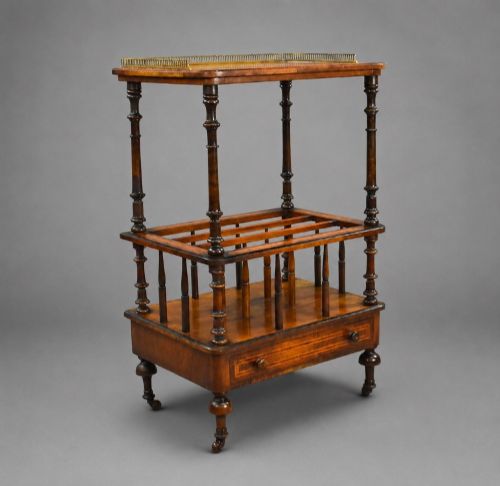


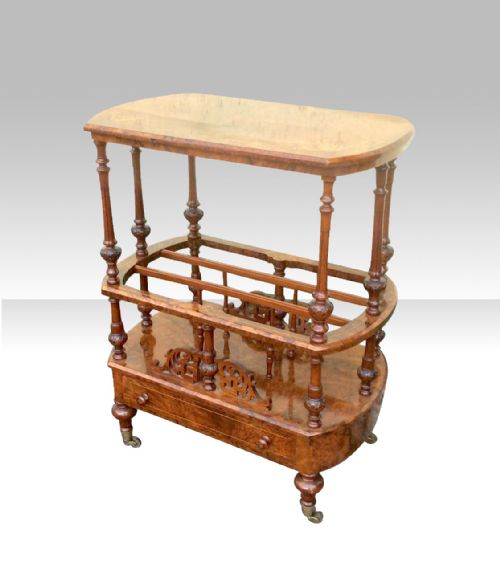

Victorian Inlaid Canterbury
A victorian inlaid canterbury is a distinct nineteenth-century piece designed to hold sheet music and periodicals.
Victorian Inlaid Canterbury
A victorian inlaid canterbury functions primarily as a compartmentalised rack for holding sheet music, magazines, and newspapers in the parlour. The pieces seen here span the nineteenth century, with burr walnut and rosewood forming the main body of the inventory.
The layout typically incorporates slatted partitions above a low drawer, though variations combine the form with a whatnot or a lamp table. Walnut and burr walnut dominate current and past listings, often finished with marquetry or wood inlay.
Materials and Construction
Cabinet makers utilised dense hardwoods such as burr walnut, rosewood, mahogany, and amboyna as the primary structural and decorative timbers. Marquetry and wood inlay employ contrasting boxwood and lighter elements to create geometric or floral patterns across the surfaces.
Detailing often includes turned supports, brass castors, glass elements, and intricate fretwork panels. The integration of drawers beneath the partitions requires precise joinery suited to daily handling in a domestic setting.
The archive records show frequent use of burr walnut alongside rosewood, mahogany, and amboyna across nineteenth-century examples.
Distinguishing Quality
The refinement of the timber figure and the precision of the marquetry dictate the upper tier of the range. Burr walnut with rich grain variation paired with crisp, detailed wood inlay separates superior examples from plainer utility pieces.
Structural complexity also defines the grade, particularly where a canterbury merges with a whatnot or incorporates a fitted drawer and turned uprights. The crispness of the fretwork and the execution of the inlay reflect the workshop standard.
The Victorian Inlaid Canterbury Glossary
- Canterbury
- A low stand fitted with vertical partitions for holding music sheets and folios. Invented in the late eighteenth century, the form remained popular throughout the Victorian period.
- Marquetry
- Decorative veneer applied to furniture in patterns using different woods, metals, or shells. Craftsmen arrange these contrasting materials to form pictorial or geometric designs.
- Burr Walnut
- A figured wood taken from the burl growth of a walnut tree. It produces intricate, swirling grain patterns highly prized for cabinet fronts and table tops.
- Whatnot
- An open set of tiered shelves used for displaying ornaments or books. Victorian makers frequently combined this form with the lower rack of a canterbury.
- Fretwork
- Ornamental work consisting of interlaced or perforated designs cut from wood. This technique appears on the vertical partitions and side panels of certain racks.
Victorian Inlaid Canterbury: Frequently Asked Questions
What was a canterbury used for?
These pieces served as dedicated storage for sheet music, folios, and periodicals near a piano or seating area. The slatted sections kept unbound papers upright and organised.
Later Victorian examples also functioned as small side tables or lamp stands while retaining their primary storage purpose.
How do I identify a Victorian piece?
Examination of the timber, construction methods, and secondary woods helps establish the nineteenth-century origin. Walnut and rosewood were standard choices during the Victorian era.
Turned legs often feature brass castors typical of mid-to-late nineteenth-century cabinet making.
Where should I place a canterbury at home?
These low stands suit placement beside a sofa, armchair, or piano where magazines and papers accumulate. Their compact footprint allows them to function as occasional tables.
The decorated top surface accommodates a lamp, small clock, or decorative objects.