
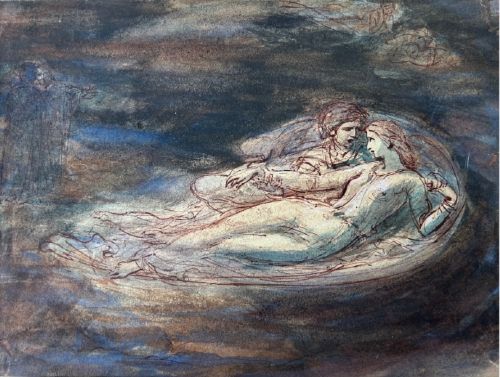
![Pen and Ink Sketch - Female Nudes by William Edward Frost [1810-1877]](https://www.sellingantiques.co.uk/photosnew/dealer_kendallhouse/dealer_kendallhouse_full_1758970795762-8493507346.jpg)


Victorian Ink Drawing
Victorian ink drawing works on paper bring nineteenth-century draftsmanship straight to your walls, offering intimate monochrome studies and detailed architectural plans.
Victorian Ink Drawing
When you search for a victorian ink drawing, you encounter original nineteenth-century works on paper executed in pen, ink, and wash. These pieces range from rapid sketches of female nudes and battle scenes to finished historical studies and architectural drawings.
The selections available include portraits, landscape views, and literary scenes rendered with sepia ink or combined with watercolour. Many examples retain their period frames in wood, gilt wood, or glass, preserving the original presentation.
Origins span the nineteenth century, encompassing early Victorian pieces alongside Georgian survivals and later academic works. You find both signed sheets by named artists and anonymous architectural drafts created for institutions such as the South Kensington School.
What varies in quality
Line confidence and precision separate rapid preparatory sketches from highly resolved finished compositions. The sureness of the pen stroke dictates the visual energy of figures, architectural lines, and landscape foliage.
Context and provenance elevate certain works, particularly when sheets bear signatures, dates, or documentation connecting them to known makers, specific historical events, or architectural projects. The survival of the original framing material also contributes to the integrity of the piece.
One architectural drawing records a royal palace drafted by a seventeen-year-old student for the South Kensington School.
William Edward Frost·Louis Wain·Theobald Chartran·Joseph Hansom·Thomas Lound
The Victorian Ink Drawing Glossary
- Ink and wash
- A drawing technique combining linear ink work with diluted ink applied as a wash for tonal depth. This method allows artists to build volume and shadow quickly.
- Sepia ink
- A brown pigment derived from the cuttlefish, widely used for nineteenth-century monochrome drawings. It imparts a warm, reddish-brown tone to the paper.
- Architectural drawing
- A technical plan or elevation drawn to scale, often produced for building proposals or school instruction. These sheets record precise structural details and ornamentation.
- Pre-Raphaelite
- An artistic style associated with detailed observation and literary subjects, emerging in the mid-nineteenth century. Works in this vein often display intense linear clarity.
- Gilt wood
- Wood coated with a thin layer of gold leaf or gilt paint, commonly used for nineteenth-century picture frames. It provides a reflective border that enhances monochrome works.
Victorian Ink Drawing: Frequently Asked Questions
How should I frame and hang a victorian ink drawing?
Paper works from this period require conservation framing with acid-free mounts to prevent deterioration over time. Keep them away from direct sunlight to protect the ink and watercolour pigments from fading.
Display them on walls with stable ambient humidity, using glass that offers UV protection. This safeguards the delicate paper support and any gilt wood framing elements.
What subjects appear in these nineteenth-century drawings?
The subject matter ranges widely across portraiture, landscape, architectural studies, and literary narrative scenes. You find military figures, churchyards, animal studies, and historical illustrations.
Many drawings reflect the academic interests of the era, recording architectural history or contemporary portrait subjects. Others capture intimate moments like figures with animals or battle scenes.
How do I identify the date of an ink drawing?
Look for contemporary inscriptions, signatures, or dates written on the front or reverse of the paper. Stylistic clues such as Gothic Revival motifs or Pre-Raphaelite draftsmanship also help place the work within the nineteenth century.
Paper characteristics, watermarks, and framing styles provide additional chronological markers. Architectural drawings often name specific schools or institutional projects tied to exact decades.
Are these drawings original works or prints?
The pieces listed are original handmade works executed directly on paper by artists, draftsmen, and students. Each sheet contains unique brushstrokes, pen lines, and wash applications.
Unlike mechanical reproductions, these drawings show the pressure of the pen and the individual hand of the creator. Close inspection reveals the texture of the ink sitting upon the paper surface.