
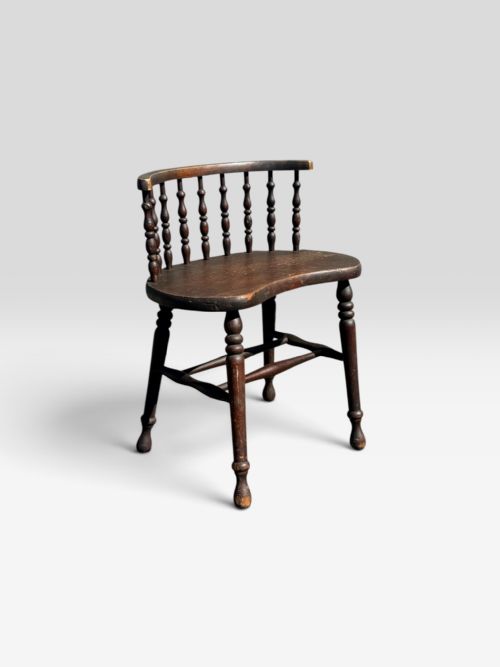
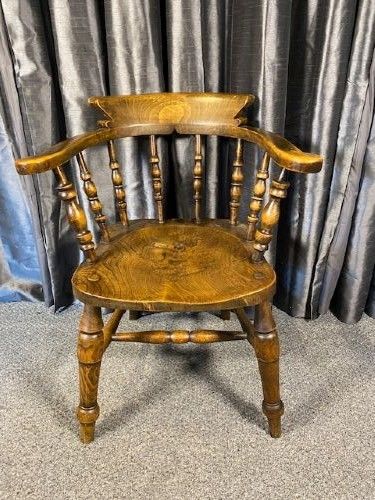


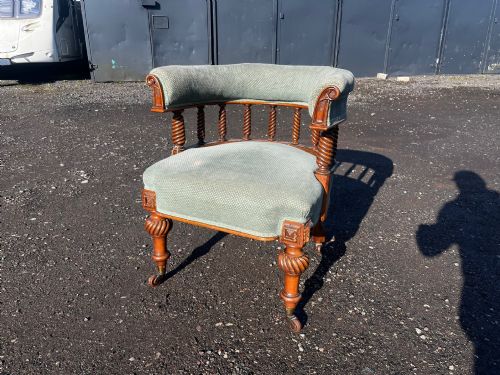


Victorian Horseshoe Chair
A victorian horseshoe chair offers a distinctive curved back built for the study or library, combining deep timber framing with supportive seating.
Victorian Horseshoe Chair
When you search for a victorian horseshoe chair, you are looking at nineteenth-century seating defined by a continuous curved backrest that wraps around the user. These pieces appear in forms such as library chairs, desk armchairs, and captain's chairs.
The versions you are most likely to meet on this page span the Victorian and Edwardian periods, stretching from the eighteen-fifties through to the eighteen-nineties. They take shape in timbers including mahogany, walnut, oak, elm, and beech, frequently paired with leather or fabric upholstery.
How they were made
Cabinet makers constructed the distinctive curved frames using steam-bent or segmented solid hardwoods like mahogany, walnut, and oak to achieve the continuous horseshoe sweep. These timbers were polished to a deep finish that highlighted the natural grain.
Seating surfaces were heavily padded and upholstered in dark red leather or woven fabric, secured with traditional methods to provide sturdy support for daily desk and library use.
The listings on this site record timber frames in mahogany, walnut, oak, elm, beech, and rosewood.
What varies in quality
The distinction between standard examples and the finest pieces lies in the fluidity of the timber frame's curve and the sophistication of the joinery where the back meets the seat. Superior specimens exhibit seamless integration of the arm supports and tighter proportions.
Selection of denser hardwoods like figured walnut or rich mahogany, alongside deep patination on the timber and hand-tooled leather upholstery, marks out the higher tier of these chairs.
The Victorian Horseshoe Chair Glossary
- Horseshoe chair
- A seat featuring a rounded, semi-circular backrest that resembles the shape of a horseshoe. This design wraps around the sitter to provide integrated armrests.
- Library chair
- A heavy, stable armchair designed for long periods of reading at a desk or table. These typically incorporate supportive upholstered backs and sturdy wooden frames.
- Captain's chair
- A sturdy wooden armchair with a low, curved back rail supported by spindles. They were traditionally used in offices and captains' quarters.
- Cockfighting chair
- A specialised low seat with a narrow back and a writing tablet or padded rest. They allowed the sitter to straddle or sit facing forward during events.
Victorian Horseshoe Chair: Frequently Asked Questions
What is a horseshoe chair?
A horseshoe chair is a seat defined by a continuous curved backrest that forms a semi-circle around the sitter, combining the back and arms into one flowing line.
These pieces were primarily designed for studies, libraries, and offices during the nineteenth century to offer ergonomic support during long hours of work.
How were these chairs used?
They were utilised primarily as desk chairs, library seating, and gaming seats where comfort and stability were essential for the user.
The wraparound back provided natural support for reading, writing, and administrative tasks in private studies and commercial offices.
How do I date a Victorian chair?
Dating relies on examining the timber species, construction methods, and hardware used in the frame, alongside stylistic cues from specific decades.
Earlier examples from the mid-nineteenth century often utilise solid rosewood or heavy mahogany, while later pieces shift toward walnut, oak, and elm.
What woods were used?
Cabinet makers utilised a variety of dense hardwoods to construct the curved frames, ensuring the timber could withstand the tension of the bent back.
Mahogany, walnut, oak, elm, beech, and rosewood appear across these listings, often finished with a polished surface.