


Victorian Hardstone Jewellery
Victorian hardstone jewellery brings together banded agate, onyx, and pietra dura set in gold to create brooches, rings, and caskets that define nineteenth-century taste.
Victorian Hardstone Jewellery
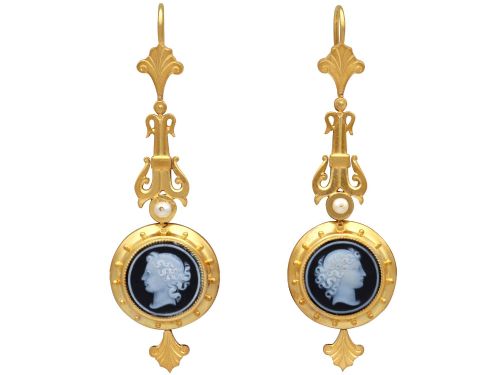
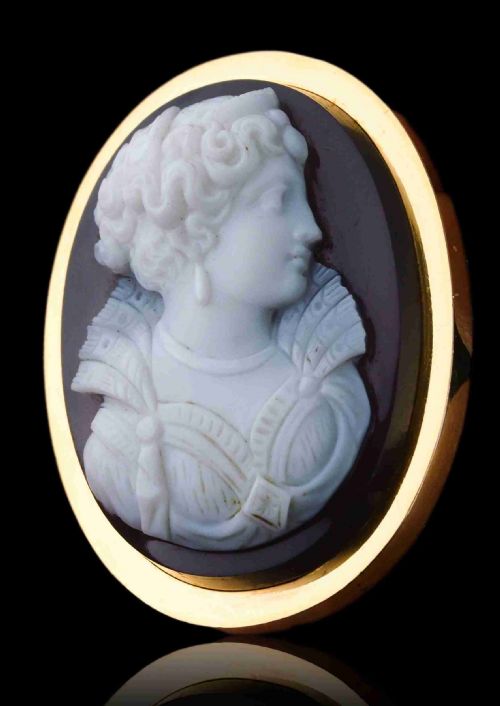
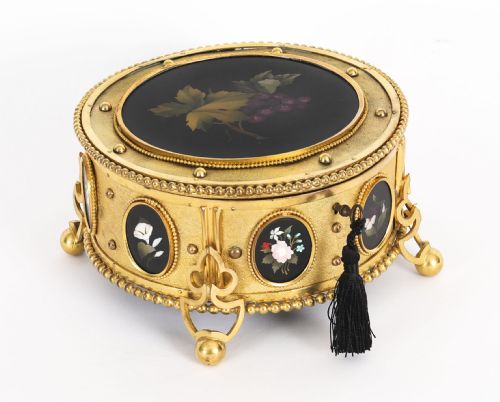
The objects on this page range from carved agate cameo brooches and banded agate gents cufflinks to pietra dura pendants and ebonised wood boxes. French and Italian craftsmanship appears frequently alongside British examples, reflecting the international travel and trade of the period.
Smaller personal ornaments like drop earrings and signet rings sit alongside larger decorative boxes and jewellery caskets. Each piece demonstrates the Victorians' fascination with mineral specimens and classical lapidary techniques.
How they were made
Lapidaries shaped quartz-based stones such as agate and onyx using abrasive wheels and polishing agents to achieve smooth cabochon surfaces and sharp cameo reliefs. Hardstones were selected for their natural banding and colour variations before being secured into metal mounts.
Metalwork involved both 18ct and 9ct gold, alongside silver, ormolu, and ebonised wood for larger caskets and boxes. Pietra dura work required precise inlay of micro-mosaics using coloured stones set flush into a dark ground.
Materials recorded across the inventory include hardstone, agate, onyx, pietra dura, 18ct gold, 9ct gold, yellow gold, rose gold, silver, and ormolu.
What varies in quality
Quality rests in the precision of the lapidary work, visible in the sharpness of carved cameo profiles and the tight alignment of pietra dura micro-mosaics. Superior stones display natural banding and rich colour contrast without obscuring fractures.
The weight and purity of the gold or silver mountings also distinguish finer pieces, where structural mounts integrate cleanly with the stone rather than relying on heavy adhesive or clumsy prongs.
The Victorian Hardstone Jewellery Glossary
- Hardstone
- An umbrella term for semi-precious stones harder than ordinary window glass, used for carving and inlay.
- Pietra dura
- An artistic technique of using cut and fitted polished coloured stones to create images, often floral or pictorial.
- Cameo
- A method of carving an object such as a gemstone or shell where a raised relief image stands proud of a contrasting background.
- Cabochon
- A gemstone shaped and polished as a smooth convex dome rather than faceted with flat planes.
- Banded agate
- A variety of chalcedony quartz featuring distinct parallel strata of contrasting colours.
Victorian Hardstone Jewellery: Frequently Asked Questions
What is victorian hardstone jewellery made from?
These pieces combine natural mineral stones such as agate, onyx, and pietra dura with precious metals including 18ct gold, 9ct gold, and silver.
Makers also incorporated ormolu and ebonised wood, particularly for larger decorative boxes and jewellery caskets.
How do I care for hardstone jewellery?
Clean hardstone items gently with a soft cloth and warm soapy water, avoiding harsh chemical dips that can damage softer stones or metal mounts.
Store rings and brooches separately in lined boxes to prevent harder gems from scratching the polished agate surfaces.
Are these pieces purely British origin?
While many items reflect British Victorian taste, a significant portion of the evidence points to Italian and French origin.
Grand Tour travellers frequently brought back pietra dura boxes and mosaic panels from Italy, while French workshops produced refined cameo brooches.
How can I tell a cameo from pietra dura?
A cameo is carved in relief from a single layered stone or shell, creating a three-dimensional portrait or scene.
Pietra dura is flat, formed by precisely cutting and assembling multiple individual coloured stones into a solid plaque.