




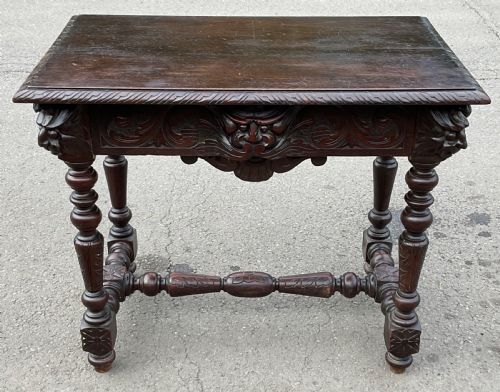

Victorian Green Man Table
A victorian green man table brings the forest spirit indoors through bold woodwork that commands attention.
Victorian Green Man Table
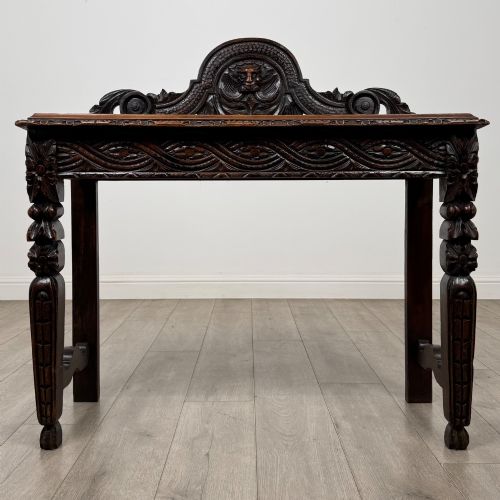
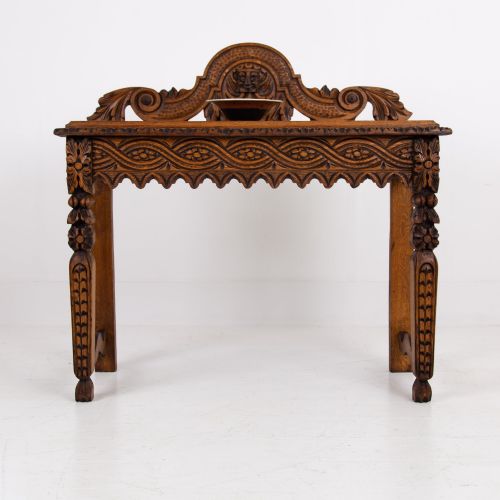
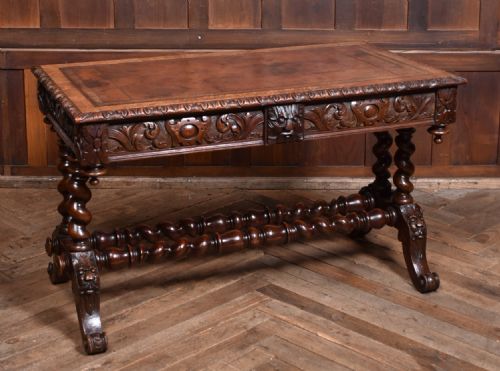
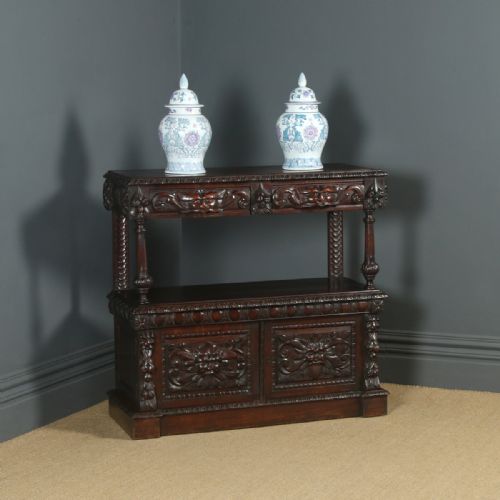
A victorian green man table centres on the carved foliage mask of the foliate face, peering out from heavily detailed timber frames. These pieces span compact side tables, hall tables, writing desks, and substantial dining sets.
The aesthetic leans heavily into revival movements, merging Gothic, Flemish, and Jacobean motifs into sturdy utilitarian furniture. Most examples encountered here rely on rich timber grains and deep relief carving to anchor a hallway or reception room.
How they were made
Solid oak serves as the primary structural and decorative medium, chosen for its strength and capacity to hold crisp, deep chisel work. Golden oak and standard oak varieties dictate the underlying warmth of the carved mask.
Joinery relies on traditional methods to support heavy tops and carved aprons, often complemented by brass hardware, glass inserts, or leather writing surfaces on desk variants.
Listings feature oak as the dominant material, spanning side tables, writing desks, and dining sets from the Victorian era.
What varies in quality
Carving depth and anatomical expression dictate the distinction between standard production items and masterworks. A crisp, deeply undercut foliage mask reveals the hand of a skilled artisan rather than a hurried workshop output.
Timber selection and secondary framing integrity separate finer library tables from utilitarian hall pieces. The proportion of the mask relative to the structural legs shows the maker's eye for balance.
Winterhalder and Hofmeier
The Victorian Green Man Table Glossary
- Green Man
- A sculptural mask of a human face disgorging foliage, vines, or branches from its mouth. This motif symbolises rebirth and the spirit of vegetation.
- Flemish Renaissance Revival
- A nineteenth century decorative style drawing on sixteenth century Low Countries art. It relies on strapwork, heavy scrollwork, and prominent figural carving.
- Gothic Revival
- An architectural and decorative movement reviving medieval forms. Pointed arches, tracery, and dark timber dominate this aesthetic.
- Hall Table
- A narrow piece designed for a passage or entranceway. These surfaces held calling cards and keys in nineteenth century homes.
Victorian Green Man Table: Frequently Asked Questions
What is a green man table?
A victorian green man table is a nineteenth century wooden furnishing featuring carved faces entangled in leaves and vines. These designs draw heavily from Gothic and Renaissance revival styles.
Craftsmen utilised sturdy oak to carve these mythical foliage masks into the aprons, drawers, and legs of side tables, desks, and console pieces.
Where do I put a hall table?
A hall table fits best in narrow entryways, corridors, or behind living room sofas where surface space is needed without blocking traffic. Their shallow depth allows them to sit flush against walls.
These pieces provide a convenient drop zone for daily items while adding strong architectural presence to an interior through their dark carved woodwork.
How do I date a carved oak table?
Dating relies on examining the revival style, construction methods, and timber patination. Pieces showing Flemish Renaissance or Gothic revival motifs typically point to the middle and late nineteenth century.
Hardware, drawer construction, and the crispness of the hand-carved foliage mask offer further clues to pinpoint whether a piece originates from the eighteen sixties or nineteen hundreds.
Are writing desks and side tables the same?
Writing desks incorporate drawers, modesty panels, and occasionally inset leather surfaces designed specifically for correspondence. Side tables offer a clean timber top intended for display.
Both formats utilise the same heavy oak construction and green man iconography, but desks prioritize practical workspace over flat surface area.