
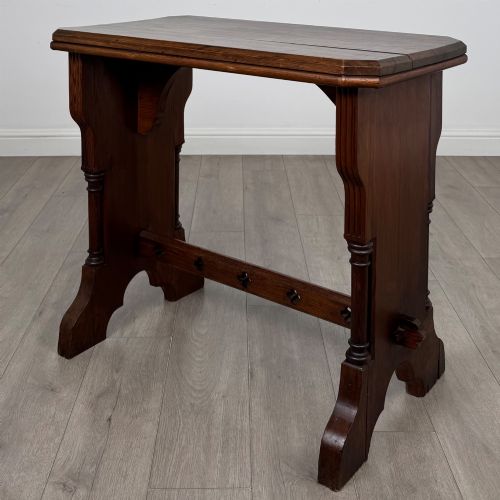


Victorian Gothic Trestle Table
These robust victorian gothic trestle table examples combine ecclesiastical gravity with domestic utility, forged in solid timber for daily service.
Victorian Gothic Trestle Table
A victorian gothic trestle table brings medieval architectural form into nineteenth-century domestic spaces through heavy timber construction and pointed arch motifs. These pieces serve primarily as dining tables, refectory tables, or side and hall tables within country houses and vicarages.
The materials span solid oak, pitch pine, walnut, and ebonised wood, reflecting the revival of medieval craft traditions during the nineteenth century. Makers applied Gothic Revival, Arts and Crafts, and Flemish Renaissance Revival styles to create sturdy furniture suited for communal gatherings.
Most examples date across the nineteenth century, from mid-century desks to substantial late-century dining sets. Buyers encounter formats ranging from narrow pitch pine console tables to huge monastery dining tables designed for large halls.
What Varies in Quality
The distinction between standard utility pieces and finer examples rests upon timber selection and the depth of carved detail. Superior tables utilise dense, clear-grained solid oak or pitch pine with hand-finished mouldings rather than machine-cut surface decoration.
Structural integrity depends on the rigidity of the trestle supports and the precision of the pegged joints. Tables associated with known design idioms or specific maker influences often display more refined proportions and carefully balanced structural mass.
The forms recorded range from narrow hall consoles to massive monastery dining sets with matching benches.
AW Pugin·Charles Bevan·Gillows
The Victorian Gothic Trestle Table Glossary
- Trestle table
- A table comprising a horizontal top supported by two vertical uprights or frames at each end. This ancient form allows maximum legroom along the length of the surface.
- Pitch pine
- A resinous North American softwood utilised extensively in nineteenth-century British furniture for its durability and strong grain pattern. It takes a smooth finish while retaining a rugged appearance.
- Refectory table
- A long, narrow dining table traditionally used in monastic refectories and later adopted for domestic dining rooms. These examples feature substantial underframing to ensure stability.
- Gothic Revival
- An architectural and decorative style spanning the eighteenth and nineteenth centuries that revives medieval Gothic forms, pointed arches, and ecclesiastical motifs. Furniture in this style mimics stone tracery in wood.
- Green Man
- A sculptural motif representing a human face surrounded by or entwined from leaves and vines. Carvers frequently incorporated this symbol into nineteenth-century oak furniture to denote nature and rebirth.
Victorian Gothic Trestle Table: Frequently Asked Questions
How do I care for pitch pine?
Pitch pine surfaces respond well to regular dusting and occasional applications of natural beeswax to nourish the timber.
Avoid placing these tables near direct heat sources to prevent the resinous wood from drying out or splitting.
Are these tables suitable for modern dining?
These robust tables provide generous surface area and sturdy construction, making them ideal for everyday family dining.
The trestle design allows chairs to tuck neatly underneath along the entire length.
How can I identify the period?
Examine the timber species, tool marks on the underside, and the specific manifestation of the Gothic Revival style.
Mid-nineteenth-century examples often feature simpler pitch pine construction, while later pieces incorporate elaborate carved oak details.
What is an X-frame table?
An X-frame table utilises intersecting diagonal supports at each end instead of standard four-legged vertical posts.
This structural arrangement distributes weight evenly and adds architectural drama to the piece.