

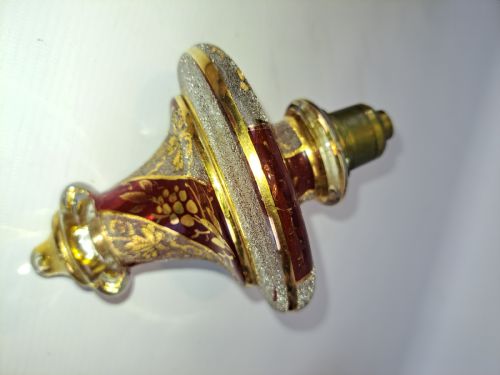


Victorian Glass Finial
These Victorian glass finial pieces are decorative terminal ornaments and servingware lids that collectors seek for their rich coloured glass and metal mountings.
Victorian Glass Finial
A buyer searching for a victorian glass finial encounters decorative terminal knobs and sculptural stoppers attached to nineteenth-century serving vessels and mirrors. The evidence shows these pieces span biscuit barrels, claret jugs, and mirrors dating from eighteen fifty to eighteen ninety.
The versions most commonly met on this page include ruby and cranberry glass bodies paired with silver plate, brass, or gold leaf. Many items integrate moulded or cut glass elements directly into hinged lids and frames.
Origins include Bohemian workshops alongside British Victorian makers, producing both utilitarian household objects and ornamental display pieces. The form serves as both a functional handle and a focal point for nineteenth-century tableware.
Materials and construction
Glass production during this era relies on traditional blowing and pressing techniques, yielding deep cranberry and ruby tones alongside clear cut crystal. Artisans frequently added surface decoration through etching and gold leaf application.
Metal components utilise silver plate and brass, often cast into Heraldic dragons, lions, and rope motifs. These mounts are secured directly to the glass vessels and frames using period mechanical fixings.
Victorian Glass Finial Retail Price Guide 2026
Typical asking prices for victorian glass finial among the pieces listed under this phrase on Sellingantiques today, from the lower quarter to the upper quarter. They describe what is for sale here now, not the wider market.
Listings feature items spanning the nineteenth century, including specific dates such as eighteen fifty, eighteen sixty, eighteen seventy, eighteen eighty, and eighteen ninety.
Assessing quality
Quality rests on the depth of colour in the glass and the crispness of any cut or etched surface patterns. Rich cranberry and ruby hues paired with well-defined gilding distinguish superior examples.
The integration between the glass body and the metal mounts dictates the standard of manufacture. Finely cast figural work, such as detailed lions or heraldic dragons on the metal elements, indicates higher craftsmanship.
The Victorian Glass Finial Glossary
- Cranberry glass
- A rich pinkish-red glass coloured with gold chloride during production. It is frequently seen in nineteenth-century biscuit barrels.
- Silver plate
- A thin layer of silver fused to a base metal such as copper or brass. This technique allowed Victorian manufacturers to produce ornate claret jug mounts at a lower cost than solid silver.
- Bohemian
- A style and regional origin associated with decorative glassware from Central Europe. These pieces often feature elaborate etching and gilding.
- Cut glass
- Glass decorated by grinding facets or patterns into the surface using a wheel. This process creates reflective properties that enhance the sparkle of nineteenth-century tableware.
Victorian Glass Finial: Frequently Asked Questions
What is a victorian glass finial?
A victorian glass finial is a decorative terminal knob, stopper, or sculptural top fitted to nineteenth-century serving vessels, jars, and mirrors. These elements function as functional handles while adding a distinct aesthetic detail to the object.
They appear on items ranging from cranberry glass biscuit barrels to claret jugs and wall mirrors. The form combines moulded glass with metals such as brass and silver plate.
How were these glass items used?
Victorian households utilised these glass and metal pieces primarily for dining and dressing room displays. Biscuit barrels and claret jugs served during formal meals, while mirrors adorned drawing rooms and bedrooms.
The decorative finials provided a secure grip for lifting lids while contributing to the overall ornamentation of the table setting or furniture piece.
How do I identify cranberry glass?
Cranberry glass displays a distinctive translucent pinkish-red colour achieved by adding gold to the molten batch. It is characteristic of nineteenth-century decorative tableware.
Items in the evidence pair this vibrant glass with silver-plated mounts and etched surface patterns to create striking visual contrast.
What metals are found on these pieces?
Nineteenth-century makers utilised silver plate and brass for the metal mounts, hinges, and decorative finials attached to the glass bodies. Gold leaf was also applied for surface enrichment.
These metals provide structural support and create decorative contrast against the coloured and cut glass surfaces.