

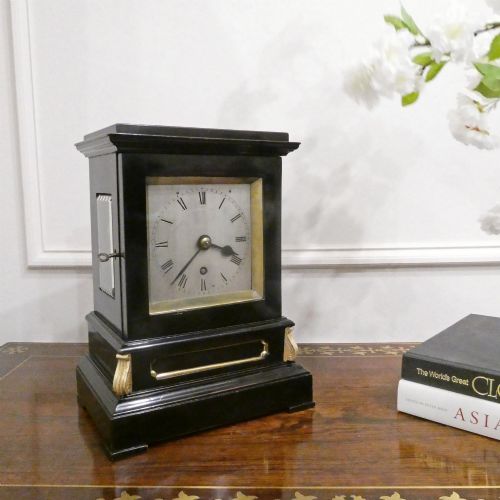


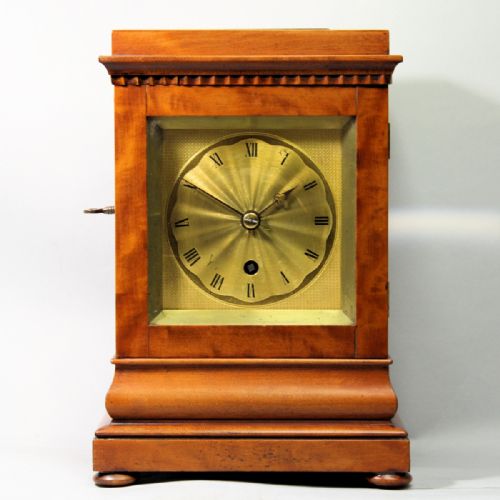
Victorian Fusee Library Clock
A victorian fusee library clock brings precision engineering into a study or drawing room, combining a steady movement with a substantial timber or glass housing.
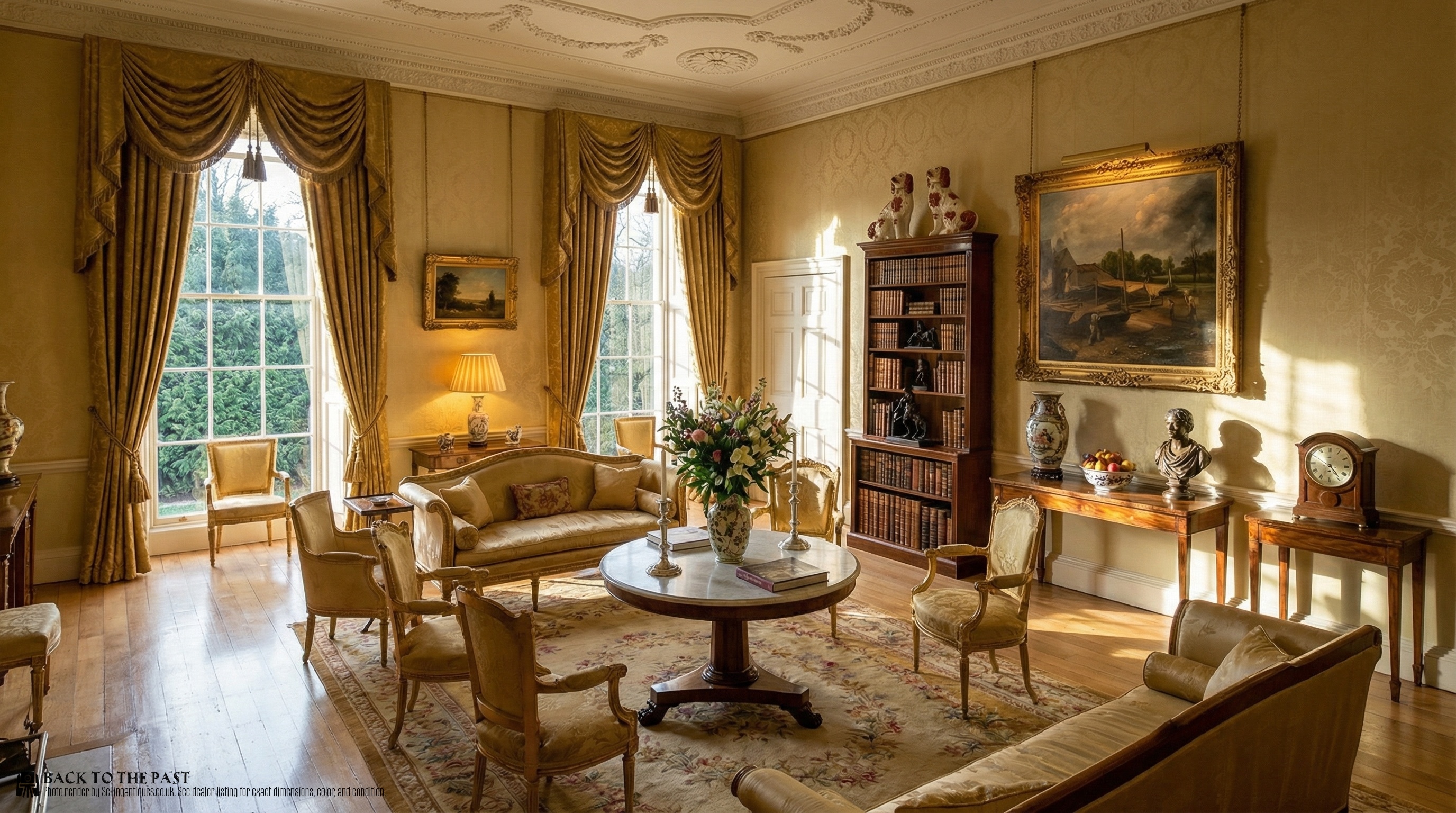
Victorian Fusee Library Clock
A victorian fusee library clock is a dependable timekeeper designed for desk or shelf placement during the nineteenth century. These pieces most commonly appear in rich timber cases such as mahogany, rosewood, ebonised wood, and satinwood, paired with brass fittings and glass panels.
The objects listed on this page span the mid to late nineteenth century, including specific decades like the 1850s, 1860s, 1870s, 1880s, and 1890s. Buyers will find variations ranging from traditional wooden bracket designs to five-glass and four-glass layouts that showcase the internal mechanics.
These clocks function primarily as timepieces, often featuring single chain fusee movements driven by reliable mechanisms. They bridge the gap between portable desk instruments and larger mantel or bracket clocks.
Materials and construction
Cases are constructed from dense hardwoods like mahogany, rosewood, and satinwood, or finished with ebonised wood for a dark, uniform appearance. Glass panels enclose many of these mechanisms, allowing light to reach the silvered metal or gilded dials.
Internal mechanisms rely on steel components and brass plates, regulated by a fusee movement that ensures even power delivery from the mainspring. Dials frequently incorporate engine-turned gilded brass or silvered metal surfaces engraved with numerals and maker signatures.
Victorian Fusee Library Clock Retail Price Guide 2026
Typical asking prices for victorian fusee library clock among the pieces listed under this phrase on Sellingantiques today, from the lower quarter to the upper quarter. They describe what is for sale here now, not the wider market.
Listings feature nineteenth-century pieces spanning the 1850s to the 1890s, constructed from mahogany, rosewood, satinwood, and ebonised wood with brass and glass.
Judgement of quality
Quality rests in the crispness of the case timber and the refinement of the dial work, such as engine-turned gilded brass. Cabinetry with well-matched veneers and intact glass panels separates standard production from finer workshop output.
The sophistication of the internal movement dictates the upper tier of pieces, particularly those featuring complex year-going capabilities or chains rather than cords. Signed dials by notable makers add a layer of distinction to the mechanics.
Webster Cornhill London·Walker·Dent·Phillips Brothers·McCabe London·Barraud and Lunds·John Massey London
The Victorian Fusee Library Clock Glossary
- Fusee
- A conical pulley used in clock movements to maintain even tension on the chain as the mainspring unwinds. This mechanism ensures consistent timekeeping throughout the power reserve.
- Five glass clock
- A style of timepiece encased in glass on the top and all four sides, permitting a clear view of the internal brass and steel movement from multiple angles.
- Engine-turned
- A decorative surface finish applied mechanically to dials, producing intricate geometric patterns in the metal. It catches light subtly behind the hands.
- Bracket clock
- A portable timekeeper originally designed to sit on a wall bracket or a furniture surface. Many examples include carrying handles or matching wall supports.
- Silvered metal
- A dial surface treated with a silver compound to create a bright, matte finish that contrasts with dark numerals. This treatment was common on mid-nineteenth-century English movements.
Victorian Fusee Library Clock: Frequently Asked Questions
What is a fusee movement?
A fusee movement uses a conical pulley connected to a chain or cord to equalise the pulling power of the mainspring as it winds down. This keeps the force on the gear train constant from a full wind to empty.
Such mechanisms were favoured in better quality nineteenth-century English clocks for their superior timekeeping accuracy compared to standard spring-driven alternatives.
Where were library clocks placed?
These clocks were designed for desks, tables, or bookshelves in private studies, libraries, and drawing rooms of large homes. Their portable nature allowed owners to move them easily between rooms.
Some examples also included optional wall brackets, letting the owner mount the clock securely off the desk surface.
How do I wind a chain fusee clock?
Winding requires a dedicated key inserted into the dial to tension the chain back onto the conical fusee drum. Care must be taken not to overwind the mechanism.
Consulting the specific movement instructions for single fusee systems ensures the internal chain seats correctly on the drum grooves.
What woods were used for the cases?
Cabinet makers utilised dense, stable hardwoods that could take a fine polish and protect the delicate brass movements within. Mahogany, rosewood, and satinwood provided rich natural grain, while ebonised wood offered a sleek, dark finish.
These timbers matched the heavy library furniture of the Victorian era.