
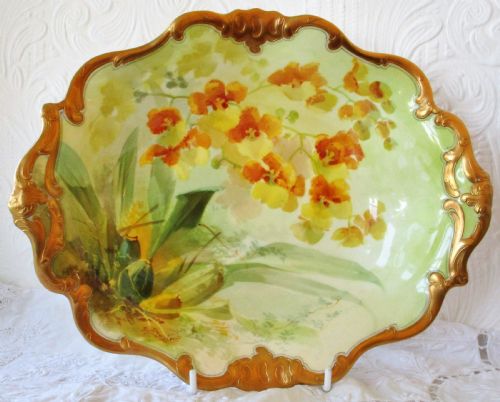


Victorian Floral Botanical Plate
These victorian floral botanical plate pieces bring hand-painted flora straight to the table, offering a colourful study of nineteenth-century horticulture.
Victorian Floral Botanical Plate
A victorian floral botanical plate brings together nineteenth-century porcelain and earthenware with detailed floral and orchid painting. Buyers searching this phrase look for cabinet dishes and dessert services decorated with hand-painted botanicals.
The pieces on this page span the nineteenth century into the early twentieth century, showing styles from English Rococo Revival to Art Nouveau. Most examples take the form of decorative plates, cabinet dishes, and part dessert services.
Materials and methods
Potters shaped these objects from porcelain, bone china, creamware, and earthenware, applying a protective glaze to the clay body. Many items received rich decoration through enamel and hand painting, often highlighted with gold leaf and gilt.
Makers utilised skilled artisans to hand paint specific botanical studies, such as named orchids, directly onto the ceramic surface before firing. The combination of transfer printing in blue and white with hand-applied enamel work also appears across the selection.
David Dewsberry painted orchids so accurately on Royal Doulton porcelain that botanists could identify the exact species across the century.
Distinguishing quality
Quality rests primarily on the execution of the hand-painted botanical artwork and the precision of the enamel work. Finely detailed floral studies by named painters command greater attention than standard transfer-printed motifs.
The choice of ceramic body also dictates the tier of the piece, with translucent porcelain and fine bone china sitting above standard creamware and earthenware. Gilt and gold leaf application shows varying degrees of hand-chasing and wear over time.
Royal Doulton·Wedgwood·Royal Worcester·Elkin And Newbon·Royal Crown Derby
The Victorian Floral Botanical Plate Glossary
- Cabinet dish
- A decorative ceramic plate intended for display in a cabinet rather than for daily dining use.
- Creamware
- A refined earthenware with a pale yellowish-cream glaze, developed in the eighteenth century and continued through the nineteenth century.
- Enamel
- Opaque vitreous material fused to the ceramic surface to create brightly coloured painted details.
- Gilt
- A thin layer of gold applied to the ceramic surface to accent rims and borders.
- Dessert service
- A matching set of plates and dishes specifically designed for serving the final course of a meal.
Victorian Floral Botanical Plate: Frequently Asked Questions
What are botanical plates?
Botanical plates are ceramic dishes painted with accurate depictions of flowers, plants, and orchids. They were produced to record scientific plant discoveries as well as to decorate fashionable dining rooms.
Most examples found on this page date from the nineteenth century, reflecting a period of intense interest in natural history and horticulture.
How were cabinet dishes used?
Cabinet dishes were made primarily for display in glass-fronted cabinets rather than for serving food. Their delicate hand-painted decoration and gilt borders meant they functioned more like works of art.
Owners would showcase single plates or small groupings to demonstrate their refined taste in botany and porcelain.
How do I care for antique plates?
Antique porcelain and creamware require gentle handling and should be washed by hand in lukewarm water using mild soap. Avoid soaking pieces with gilt or enamel decoration to preserve the painted surface.
Display them securely on stable plate stands or store them safely in cabinets away from direct sunlight.
How do I date these pieces?
Dating relies on maker marks stamped or painted to the underside, combined with the style of the ceramic body and painting. Nineteenth-century pieces often feature specific registry marks or factory ciphers that narrow down the year of production.
The transition from earthenware and creamware towards fine bone china and porcelain also helps place an item within the Victorian or Edwardian eras.