






Victorian Fitted Sewing Box
These victorian fitted sewing box pieces are charming wooden containers and tables designed to hold threads and needles, offering both practical storage and elegant Victorian craftsmanship.
Victorian Fitted Sewing Box
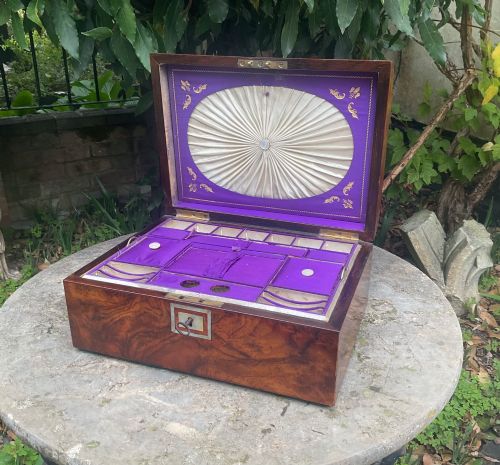
When you search for a victorian fitted sewing box, you encounter a range of desktop boxes and freestanding work tables created during the nineteenth century. These objects typically feature compartmentalised interiors designed to organise sewing implements, threads, and small accessories.
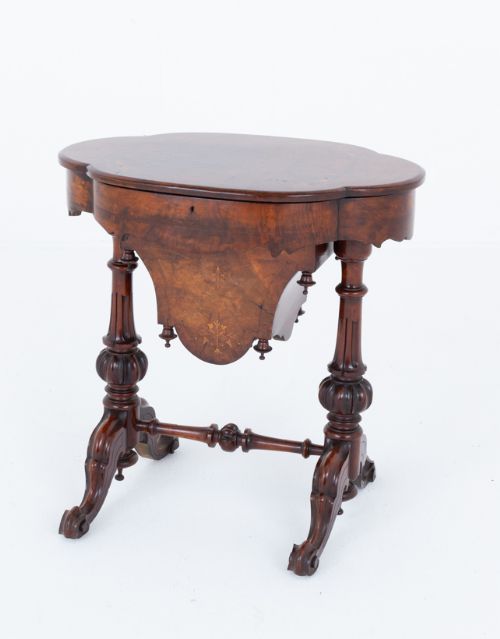
Desktop boxes often incorporate mother-of-pearl inlay, coromandel-wood, rosewood, or tortoiseshell, whilst freestanding work tables provide a larger surface and frequently rest on carved and turned supports or cradle bases. Certain examples originate from French workshops or Anglo-Indian makers, expanding the stylistic variety within this category.
The most common formats on this page are burr walnut work tables and portable wooden boxes fitted with velvet and silk lined compartments. Collectors also find occasional haberdashery display cases and jewellery boxes adapted for similar storage uses.
How they were made
Cabinet makers utilised dense hardwoods such as walnut, rosewood, and coromandel as foundational structures, often applying burr walnut veneers to display intricate wood grain patterns. Tunbridge ware examples incorporated precise mosaic woodwork, creating geometric patterns from multiple natural wood colours.
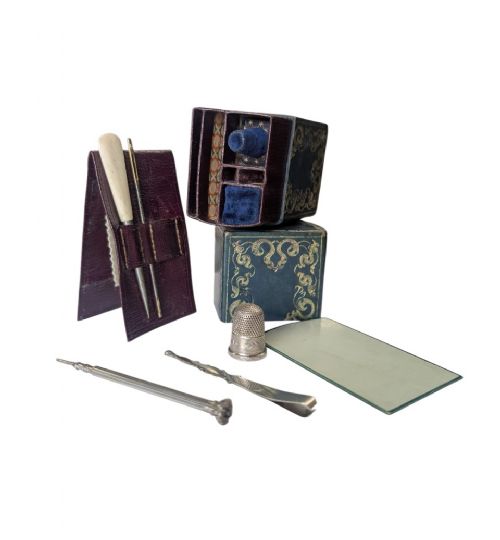
Surface ornamentation frequently involved brass stringing, mother-of-pearl inlay, and marquetry detailing. Interiors were meticulously lined with silk and velvet, incorporating small glass containers, bone implements, and fitted trays to secure sewing tools.
Listings feature burr walnut as the predominant timber, alongside rosewood, coromandel-wood, and tortoiseshell across nineteenth-century forms.
What varies in quality
Quality depends heavily on the choice of timber and the precision of the exterior veneer work, with burr walnut and coromandel examples sitting towards the higher end of the range. The complexity of the interior fitting also dictates standard, as complete velvet and silk linings with intact bone or glass accessories indicate superior original commission.
The execution of decorative inlays, such as mother-of-pearl placement and marquetry detailing, distinguishes standard production items from finer specimens. Structural integrity in the turned supports of work tables and the condition of original hinges and locking mechanisms further influence overall merit.
Edwards
The Victorian Fitted Sewing Box Glossary
- Work table
- A freestanding piece of furniture incorporating a storage compartment or bag beneath the top for sewing materials. These items often double as occasional tables.
- Tunbridge Ware
- Woodwork decorated with tiny mosaic tiles forming pictorial or geometric designs. This technique originated in Kent during the nineteenth century.
- Marquetry
- The art of applying pieces of veneer to a structure to form decorative patterns. Craftsmen utilised various timber shades to create pictorial designs on box lids.
- Coromandel-wood
- A dense, dark timber imported from Asia with contrasting light brown stripes. Cabinet makers reserved this material for luxury boxes and writing desks.
- Etui
- A small portable case designed to hold needles, small scissors, and tweezers. These items are often associated with French nineteenth-century craftsmanship.
Victorian Fitted Sewing Box: Frequently Asked Questions
What was inside a fitted sewing box?
Original interiors typically contained removable trays with small compartments for spools, needles, and thimbles. Many included bone or mother-of-pearl winding tools, miniature glass jars, and velvet pin cushions.
These fitted sections ensured that delicate sewing implements remained organised and protected during transport or storage in the parlour.
How do I tell a work table from a box?
A work table stands on legs, often featuring carved and turned supports or a cradle base, and provides a surface for daily use alongside its storage capacity. Portable sewing boxes lack legs and are designed to sit on tabletops, featuring carrying handles or flush side mounts.
Both forms share similar internal compartments, but the freestanding tables offer additional furniture presence in a room.
What woods were used for these boxes?
Cabinet makers predominantly selected walnut, rosewood, and mahogany as primary timbers. Burr walnut veneers were especially popular for their swirling grain patterns.
Exotic woods like coromandel appeared on luxury commissions, frequently enhanced by contrasting inlays of mother-of-pearl and brass.
Are all these items strictly for sewing?
Whilst designed primarily for needlework and threads, many of these containers served multiple domestic purposes during the nineteenth century. Owners frequently repurposed them to store letters, trinkets, or jewellery.
Several surviving examples function equally well as modern jewellery boxes or occasional display pieces.