


Victorian Fireside Tools
These victorian fireside tools are the working brass and steel implements that kept nineteenth-century hearths burning.
Victorian Fireside Tools
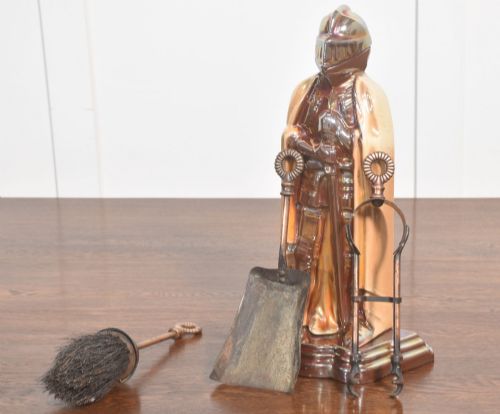
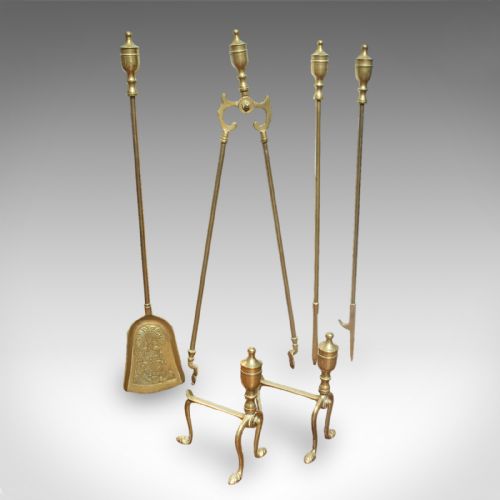
When you search for victorian fireside tools, you encounter everything from complete companion sets to individual pokers, shovels, and toasting forks. The pieces listed here span the period from the mid-nineteenth century through to the early decades of the twentieth, reflecting the changing domestic tastes of the era. You will find sets mounted on stands, pairs of tool rests, and specialised items like chestnut roasters and extendable forks.
The dominant forms are companion sets comprising a shovel, poker, and tongs, frequently accompanied by fire dogs or rests. Brass is the most common metal, though cast iron, steel, and copper finish appear regularly across the inventory. Makers drew upon diverse stylistic influences, ranging from straightforward Victorian utility to Gothic Revival, Rococo Revival, Aesthetic Movement, and Art Nouveau.
How they were made
The manufacture of these implements relied heavily on brass casting, forged steel, and cast iron fabrication. Brass components were often turned on lathes or cast in moulds to achieve decorative handles and claw and ball designs, while steel shafts provided the necessary strength for daily stoking. Hand-finishing, polishing, and occasional copper inlay or tole ware painting gave individual items their distinct surface textures.
Companion sets required a combination of blacksmithing for the iron and steel tools and foundry work for the stands and rests. Bristles were integrated into brushes, and moving parts such as tongs and revolving toasters relied on simple yet robust mechanical joints. The materials were chosen to withstand intense heat while maintaining an ornate appearance suitable for the principal rooms of the house.
Several items double as snack equipment, letting you roast chestnuts or toast bread while maintaining the drawing room's aesthetic.
What varies in quality
Quality in these pieces is dictated by the weight of the metal and the crispness of the casting. Superior sets employ heavy-gauge brass or forged steel that feels substantial in the hand, whereas lesser examples rely on thin sheet metal or hollow stampings that lack durability. The refinement of the detailing on handles and stands separates standard utility items from more ambitious decorative works.
Design integrity also plays a major role, as evidenced by pieces utilising distinct aesthetic movements like Art Nouveau or Gothic Revival. Well-proportioned companion sets where every tool matches the stand demonstrate a higher level of original conception than disparate pieces assembled later. The survival of original polished finishes or patination without excessive modern intervention preserves the character of the object.
The Victorian Fireside Tools Glossary
- Companion set
- A matched group of fireside implements, usually consisting of a poker, shovel, and tongs, often arranged on a dedicated stand or rack near the hearth.
- Fire dog
- A metal support used to hold logs in an open fireplace, frequently paired with tool rests or matching companion sets.
- Tole ware
- Enamelled or lacquered metalware, occasionally decorated with painted designs, seen in specialised twin companion sets.
- Aesthetic Movement
- A late nineteenth-century design style emphasising visual and material qualities over narrative content, appearing on tool rests and accessories.
Victorian Fireside Tools: Frequently Asked Questions
What is included in a typical companion set?
A standard set generally comprises a poker for adjusting logs, a shovel for clearing ash, and a pair of tongs for handling fuel.
Many configurations also include a hearth stand or a pair of fire dogs to keep the implements organised and accessible beside the fireplace.
How do I identify the period of a set?
Dating relies on stylistic clues such as Rococo curves, Gothic Revival motifs, or the flowing lines typical of Art Nouveau and the Aesthetic Movement.
Materials also offer guidance, as heavy cast iron and polished brass dominate the core Victorian decades, while later twentieth-century pieces introduce varied finishes.
Were these tools meant for daily use?
Most pieces were manufactured for active service in coal- or wood-burning hearths, combining functional strength with decorative appeal for the principal reception rooms.
Heavier steel and brass construction ensured they could withstand regular stoking and ash removal without bending.
What are specialised items like chestnut roasters used for?
Chestnut roasters and extendable toasting forks were domestic accessories designed for preparing food directly over the open fire.
Items like revolving toasters allowed users to turn bread or chestnuts evenly without exposing their hands to excessive heat.