
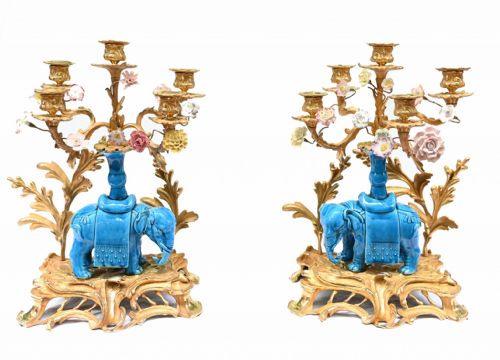


Victorian Figural Candelabra
Victorian figural candelabra are dramatic lighting pieces bringing sculpted human or animal forms together with branch mounts, built to command a dining table or mantlepiece.
Victorian Figural Candelabra
Victorian figural candelabra combine practical illumination with sculptural artistry, frequently taking the form of human figures, cherubs, or animals supporting multiple candle arms. These works span the nineteenth century and draw heavily upon historical revivals, incorporating classical motifs into domestic interiors.
The pieces appearing on this page encompass various configurations, from monumental bronze figures to delicate porcelain creations. Pairs frequently emerge alongside single examples, demonstrating the formal symmetry favoured during the period.
Makers and factories utilise diverse ceramic bodies and metalwork techniques, uniting porcelain figures with gilt bronze branches or silver plated mounts. The resulting objects reflect both British production and continental European workshops exported to collectors.
Materials and construction methods
Metalwork pieces rely upon cast bronze and patinated bronze, often enhanced with gilding or gold leaf to highlight ornamental details. Silver plate provides an alternative lustrous finish for structural components and candle nozzles.
Ceramic elements utilise porcelain and enamel, moulded into detailed figures and botanical motifs. Factories such as Royal Worcester and Sitzendorf shape these porcelain components before applying hand-painted pigments and gilt accents.
Complex forms combine multiple manufacturing traditions, securing porcelain figures onto bronze bases or mounting metal arms directly into ceramic bodies using threaded fixings.
Elephants appear alongside cherubs and classical figures, proving that Victorian dining tables occasionally welcomed exotic company.
Evaluating the craftsmanship
Quality rests upon the crispness of the casting in bronze elements and the delicacy of the modelling in porcelain figures. Finer pieces display sharply defined facial expressions and intricate drapery without softening of the original detail.
The application of surface finishes distinguishes standard production from superior examples. Hand-applied gilding, careful enamel work, and subtle patination create depth across the sculptural surfaces, whereas inferior items show flat or uniform colouration.
Structural integrity of the branch mounts and the matching quality of paired pieces determine the overall standard. Superior candelabra maintain balanced proportions and secure joints between disparate materials like porcelain and metal.
Royal Worcester Hadley·Sitzendorf·Helena Wolfsohn·James Hadley
The Victorian Figural Candelabra Glossary
- Candelabra
- A branched candlestick designed to hold multiple candles simultaneously. These pieces often feature removable branches to allow conversion into simple candlesticks.
- Gilt
- A thin layer of gold applied to the surface of bronze, silver, or porcelain. This technique provides a durable golden finish without requiring solid precious metal.
- Patinated Bronze
- Bronze treated with chemicals, heat, or friction to produce a specific surface colour and texture. This process darkens the metal to accentuate sculptural contours.
- Silver Plate
- A thin layer of silver fused to a base metal such as copper or brass. This method achieves the appearance of solid silver at a reduced manufacturing cost.
- Rococo Revival
- A nineteenth-century design style reviving the asymmetrical scrolls, shell motifs, and curving lines of the eighteenth-century French Rococo movement.
Victorian Figural Candelabra: Frequently Asked Questions
Were these pieces used for lighting?
These candelabra served as functional lighting on dining tables, sideboards, and mantlepieces during the nineteenth century. Multiple candle arms provided significant illumination before the widespread adoption of electricity.
Many examples were later adapted to hold electrical fittings or converted into table lamps while retaining their original sculptural bases.
How do I spot a matched pair?
Examine the casting marks, dimensions, and hand-painted details on both pieces to confirm uniformity. Minor variations often occur in hand-modelled porcelain and cast bronze, reflecting individual craftsmanship.
Look for consistent patination on metal components and matching factory stamps on the bases to verify they were produced together.
What defines the Egyptian Revival style?
Egyptian Revival design incorporates motifs from ancient Egyptian art, including sphinxes, scarabs, and architectural obelisks. This style surged in popularity following nineteenth-century archaeological discoveries.
In candelabra, these elements appear as sculpted figures in traditional pharaonic dress or pedestal bases decorated with hieroglyphic patterns.