



Victorian Farmyard Oil Artwork
Victorian farmyard oil artwork captures rural life through detailed brushwork on canvas, offering buyers a genuine slice of nineteenth-century country tradition.
Victorian Farmyard Oil Artwork
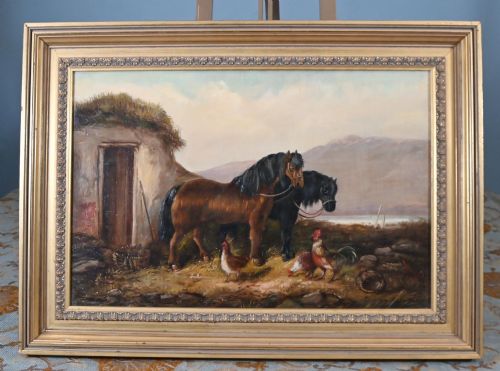
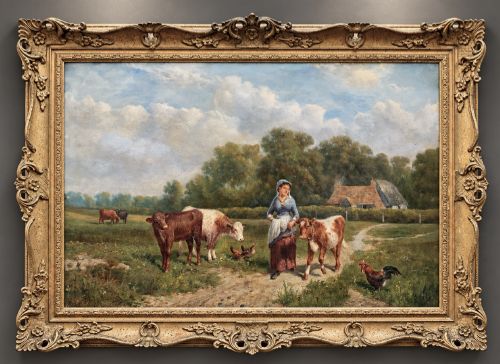
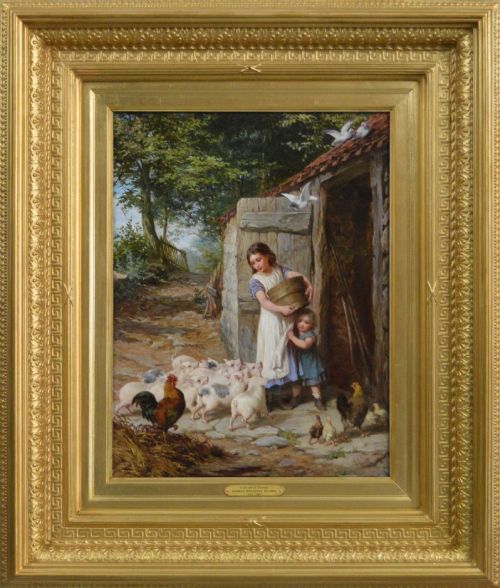
Victorian farmyard oil artwork depicts rural scenes populated by horses, cattle, pigs, and poultry alongside agricultural laborers and country landscapes. These works reflect a nineteenth-century fascination with pastoral life, ranging from quiet farmyard corners to busy agricultural settings.
The pieces on this page span the Victorian and Edwardian periods, stretching from the mid-nineteenth century into the early twentieth century. Common subjects include hens, cockerels, and chicks, as well as working shire horses and ducks gathered near barns and ponds.
Most examples present traditional realism, capturing the textures of feathers, fur, and weathered wood with careful observation. Buyers encounter both single framed canvases and paired compositions by known nineteenth-century painters.
Distinguishing quality in pastoral art
Quality rests upon the artist's ability to render animal anatomy and texture convincingly, from the feather patterns on a cockerel to the musculature of working horses. Stronger works display confident brushwork and balanced composition that bring the farmyard scene to life.
The condition of the canvas and the integrity of the original giltwood and gesso frame influence the overall appeal. Works with well-preserved paint layers and minimal historical restoration offer a more direct connection to the artist's original intent.
Victorian Farmyard Oil Artwork Retail Price Guide 2026
Typical asking prices for victorian farmyard oil artwork among the pieces listed under this phrase on Sellingantiques today, from the lower quarter to the upper quarter. They describe what is for sale here now, not the wider market.
Listings feature works spanning the nineteenth and early twentieth centuries, utilising oil on canvas alongside gesso, gold leaf, and wood frames.
Samuel Joseph Clark·George Augustus Holmes·Edgar Hunt·Claude Cardon·John Frederick Herring Jnr·Percival Glenfern·John Linnell·Pierre Emmanuel Dielmans·Arthur Charles Dodd·Arthur Walker Redgate·Georgina Lara·Thomas Blinks
The Victorian Farmyard Oil Artwork Glossary
- Oil on Canvas
- A painting technique using pigment suspended in drying oil applied to a woven canvas support. This combination provides durability and allows for deep colour saturation.
- Giltwood
- Wood carved and covered with a thin layer of gold leaf. It forms the decorative surface of traditional period frames.
- Gesso
- A plaster-like mixture applied to wooden frames as a base for gilding. It allows for crisp ornamental mouldings.
- Genre Realism
- Art depicting scenes from everyday life with a focus on realistic detail. In these works, farm laborers and domestic animals form the central subject.
- Victorian Pastoral
- A nineteenth-century artistic style focusing on idealized or realistic country scenes. These compositions emphasise harmony between rural workers, animals, and the landscape.
Victorian Farmyard Oil Artwork: Frequently Asked Questions
What subjects appear most often in these paintings?
The compositions frequently feature farmyard animals such as horses, pigs, cattle, ducks, and poultry. Domestic fowl like cockerels, hens, and chicks are particularly common subjects.
Human figures also feature in many works, including agricultural labourers resting near trees, children feeding livestock, and women tending to poultry.
How do I identify a Victorian oil painting?
Look closely at the canvas support, the materials used, and the style of the frame. Nineteenth-century works typically employ oil paint on canvas, often housed in heavy wood and gesso frames.
Subject matter provides another strong indicator, as Victorian pastoral realism focused heavily on agricultural scenes and detailed animal studies before the shift into modern art forms.
Where were these artworks displayed originally?
These paintings hung primarily in domestic interiors, reflecting the Victorian appetite for comforting scenes of country life and agricultural abundance. Town houses and country residences alike displayed framed pastoral works in reception rooms and parlours.
Today, they suit similar domestic spaces, adding warmth and traditional character to living rooms, studies, and hallways.
Are these paintings signed by the artists?
Many of the works carry signatures or initials from the artists who painted them, ranging from well-documented nineteenth-century painters to lesser-known regional hands. Signatures typically appear discreetly in the lower corners of the canvas.
Unsigned pieces still offer stylistic clues through brush technique, subject matter, and canvas preparation that point toward specific periods and schools of realism.